Plank On Elbows Toe Tap
Plank On Elbows Toe Tap is a forearm plank variation where you keep your upper body anchored on your elbows while tapping one foot out to the side at a time, touching the floor lightly with your toe before bringing it back in. Because the elbows stay planted, your shoulders and arms are removed from the equation almost entirely, and the demand shifts straight into the trunk, the hip abductors, and the muscles that keep your pelvis level while one point of support moves away from your center line.
The movement is best thought of as a plank with a controlled hip and leg action rather than a leg exercise. Every time a foot reaches sideways, your base narrows and your body wants to rotate and drop through the low back. Holding a rigid line from head to heel while the toe reaches out and returns is the entire point, so the deep core and obliques work overtime to resist rotation, and the glute on the working side controls the leg as it travels out and back.
This exercise suits people who already hold a basic forearm plank comfortably for 30 seconds or more and want a way to make that position more dynamic without jumping, as in a plank jack. It is a common fit in general strength circuits, warm-ups, and core finishers, and it is a useful option for anyone whose wrists bother them in straight-arm plank variations, since the forearms carry the load throughout.
Setup matters more here than in most plank variations. Elbows stacked directly under the shoulders, forearms flat on the mat, and feet about hip-width apart give you a stable frame to tap from. If your elbows drift forward or your hips climb toward the ceiling, the tap becomes a lazy leg swing and the trunk stops doing the work. Aim for a long body line with the ribs down and the pelvis in a neutral, slightly tucked position.
To execute it well, brace the midsection as if bracing for a light push, then reach one foot out to the side and touch the toe to the floor a comfortable distance from your other foot. The tap should be light and quiet, not a stomp. Bring the foot back under the hip with control before switching sides, and keep the hips as level as you can from side to side. Expect some natural hip movement; the goal is to keep it small.
The most common fault is speeding up and turning the taps into bouncy hops, which lets the low back sag and the hips sway. Slowing down and lowering the distance of the tap are the two easiest corrections. If your hips drop and you feel pressure in your lower back, end the set, rest, and restart with a firmer brace and fewer total taps. Quality of the hold always beats the number of taps you accumulate.
[ Workout Log & Planner ]
Put your next workout in Fitwill
Keep your plan and training log ready when you are.


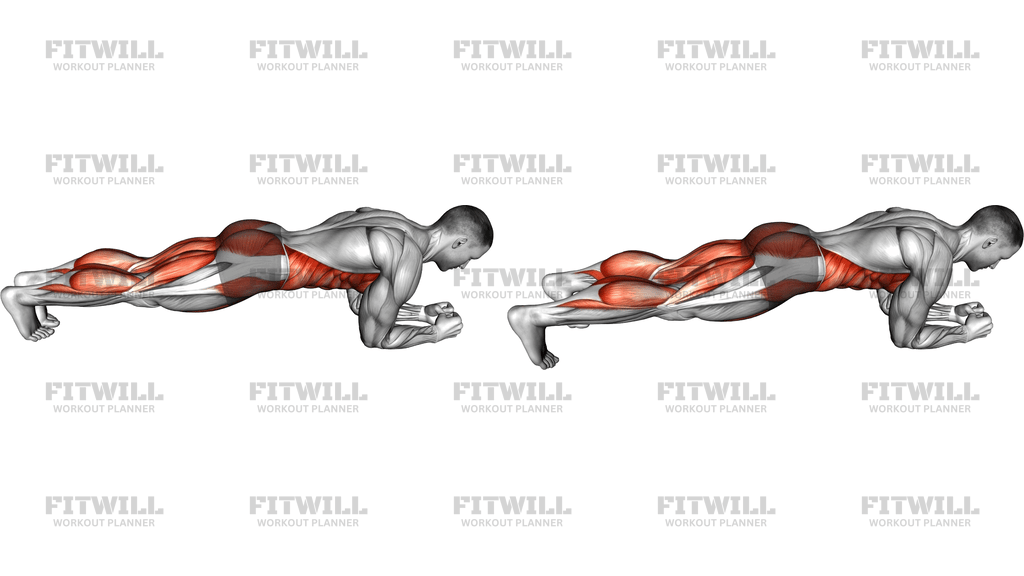
Instructions
- Place an exercise mat on the floor and kneel on it, then lower onto both forearms with your elbows positioned directly under your shoulders and your forearms parallel to each other.
- Extend both legs back so your body forms one straight line from head to heels, and set your feet about hip-width apart with your toes tucked under.
- Squeeze your glutes, brace your abdominal wall, and press your forearms into the floor so your upper back does not slump between the shoulder blades.
- Shift a little more of your weight into the ball of your stationary foot and begin reaching your other foot out to the side, keeping the knee soft.
- Lightly tap your toe on the floor out to the side at a distance that lets you keep your hips square and your trunk rigid.
- Draw the foot back in until it sits under your hip again, then repeat the tap on the opposite foot, continuing to alternate.
- Exhale as each foot reaches out and inhale as it returns, keeping the breath steady rather than holding it.
- Keep your hips level throughout, resisting the urge to let the working-side hip lift or the low back sink as the foot travels out.
- Move at a slow, even tempo the whole way, roughly two seconds out and two seconds back, so the toe tap stays quiet and controlled.
- When your plank position starts to break or your hips sag, stop, rest on your knees briefly, and reset your line before continuing or finishing the set.
Tips & Tricks
- If your hips sway from side to side with every tap, shorten the distance you reach; a small, precise tap still trains the trunk without destabilizing your plank line.
- Widening your stationary foot slightly before starting the set gives you a broader base and makes it easier to keep the pelvis square.
- A frequent mistake is letting the elbows creep forward of the shoulders as fatigue builds; check your elbow position before each rep and pull them back under you if needed.
- Keep the tap silent. A loud foot strike usually means the leg is being dropped rather than controlled by the hip muscles on the way out.
- If you feel the work moving into your lower back, stop and re-brace by tucking the pelvis slightly and pulling the ribs down; a sagging trunk is the usual culprit.
- Do not point your tapping foot excessively; a flexed or neutral foot makes it easier to place the toe accurately and keeps the calf from cramping.
- Your stationary leg is doing more work than it looks, glute and quad engaged with the heel pressing back, so keep it active rather than letting it go slack.
- If your shoulders feel the strain, spread the forearms no wider than shoulder-width and think about pushing the floor away rather than hanging between your elbows.
- Start with taps on one side only if you are new to the pattern, then progress to alternating once the hip stays level on both sides.
Frequently Asked Questions
What muscles does Plank On Elbows Toe Tap work?
The primary work comes from the abdominals and deep core holding the plank line, with the obliques resisting the rotation created each time a foot leaves the center line. The glutes, especially the hip abductors on the working side, control the leg as it taps out and back.
How is Plank On Elbows Toe Tap different from a regular forearm plank?
In a static forearm plank both feet stay planted, while in this variation one foot repeatedly reaches sideways and returns. That moving foot narrows your base and forces the trunk and hip muscles to work much harder to keep your body square.
Is Plank On Elbows Toe Tap suitable for beginners?
Beginners can do it if they can first hold a solid forearm plank for around 30 seconds. Starting with a short reach, a slower tempo, and shorter sets keeps the movement manageable while the plank position strengthens.
Why do my hips rock side to side when I tap my toe out?
Hip sway usually means the reach is too wide or the trunk is not braced firmly enough. Reduce the distance of the tap, widen your stationary foot slightly, and squeeze the glutes on both sides to level the pelvis.
Should both feet tap out at the same time?
No, this version uses one foot at a time, alternating sides, which is what separates it from a plank jack. Tapping one foot lets you focus on keeping the pelvis level and resisting rotation.
Can I do Plank On Elbows Toe Tap if straight-arm planks bother my wrists?
Yes, that is one of its main advantages. Since your weight rests on the forearms with the elbows under the shoulders, the wrists are unloaded for the entire set.
How many toe taps should I aim for per set?
Count each tap on one foot as one rep and start with 10 to 16 alternating taps, stopping the moment your hips sag or your elbows drift. Adding reps only makes sense if your plank line holds up through the whole set.
What can I use instead if the movement is too hard?
Hold a plain forearm plank, or try slow standing side leg lifts while bracing your core, both of which build the hip control this exercise needs. You can also tap the foot a shorter distance out and gradually widen the reach over time.
Is it safe for my lower back?
It is generally fine when your trunk stays braced and your hips stay level, since the plank position supports the spine with your own muscle tension. If you notice your hips dropping or feel strain in the low back, end the set and rest rather than pushing through.