Barbell Skull Crusher (Version 2)
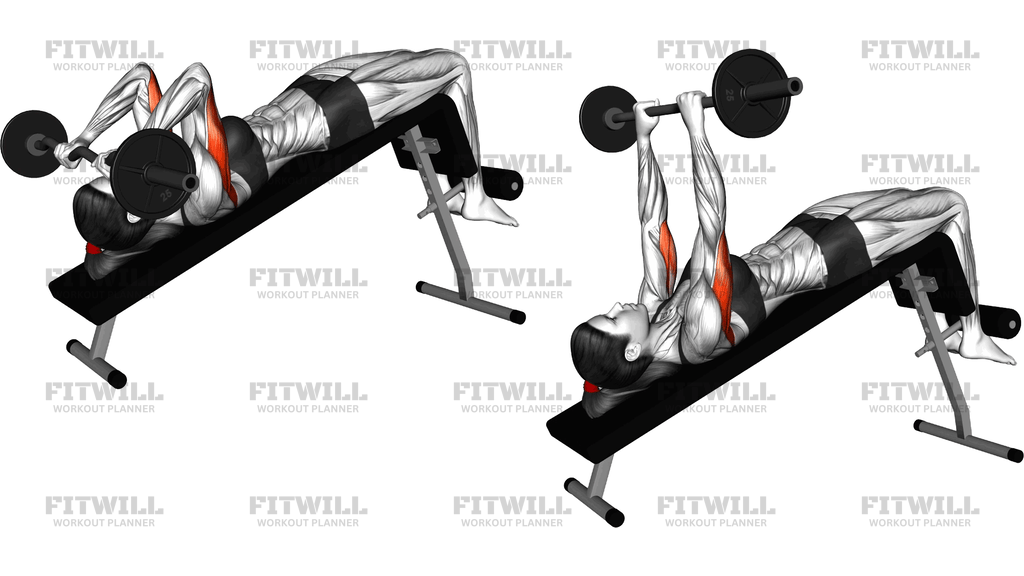
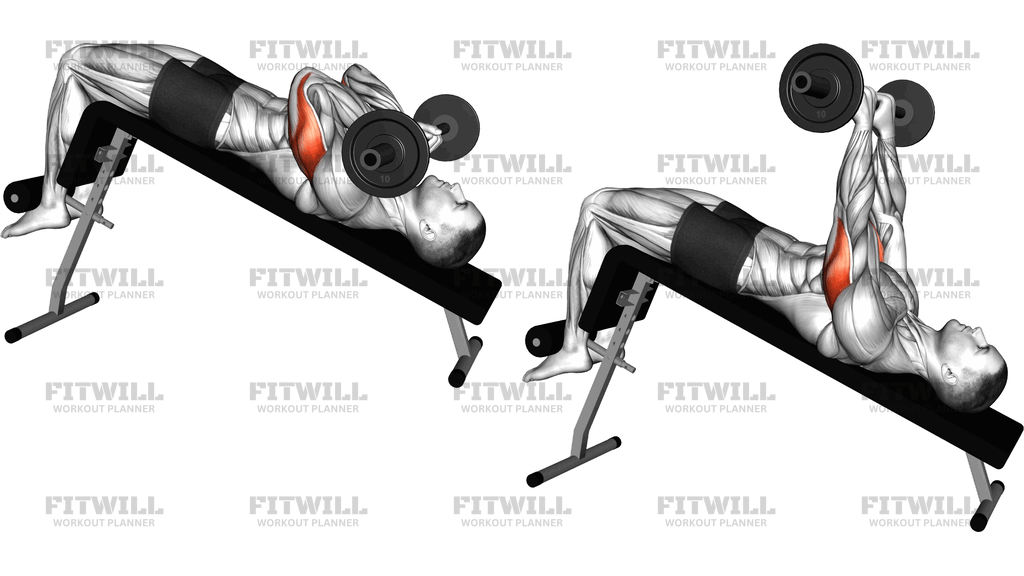
The Barbell Skull Crusher (Version 2) is a lying triceps extension performed on a flat bench with a straight barbell. You lie on your back, press the bar to a locked-out position over your chest, then bend only at the elbows to lower the weight down behind your head before extending back to the top. The defining feature of this version is the path: the bar travels back past the plane of your head rather than stopping at your forehead, which places a longer, deeper stretch on the triceps through the bottom of every rep.
This movement is one of the most direct ways to load the triceps under stretch, which matters because the triceps make up the bulk of your upper-arm mass and respond strongly to full-range work. Both the lateral and long heads are involved, with the behind-the-head path in particular putting the long head under meaningful length. The front delts assist in holding the upper-arm position, but the elbows stay fixed throughout, so the triceps do essentially all of the moving.
Setup details matter more here than in most arm exercises. Because the bar finishes behind your head, your grip, bench position, and elbow tracking determine whether the rep feels smooth or strains your shoulders and wrists. Your upper arms should stay roughly vertical to slightly angled back, your feet planted on the floor, and your shoulder blades pinned to the bench so nothing drifts as fatigue builds.
To execute it well, keep the descent slow and deliberate, letting the elbows flex until the bar is just past your head. Avoid flaring the elbows outward or letting the shoulders roll forward off the bench. On the way up, press to full elbow extension without pushing the bar forward over your face, then repeat. The whole motion happens at the elbow joint; if your shoulders are moving the weight, the load is too heavy.
Skull crushers fit well on upper-body or arm-focused training days, typically as a secondary movement after heavier pressing work. They pair naturally with pressing exercises because the long head does relatively little in standard benching, so dedicated extension work fills that gap. Most lifters do best with moderate loads in the 8 to 15 rep range, where the form is easier to control and the elbow joints stay comfortable.
A few practical safety points will keep this exercise sustainable. Start lighter than you think you need, because the stretch position is much harder than the lockout suggests. Always use collars on the bar, and if you train alone, be comfortable bailing by letting the bar lower safely behind the bench rather than dropping it toward your face. If your elbows complain about a straight bar, switching to an EZ bar or dumbbells usually solves the problem without losing the effect.
[ Workout Log & Planner ]
Put your next workout in Fitwill
Keep your plan and training log ready when you are.


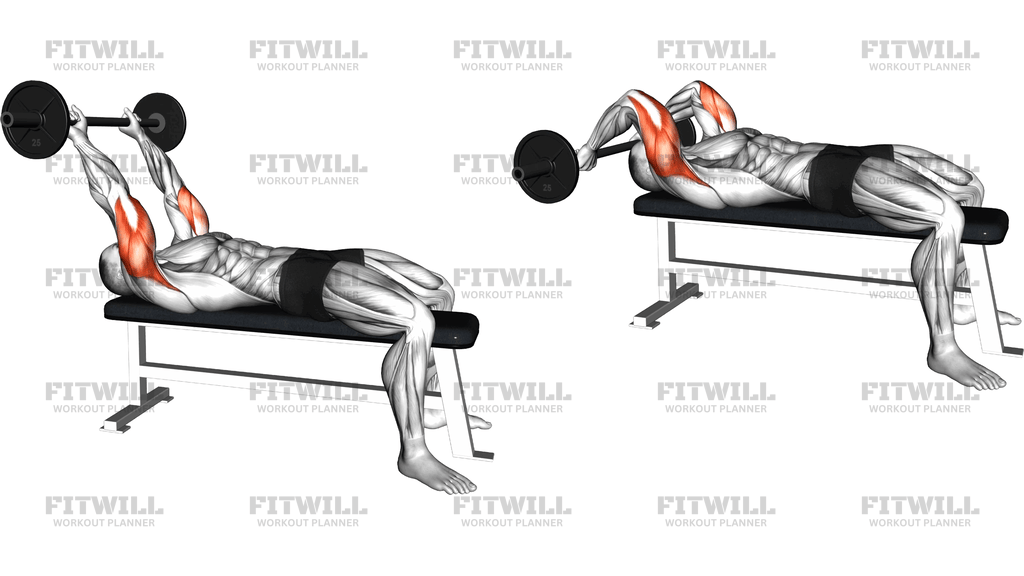
Instructions
- Set a flat bench in a clear space and load a barbell with manageable plates, securing collars on both ends.
- Sit on the bench with the bar on your thighs, then lie back and press the bar straight up over your chest with a pronated grip about shoulder-width apart.
- Walk the bar slightly back so it sits over your upper chest to forehead line, with your upper arms angled just past vertical toward your head.
- Plant your feet flat on the floor, squeeze your shoulder blades down into the bench, and brace your core before the first rep.
- Inhale, then bend only at the elbows, letting the bar travel back and down in a smooth arc until it passes just behind your head.
- Pause briefly at the bottom, keeping your upper arms fixed in their angled position and your elbows pointing toward the ceiling rather than flaring out.
- Exhale and extend your elbows to press the bar back along the same arc to the starting position over your upper chest, squeezing the triceps at the top.
- Repeat for your target reps, then finish the set by lowering the bar to your chest, sitting up, and returning it to the floor or rack.
Tips & Tricks
- If the bar drifts toward your face on the way up, your upper arms are rotating forward—reset with the bar over your upper chest and think about keeping the elbows planted in space.
- Elbow pain at the bottom usually comes from dropping the weight too fast; slow the descent to a two-second count and the stretch position becomes productive instead of jarring.
- A thumbless grip is not worth the risk here—wrap your thumbs fully around the bar so it cannot slip while it hangs behind your head.
- Keep your lower back in contact with the bench; arching hard to cheat the bar up turns a triceps exercise into a torso exercise.
- The temptation to flare the elbows outward grows as the set gets hard, but the triceps work hardest when the elbows track straight up toward the ceiling.
- Do not chase depth at the expense of shoulder comfort—lowering until you feel a strong but tolerable stretch behind the arm is enough, even if the bar stops short of a fully parallel position.
- Because the bar sits behind your head at the bottom, always use collars and avoid loading to a weight you could not safely guide down toward the floor if a rep goes wrong.
- Pair this with close-grip pressing or dips in the same session; extending under stretch one day and pressing heavy the next covers both heads of the triceps well.
- If your wrists bend backward at the top, narrow your grip slightly—a grip that is too wide forces the wrists into extension to keep the bar level.
Frequently Asked Questions
What muscles does the Barbell Skull Crusher (Version 2) work?
The triceps are the prime movers, with both the lateral and long heads doing most of the work. The front delts help stabilize the upper-arm position, but they are supporting players, not targets.
How is Version 2 different from a standard Barbell Skull Crusher?
In this version the bar lowers down behind your head instead of stopping at your forehead. That longer path places the triceps, especially the long head, under a deeper stretch at the bottom.
Is the Barbell Skull Crusher (Version 2) suitable for beginners?
Yes, but start with an empty bar or very light load and master the arc before adding weight. The behind-the-head path feels unfamiliar at first, and control matters more than load.
Why should my upper arms stay angled back instead of straight up?
Angling the upper arms slightly past vertical keeps tension on the triceps through the full range and lets the bar travel behind your head cleanly. If the upper arms drift toward vertical over your face, the shoulders start taking over.
Should I use a straight barbell or an EZ bar for this exercise?
A straight bar works fine, but many lifters find it stresses the wrists and elbows at the deep stretch position. If your joints ache, an EZ bar or a pair of dumbbells is an easy swap with nearly the same training effect.
What is the most common mistake with the Barbell Skull Crusher (Version 2)?
Letting the shoulders and upper arms move the bar instead of isolating the elbows. If your elbows travel back and forth with every rep, the set stops being a triceps extension and becomes a partial pullover.
Can I do this exercise without a spotter?
Yes, as long as you use collars and choose a weight you control confidently. If a rep fails, the safest bailout is to guide the bar down behind the bench rather than letting it fall toward your face.
How many sets and reps should I do?
Two to four sets of 8 to 15 reps works well for most lifters. The stretch position is demanding, so moderate loads with clean technique beat heavy grinding reps here.
Is it safe for people with elbow issues?
If you have an active elbow complaint, get clearance from a qualified professional first. Otherwise, warming up the elbows with lighter extension work and controlling the tempo usually keeps this movement joint-friendly.