Weighted Sandbag Deadlift
The Weighted Sandbag Deadlift is a hip hinge performed with a sandbag resting across the upper back and shoulders rather than held in front of the body or pulled from the floor. You set the bag on your shoulders, brace hard, push your hips back, and fold forward over the bag until you feel a deep stretch through the hamstrings, then drive your hips forward to stand tall again. Because the load sits behind your neck, the pattern is closer to a good morning than a conventional deadlift, and the shifting sand inside the bag forces your trunk to work in a way a rigid bar never asks for.
The primary movers are the glutes and hamstrings, which extend the hips on the way up. Your lower back works isometrically the entire time to hold your spine neutral against a load that moves and settles as you hinge. The quads assist as the knees bend, the upper back and traps manage the bag on your shoulders, and your forearms and grip stay busy holding the handles or fabric. Even your deep core gets involved just keeping the bag from drifting off center.
The shouldered setup is the defining feature. With a barbell you can rely on a fixed shaft; with a sandbag, the fill shifts every rep, so you have to actively pull the bag into your shoulders and keep your ribs down or it will roll forward and drag your chest with it. That makes setup non-negotiable: bag position, elbow position, and bracing all happen before your hips ever move back.
Execution is simple on paper. Hinge at the hips first, let the knees bend just enough to let you fold, and keep the weight over the middle of your feet. Lower under control to a depth where your back stays flat, then stand by pushing the floor away and squeezing the glutes at the top without leaning back. The temptation is to squat the weight down or let the lower back round at the bottom; both cut the hamstrings out of the movement and put stress where you don't want it.
This exercise suits lifters who want posterior chain work without a barbell, home gym trainees, and anyone who wants anti-flexion core demand built into a hip hinge. It also works well as a secondary hinge on days when your grip is fatigued, since the load never has to be pulled from the floor. Start lighter than you think you need; an unstable bag at a modest weight is humbling enough.
[ Workout Log & Planner ]
Put your next workout in Fitwill
Keep your plan and training log ready when you are.


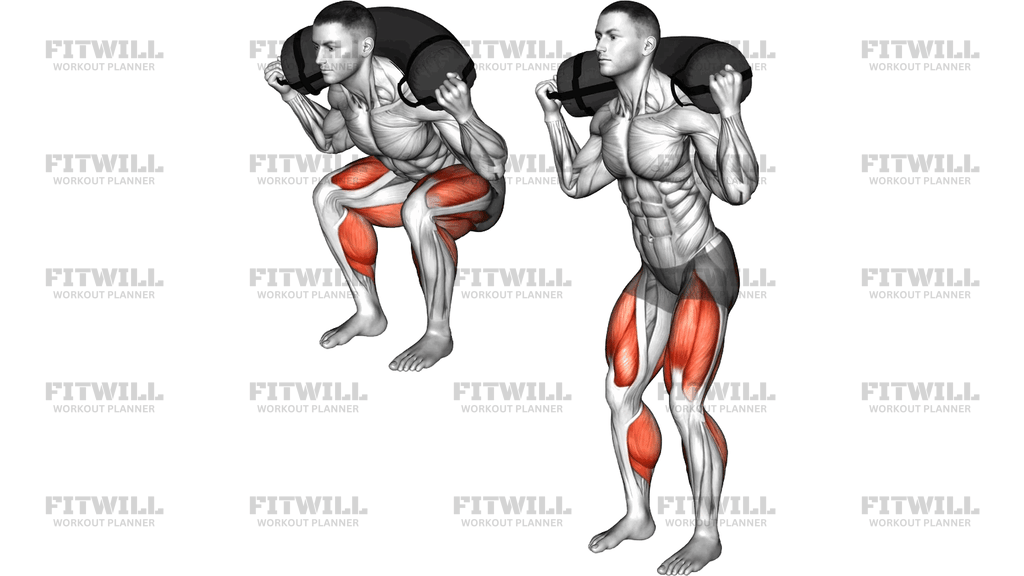
Instructions
- Load the sandbag to a moderate weight and rest it across your upper back and shoulders, just below the base of your neck, gripping the bag's handles or the fabric on each side with your elbows pointing down.
- Stand with your feet hip- to shoulder-width apart, toes turned out slightly, and your weight spread evenly across the whole foot.
- Squeeze your shoulder blades together to pin the bag in place, pull your ribs down, and brace your abs like you're about to take a punch.
- Push your hips straight back and let your knees bend slightly as your torso folds forward over the bag, keeping the bag pressed into your shoulders rather than letting it roll toward your neck.
- Lower until your torso is roughly 45 degrees or a bit lower, or until you feel a strong hamstring stretch while your back is still flat.
- Drive your hips forward and push the floor away through your heels and midfoot to return to a full stand, squeezing your glutes at the top without hyperextending your lower back.
- Exhale as you stand, then take a fresh breath and re-brace at the top before starting the next rep.
- If the bag shifts position mid-set, stop, reset it square across your shoulders, and re-grip before continuing.
- When you finish the set, lower the bag to the ground in front of you with a flat back rather than dropping it off your shoulders.
- Rest and reset your stance fully between sets, since a fatigued brace with a shifting bag is where form breaks down.
Tips & Tricks
- If the bag keeps sliding forward off your shoulders, you're not pulling it in hard enough — squeeze your shoulder blades together and keep your elbows tucked down instead of flared out to the sides.
- Rounding at the bottom is the most common fault here. Cut the depth until you can hinge lower with a flat back, and treat the hamstring stretch as your depth gauge, not the floor.
- If your knees keep drifting forward and your heels lift, you've turned the hinge into a squat. Restart each rep by consciously pushing your hips back before anything else moves.
- A bag with internal handles or shoulder-style straps is worth seeking out; a slick, floppy bag forces you to squeeze constantly and steals effort from the hinge itself.
- Don't lean back and hyperextend at the top to 'finish' the rep. The glutes end the movement; standing tall with ribs down is the finish.
- Start with roughly half of what you'd use on a barbell good morning. The shifting fill and the shouldered position make the effective load feel heavier on your trunk than the number on the bag suggests.
- Flat-soled shoes or bare feet work best — a soft, squishy heel makes it harder to keep your weight over your midfoot as your hips travel back.
- Re-brace on every single rep. The bag shifts as sand settles, so your breath and brace are the only things keeping your spine in a consistent position.
- Film yourself from the side once in a while; from a front view you can't see whether your hips are actually moving back or your chest is just falling forward.
Frequently Asked Questions
Which muscles does the Weighted Sandbag Deadlift work the most?
The glutes and hamstrings do the main work of extending your hips, while the lower back holds your spine neutral and the quads assist as the knees bend. Your traps, grip, and deep core support the bag on your shoulders throughout.
Why is the sandbag held on the shoulders instead of on the floor?
The shouldered position shifts the emphasis toward the posterior chain, similar to a good morning, and removes the floor pull from the equation. It also adds a trunk-stability demand, since the shifting bag has to be actively controlled as you hinge.
Is the Weighted Sandbag Deadlift suitable for beginners?
Yes, as long as the weight is modest and depth is conservative. Because the load sits behind the neck, beginners should first practice the hip hinge with bodyweight or a light bag before adding meaningful sand.
How is the Weighted Sandbag Deadlift different from a barbell deadlift?
A barbell deadlift starts on the floor with the load in front of you, while this version starts from a stand with the bag on your shoulders, so there's no floor pull and more trunk control required. The sandbag also shifts during the rep, which a fixed bar never does.
How low should I hinge during the Weighted Sandbag Deadlift?
Lower until your torso is around 45 degrees or slightly lower and you feel a solid hamstring stretch with your back still flat. Going deeper only helps if your spine position stays locked in.
What's the most common mistake in this exercise?
Squatting the weight down instead of hinging, usually with the chest dropping and the bag rolling forward. Push your hips back first and keep the bag pinned to your shoulders with your shoulder blades.
Can I substitute a barbell or dumbbells for the sandbag?
A barbell good morning is the closest substitute, and dumbbells held at the shoulders work in a pinch. Neither replicates the shifting instability of sand, so expect the stabilization demand to drop with those swaps.
Is the Weighted Sandbag Deadlift safe for the lower back?
It's generally well tolerated when you keep the back flat, brace every rep, and stay within a depth you can control. If you notice your lower back rounding or the bag pulling you forward, reduce the weight and depth before continuing.