Dumbbell Russian Twist With Legs Supported
The Dumbbell Russian Twist With Legs Supported is a seated rotational core exercise where your feet are anchored under a flat bench while you lean your torso back and rotate a dumbbell from hip to hip. The bench support is what separates this version from the classic floor-based Russian twist: because your feet are fixed in place, you can focus entirely on rotating through the trunk instead of fighting to keep your legs lifted and your balance steady.
This setup makes the movement a great fit for lifters who find the floating-leg version turns into a hip flexor and balance exercise before the abs ever get real work. With the feet anchored, the obliques on the front and side of your trunk do the actual turning, and the rectus abdominis works isometrically to hold your leaned-back torso position the whole time. The dumbbell adds load, which lets you progress the exercise gradually in a way bodyweight twists never could.
To perform it, you sit on the floor with your knees slightly bent and slide your feet under the bench so your ankles are secured. From there you recline to roughly a 45-degree angle, keep your chest tall and your lower back from rounding, hold the dumbbell with both hands close to your torso, and rotate your shoulders and the weight toward one hip before sweeping across to the other side. Each pass across the front of your body counts as one repetition.
Because the legs are supported, this variation suits a wide range of trainees, from beginners building their first real rotational strength to more experienced lifters using it as a controlled finisher after heavier compound work. It is commonly used in general strength training, martial arts and racquet sport preparation, and any program where twisting force matters.
The main form priority is keeping the rotation in your upper body rather than letting your shoulders collapse or your lower back round as you lean back. Move the dumbbell with your trunk, not just your arms, and keep the tempo smooth. A weight you can control through the full sweep is worth far more than a heavy dumbbell that turns the set into a series of jerky swings.
[ Workout Log & Planner ]
Put your next workout in Fitwill
Keep your plan and training log ready when you are.


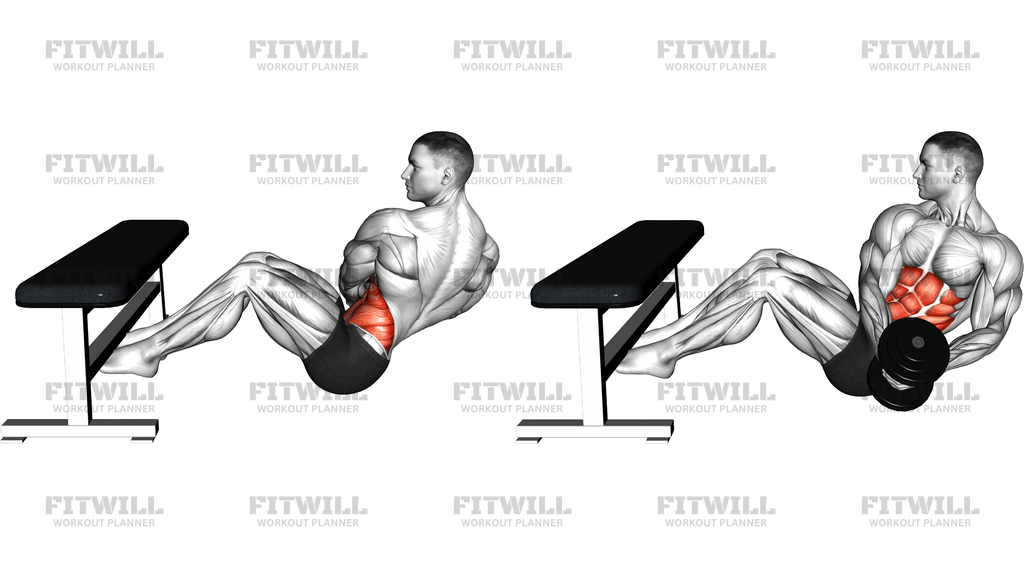
Instructions
- Sit on the floor facing away from a flat bench with your knees bent to about 90 degrees.
- Slide your feet under the bench so your ankles or heels are secured beneath the pad, then walk your heels in until your knees stay comfortably bent.
- Hold a dumbbell with both hands, wrapping your fingers around each end of the head of the dumbbell, and bring it in front of your chest.
- Lean your torso back to roughly 45 degrees, brace your abdominals, and keep your chest lifted so your lower back does not round.
- Rotate your torso to one side, letting the dumbbell travel with your shoulders until it is beside your hip.
- Pause briefly at the hip, then rotate under control across the front of your body until the dumbbell reaches the opposite hip.
- Continue sweeping side to side in a smooth arc, keeping the dumbbell close to your torso rather than swinging it wide.
- Exhale as you rotate through the middle of each sweep and inhale at the turnaround points.
- Complete your planned repetitions, then sit upright first and release your feet from under the bench before setting the dumbbell down.
- Reset your torso angle and brace again before starting the next set so you never begin a rep rounded or slumped.
Tips & Tricks
- The most common mistake is turning this into an arm swing. If the dumbbell is flying side to side but your shoulders barely move, drop to a lighter dumbbell and drive the rotation from your ribcage.
- Do not recline so far back that your lower spine rounds toward the floor. If you cannot hold a neutral trunk at 45 degrees, sit up a few degrees and rebuild the angle over time.
- Keep the dumbbell within a few inches of your body. Holding it far out lengthens the lever and multiplies the strain on your lower back before it adds anything to your obliques.
- Because your feet are hooked under the bench, resist the urge to pull with your legs each rep; the anchoring should be passive, not a rowing motion.
- Tap the floor lightly beside each hip instead of slamming the dumbbell down. The pause at the turnaround is where the control and the training effect live.
- If your hips rock side to side with each rep, slow the tempo down. The bench removes the balance problem, so any rocking means the weight is moving you.
- Start with a light dumbbell in the 5-10 kg range even if you are strong elsewhere, since rotational leverage feels much heavier than a press or curl.
- On a slick floor, place an exercise mat under your hips to stop your sitting bones from sliding forward as you rotate.
- Stop the set when your torso angle starts to sink. A sagging chest turns the exercise into a lower back strain rather than a core exercise.
Frequently Asked Questions
What muscles does the Dumbbell Russian Twist With Legs Supported work?
The obliques drive the rotation, while the rectus abdominis and deeper core muscles work isometrically to hold your leaned-back torso. The hip flexors help stabilize your bent-knee position, but the bench support means they play a much smaller role than in the legs-raised version.
Why hook my feet under a bench instead of doing the Dumbbell Russian Twist with legs off the floor?
Anchoring your feet removes the balance and hip flexor demands so the rotation itself becomes the limiting factor. This lets you use a heavier dumbbell and keeps the tension on your obliques instead of your hips and lower back.
How far back should I lean during the Dumbbell Russian Twist With Legs Supported?
Roughly 45 degrees is a good target, but only as far as you can hold a tall chest and a neutral lower back. If your spine rounds as you recline, sit up slightly and progress the angle over several weeks.
How heavy should the dumbbell be?
Choose a weight you can sweep from hip to hip without your shoulders or arms taking over the movement. For most people that is far lighter than their pressing dumbbells, so starting around 5-10 kg and adding load slowly is the sensible route.
Should each twist of the Dumbbell Russian Twist With Legs Supported count as one or two reps?
Count each full pass from one hip to the opposite hip as one rep, so touching the right hip and then the left hip equals two. Pick one convention and stay consistent so your progress tracking means something.
Is this exercise safe for people with lower back issues?
Repetitive loaded rotation is not comfortable for every back, so anyone with a history of back trouble should get clearance from a qualified professional first. Keeping the dumbbell close to your torso, limiting the recline angle, and using a light weight all reduce the stress on the lumbar spine.
Can beginners do the Dumbbell Russian Twist With Legs Supported?
Yes, and the feet-supported setup actually makes it one of the more beginner-friendly loaded core exercises. Start with no weight or a very light dumbbell, master the rotation coming from your trunk, and add load once your torso angle stays solid for a full set.
What can I use if I do not have a bench to anchor my feet?
Any sturdy low anchor works, such as a heavy sofa, a loaded barbell on the floor, or a partner holding your ankles. You can also do the standard floor version with heels lightly touching the ground, accepting that the obliques will get slightly less isolation.
How does the Dumbbell Russian Twist With Legs Supported differ from using a medicine ball?
The movement pattern is identical; a dumbbell just gives you a compact object to grip at both ends and makes small weight jumps easier. A medicine ball works well for throws and slightly longer levers, while the dumbbell version tends to encourage a tighter, more controlled rotation.
Where should the dumbbell travel during each repetition?
Keep it close to your torso and let it follow your shoulders as they rotate toward each hip in a smooth arc. Swinging it wide in front of you adds momentum and lever length without improving the work your obliques do.