Weighted Donkey Kickback
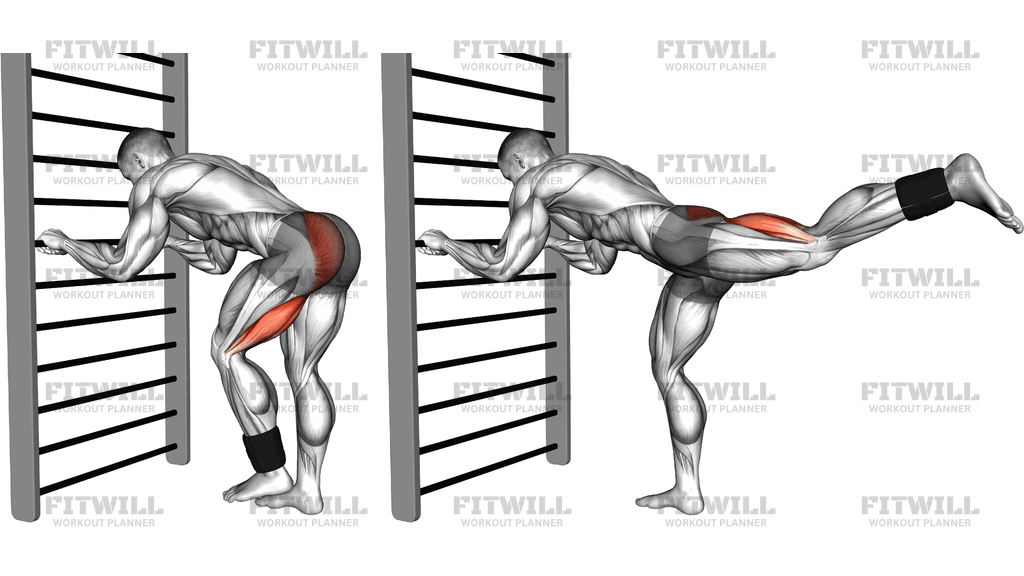
The Weighted Donkey Kickback is a hip extension exercise performed bent over while holding onto a wall bar, rack, or sturdy support, with an ankle weight strapped to the working leg. From a folded-forward position with your forearms resting on the support, you drive one leg back and up until it is roughly level with your torso, then lower it back down under control. The added load at the ankle makes the glutes and hamstrings work harder than in the classic bodyweight version, without requiring a cable stack or machine.
The main target is the gluteus maximus, which extends the hip as the leg sweeps back and up. The hamstrings assist strongly, especially once the knee bends or the leg rises above hip height, and the erector spinae and deep core work isometrically to keep your torso from wobbling while you balance on one leg. Because the torso is supported on your forearms, there is far less lower back fatigue than in standing kickbacks, which makes it easier to focus purely on the hip joint moving.
Setup matters more than people expect. The height of the bar you lean on determines how much your hips flex forward, and that angle changes how far the leg can travel and how much tension sits on the glutes at the bottom. Aim for a position where your torso is close to horizontal or slightly angled, hips stacked over the standing leg, and the ankle weight secured snugly just above the ankle joint so it does not slide during the rep.
Execution should be driven by the hip, not by momentum. Squeeze the glute of the working leg to lift it back and up, keeping a slight bend in the knee, and stop when the leg reaches its natural end range without your lower back arching or your hips rotating open. Pause briefly at the top, then lower the leg slowly so you feel tension through the whole descent. Swinging the leg up quickly is the most common error and it trades glute work for lumbar stress.
This exercise suits lifters who want direct, high-rep glute work with minimal equipment, people who find cable kickbacks awkward to set up, and anyone rehabilitating or prehabbing the hip hinge pattern with light load. It also pairs well with squats, hip thrusts, or deadlifts as a finisher when the glutes are already fatigued. Start with a light ankle weight, typically a few pounds, and only increase it when you can keep your torso and pelvis completely still for every rep.
[ Workout Log & Planner ]
Put your next workout in Fitwill
Keep your plan and training log ready when you are.


Instructions
- Strap an ankle weight snugly around one ankle, positioned just above the ankle bone so it cannot slide during the movement.
- Stand facing a wall bar or sturdy overhead support, lean forward, and rest both forearms on a bar at roughly chest-to-shoulder height so your torso angles down toward the floor.
- Walk your feet back slightly until your hips sit over your standing leg and your spine forms one long, neutral line from head to tailbone.
- Brace your abs lightly and squeeze your glutes before moving, keeping both hips square to the support.
- Keeping a soft bend in the working knee, drive that leg back and up by squeezing the glute, letting the leg travel behind and above hip height as far as your range allows without arching your lower back.
- Pause for one to two seconds at the top with the glute fully contracted and the leg level with or slightly above your torso.
- Lower the leg slowly back to the starting position, resisting the pull of the ankle weight rather than letting it drop.
- Exhale as you kick the leg back, inhale as you lower it, keeping your breathing steady throughout the set.
- Complete all reps on one leg, then re-brace, switch the ankle weight or move to the other leg, and match the reps on the second side.
Tips & Tricks
- If your lower back arches as the leg rises, you have gone past your hip's available range; stop the rep a few degrees earlier and prioritize the glute squeeze over height.
- Keep the working knee slightly bent but fixed at the same angle; kicking the knee straight and bending it mid-rep shifts tension toward the hamstrings inconsistently.
- Do not let the hips rotate open as the leg lifts. Imagine both hip points aimed at the wall bars for the entire set, which keeps the work on the glute of the moving leg.
- A common mistake is gripping the bar with straight arms and shrugging. Keep your forearms stacked on the bar, shoulders pulled gently down, so your upper body stays relaxed.
- If the ankle weight slides down toward your foot, tighten the strap or reposition it higher on the calf; a shifting load changes the resistance lever mid-rep.
- Slow the lowering phase to two or three seconds. Most people rush the descent, which halves the time the glutes spend under tension.
- If your standing calf or foot fatigues before your glutes, shift more weight onto your forearms by leaning slightly deeper into the support.
- Start with a very light ankle weight for your first few sessions; the long lever of a straight leg makes even two or three pounds feel substantial at full extension.
- To bias the upper glute fibers slightly, add a small outward turn of the working leg's toe as you kick back, but only as much as you can control without rotating the pelvis.
Frequently Asked Questions
Which muscles does the Weighted Donkey Kickback work?
The gluteus maximus is the prime mover, with the hamstrings assisting throughout the hip extension. Your lower back and core muscles also work isometrically to hold your torso steady while you balance on one leg.
Can beginners do the Weighted Donkey Kickback?
Yes. Start with no weight or a very light ankle weight to learn the hip extension pattern first, since the straight-leg position creates a long lever that amplifies even a small load.
Why lean on wall bars or a rack instead of doing standing kickbacks?
Supporting your torso on your forearms removes balance demands and lower back fatigue, so you can concentrate on squeezing the glute through a fuller range. It also lets you angle the torso closer to horizontal, which lengthens the hip extension path.
How high should I raise my leg at the top of the Weighted Donkey Kickback?
Raise it to roughly level with your torso or slightly above, but only as far as you can go without your lower back arching or your hips rotating open. Extra height beyond that point comes from the lumbar spine, not the glutes.
Should my working knee be straight or bent?
Keep a soft, fixed bend in the knee, around 15 to 20 degrees. A completely locked knee is uncomfortable at the ankle, and a deeply bent knee turns the movement into more of a hamstring-dominant leg curl pattern.
What is the most common mistake with this exercise?
Swinging the leg up with momentum. The bounce from the swing unloads the glutes at the start of the lift and tends to pull the lower back into extension, so control the first third of the rep deliberately.
What can I substitute if I do not have an ankle weight?
You can loop a small dumbbell behind your knee to hold it in place, use a resistance band anchored under the standing foot, or perform the same supported kickback with body weight only and higher reps.
How many sets and reps should I do?
Two to four sets of 12 to 20 reps per side works well, since the exercise loads a single joint with a light weight. Rest 30 to 60 seconds between sides.
Is it safe for people with lower back sensitivity?
The supported torso position generally makes this gentler on the lower back than standing kickbacks, but keep the leg within a pain-free range, avoid overarching at the top, and stop if you feel lumbar discomfort rather than glute work.