Bottle Weighted Deadlift
The Bottle Weighted Deadlift is a hip-hinge lift performed while holding a heavy water bottle or jug by its handle. Because the load sits low and slightly in front of your body, it places you in nearly the same movement pattern as a conventional barbell deadlift, but with a weight that is easy to grip, easy to adjust, and available almost anywhere. The lift takes you from a deep, loaded squat-hinge position at the bottom all the way to a full stand with the bottle hanging at your side.
This is one of the best entry points into hinge training. Beginners use it to learn what a neutral-spine deadlift should feel like before touching a barbell, and home lifters use it because a water jug is one of the few heavy objects most households already own. It also works well as a warm-up or groove-setting drill for experienced lifters, since the light-to-moderate load lets you rehearse the hip hinge without the fatigue of heavy pulling.
The main work is done by the glutes and hamstrings, which extend the hips to bring you upright. The quads contribute as you drive out of the deep bottom position, the erector spinae along the lower back hold your trunk rigid, and the muscles of the upper back and forearms keep the bottle from swinging or pulling you forward. Because the weight is compact and held close to the legs, the demand on the grip is real but manageable.
Setup matters more with a bottle than with a bar in one specific way: the handle sits above the bottom of the jug, so the weight hangs below your hand. That shifts the load a few inches lower than a barbell plate would sit, which means the bottle can drift forward or tap the floor earlier in the lift. Keep the jug close to your shin throughout, and treat any forward drift as a cue to pull your hips back rather than round down toward it.
To execute the lift, stand over or beside the bottle, sit your hips back and down until you can grab the handle with a straight arm, then brace your trunk and push the floor away. Stand tall by driving the hips forward at the top, squeezing the glutes rather than leaning back. Lower the bottle by reversing the path: hips travel back first, the jug tracks down the front of your leg, and your spine stays long the entire way.
A few practical safety points will keep this lift productive. Start lighter than you think you need, since a jug full of liquid sloshes and shifts more than a fixed weight. Never round your lower back to reach the handle, and if the full bottle is too heavy but the empty one is too light, simply adjust the water level until the load matches your strength.
[ Workout Log & Planner ]
Put your next workout in Fitwill
Keep your plan and training log ready when you are.


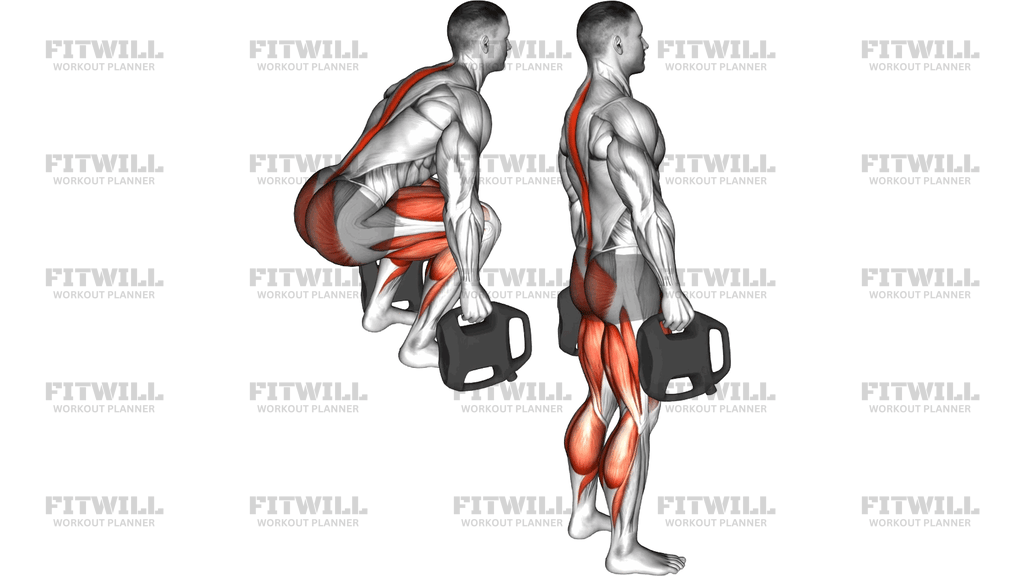
Instructions
- Place a water bottle or jug on the floor with the handle facing you, and stand over it with your feet about hip-width apart so the bottle sits over mid-foot.
- Push your hips back and bend your knees until you can reach the handle with your arm straight, keeping your shoulders slightly higher than your hips.
- Grip the handle firmly and check that your back is flat and long, not rounded, before you take any tension.
- Take a breath into your belly, brace your trunk like you are about to be tapped on the stomach, and pull your shoulder blades down and back.
- Drive through your whole foot, pushing the floor away, and let your hips and shoulders rise together as you stand.
- Keep the bottle tracking straight up the front of your shin and thigh, close to your body the entire way.
- Finish standing fully upright with hips extended and glutes squeezed, the bottle hanging at arm's length beside your thigh.
- To lower, push your hips back first and slide the bottle down the front of your leg, bending your knees only as the jug approaches the floor.
- Exhale at the top of each rep, and reset your grip and brace on the floor before starting the next lift.
- Repeat for your target reps, then set the bottle down fully between sets rather than holding it while you rest.
Tips & Tricks
- The most common fault with a jug is reaching for the handle with a rounded lower back, because the weight hangs lower than a barbell would. If you cannot reach it with a flat back, bend the knees more and sit deeper instead.
- Liquid sloshes as you lift, which can yank the bottle off its path. Lift a little slower than you would with a fixed weight, especially on the first rep of a set.
- If the jug drifts forward, it usually means your hips shot up early. Cue yourself to push the floor away with your legs and let your hips and chest rise at the same rate.
- Do not lock out by leaning back at the top. Finish with a strong glute squeeze and a tall ribcage; hyperextending the lower back under load is the classic deadlift finish mistake.
- Adjust the water level to tune the load. Half full is often harder to control than three-quarters full because the water has more room to shift, so experiment slightly below your target weight first.
- Set your stance so the bottle hangs beside your shin, not between your knees. If it bumps your knees on the way down, your hips are not traveling back enough.
- Barefoot or flat-soled shoes work best here. A soft, cushioned heel shifts your balance forward and makes the bottom position less stable.
- Warm up with an unloaded hip hinge, hands on your thighs, before picking the bottle up. The bottom position of this lift is deep, and cold hips tend to round instead of hinge.
Frequently Asked Questions
Which muscles does the Bottle Weighted Deadlift work the most?
The glutes and hamstrings do the primary work of extending your hips to stand up. Your quads help out of the deep bottom position, your lower back holds the trunk rigid, and your forearms and upper back control the bottle.
Is the Bottle Weighted Deadlift a good first deadlift for a beginner?
Yes, it is one of the friendliest ways to learn the hinge because the jug is easy to hold and the load can be dialed in with water level. Once you can keep a flat back through every rep, the same pattern transfers directly to a barbell.
How heavy should the bottle be?
Choose a weight you can lift for 8 to 12 reps while keeping your back flat and the bottle close to your legs. Since liquid shifts mid-rep, start lighter than your best guess and increase the water gradually.
Why does the bottle keep hitting my knees on the way down?
That happens when your knees move forward too early in the descent. Push your hips back first and let the bottle slide down your thigh, only bending the knees more once the jug is past them.
Should I hold my breath during the Bottle Weighted Deadlift?
A brief brace works well: breathe in and tighten your trunk before you pull, then exhale as you pass the hardest part of the stand-up. Reset both your breath and brace before the next rep.
Can I substitute a kettlebell or dumbbell if I do not have a suitable bottle?
Yes, a kettlebell or a dumbbell held vertically mimics the same low handle position and close-to-body path. The main difference is that a bottle's shifting water adds a small stability challenge the fixed weights do not.
How deep should I sit at the bottom of the lift?
Deep enough that you can reach the handle with a straight arm and a flat back, which for most people is near a full squat. Depth should come from your hips and knees bending together, not from rounding your spine to get lower.
Is it safe to do this lift every day?
With a moderate load it is low-stress enough for frequent practice, and daily hinge reps are a common way to groove the pattern. Keep at least one genuinely heavy or high-effort session spaced out with lighter technique days.
My lower back feels the Bottle Weighted Deadlift more than my glutes. What should I change?
Your hips are likely rising before your shoulders, turning the lift into a back pull. Start each rep by pushing the floor away with your legs and squeeze your glutes hard at the top so the hips, not the lower back, finish the movement.