Seated Table Top Lat Stretch On A Chair
The Seated Table Top Lat Stretch On A Chair is a simple, equipment-minimal stretch that targets the latissimus dorsi, the broad muscles of the back that run from the upper arm across the mid and lower back. You grip the back of a sturdy chair with both hands, walk your feet back, and drop your chest toward the floor so your arms extend overhead in line with your spine. The result is a long, open position that lengthens the lats from shoulder to hip in a way few upper-body stretches manage.
This stretch is especially useful for anyone whose lats tend to run tight: people who train pull-ups, rows, or pulldowns regularly, lifters who spend a lot of time bench pressing, and office workers whose shoulders sit rounded forward all day. Tight lats limit overhead arm reach, flatten the natural curve of the lower back, and can pull the torso into a slouched position. A few patient holds per side of the week can make overhead movements feel freer and help the arms travel further in presses, throws, and swims.
The chair is what makes this stretch practical. Because the anchor point sits at roughly hip height, you can adjust the intensity simply by stepping your feet closer or farther away, and the chair back gives your hands a firm, fixed hold so you can relax into the length instead of fighting to hold yourself up. Choose a heavy chair that will not slide, and position it against a wall if you want extra security.
Execution is straightforward but easy to rush. Hinge at the hips rather than rounding through the spine, let the chest sink down between the arms, and think about pushing the floor away with your hands as your hips drift back. The stretch should be felt along the sides of the back and into the armpits, not as a pinch in the shoulders or a strain in the lower back. Keep the knees softly bent if your hamstrings pull on your pelvis.
Hold each rep for twenty to thirty seconds, breathe slowly, and let the range deepen slightly on each exhale rather than forcing it. One to three sets is plenty, either as part of a warm-up before upper-body training or as a longer hold after training when the muscles are warm. If you have a shoulder injury or recent back issue, keep the intensity gentle and stop short of any pinching sensation.
[ Workout Log & Planner ]
Put your next workout in Fitwill
Keep your plan and training log ready when you are.


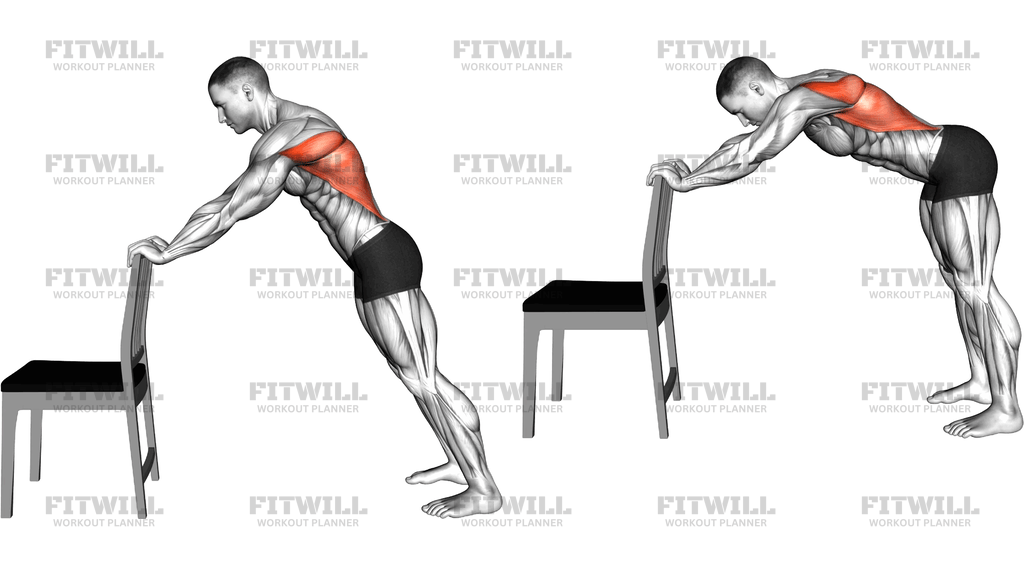
Instructions
- Place a sturdy, non-swivel chair with its back facing you, and check that it cannot slide on the floor.
- Stand an arm's length behind the chair and grip the top of the chair back with both hands, about shoulder-width apart, palms facing down or slightly inward.
- Set your feet hip-width apart and step back far enough that your arms can extend fully as you lean forward.
- Brace lightly through the trunk, then push your hips back and hinge forward, letting your chest sink down between your extended arms.
- Continue lowering until your arms, torso, and hips form one long angled line, with the stretch felt along the sides of the back and into the armpits.
- Press gently away from the chair with your hands while letting the ribcage drop toward the floor to deepen the lat stretch without rounding the lower back excessively.
- Breathe slowly and steadily, exhaling as you allow the stretch to deepen a little on each breath, and hold for 20 to 30 seconds.
- To release, walk your feet toward the chair and rise back to standing under control rather than snapping upright.
- Reset your grip and hip position, then repeat for 1 to 3 total holds, adjusting foot distance to fine-tune the intensity.
Tips & Tricks
- If your lower back takes over and rounds heavily, bend your knees slightly more; this frees the pelvis so the length lands on the lats instead of the hamstrings and spine.
- A common mistake is letting the shoulders shrug up toward the ears. Keep the shoulder blades gently drawn down your back as you press away from the chair.
- Adjust the chair height if the position feels cramped. A taller surface, such as a table edge, lengthens the angle; a lower seat makes it gentler.
- Do not chase a deep hinge at the expense of arm extension. Straight elbows matter more than how low your chest gets, since bent arms unload the lats.
- Turn your palms slightly inward or try one arm at a time on the corner of the chair back if both wrists feel strained in the palms-down grip.
- Keep weight spread through the whole foot. Pushing into the toes to lean farther shifts effort into the calves and makes the position unstable.
- Warm shoulders stretch better. If you are doing this cold, ease into the first hold at about 60 percent of your available range before settling into a full hold.
- Avoid bouncing in the end position. The value of this stretch comes from slow exhales and letting the lats release, not from pulsing up and down.
- If a chair feels unsteady, place it against a wall so the front legs cannot slide forward as you press back.
Frequently Asked Questions
Which muscles does the Seated Table Top Lat Stretch On A Chair target?
The primary target is the lats, with the teres major and rear shoulders assisting in the stretch. Because the trunk hinges forward, the muscles along the lower back also get a mild lengthening effect.
Do I actually sit down for this stretch?
No. Despite the name, you perform it standing behind the chair with your hands on the chair back and your hips pushed back in a hinge. The chair simply serves as the fixed anchor for your hands.
How far should my feet be from the chair?
Far enough that your arms can straighten fully as your chest sinks between them. Stepping back increases the stretch, while stepping closer makes it gentler, so adjust until you feel length along the sides of the back without strain.
Is this a good stretch for improving pull-ups and overhead presses?
Yes. Overhead movements require the lats to extend fully, so regular holds can improve your ability to reach the bar and keep the ribcage down during presses. Use it before training as a short hold or afterward as a longer one.
What should I do if I feel pinching in the front of my shoulders?
Reduce your depth immediately by walking your feet closer and keeping your chest higher. Make sure your shoulder blades are not shrugging, and keep the press away from the chair gentle. Persistent pinching means the position is too aggressive for your current shoulder mobility.
How long should I hold the stretch?
Twenty to thirty seconds works well for most people, repeated one to three times. Longer holds of forty-five seconds or more can be useful after training when the muscles are warm.
Can beginners do the Seated Table Top Lat Stretch On A Chair safely?
Yes. It is low-load and self-limiting since you control the intensity with foot placement. Beginners should start with a shallow hinge, keep the knees slightly bent, and stop at a mild stretch rather than pushing to full range on the first attempts.
What can I use if I do not have a suitable chair?
Any stable surface at roughly hip height works, such as a table edge, countertop, or sturdy bench. Avoid wheeled or lightweight chairs, since the backward press of the hands can make them slide.
Why do I feel the stretch more in my hamstrings than my lats?
That usually means your pelvis is being pulled by tight hamstrings or your hips are sitting too far back with the chest too high. Bend the knees more and focus on sinking the chest between the arms so the length shifts toward the sides of the back.
Should I do this stretch before or after a workout?
Both work, but the intent differs. Use shorter, gentler holds before upper-body training to prepare the shoulders for overhead work, and longer, deeper holds after training or in the evening to work on flexibility.