Dumbbell Seated Around The World
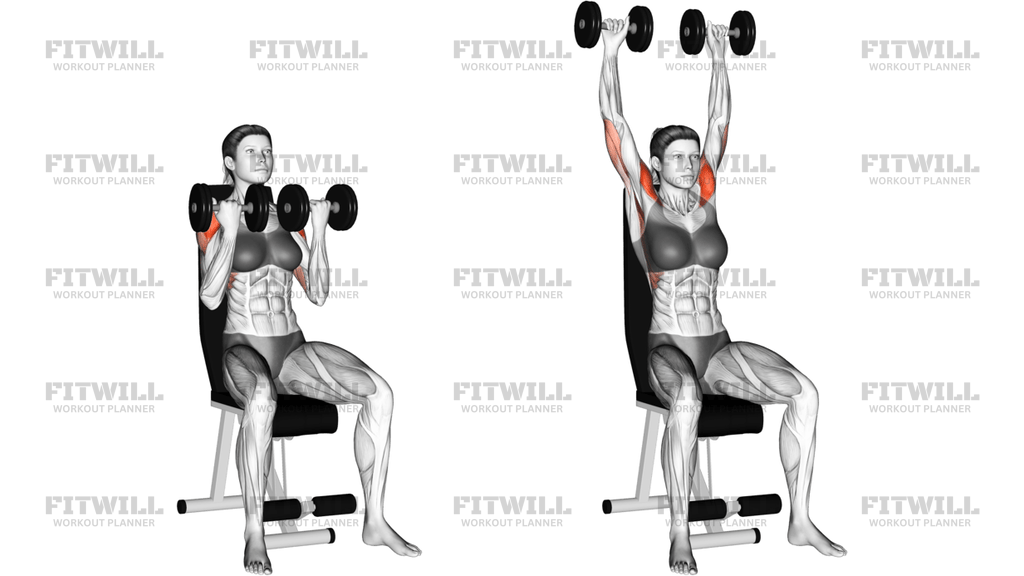
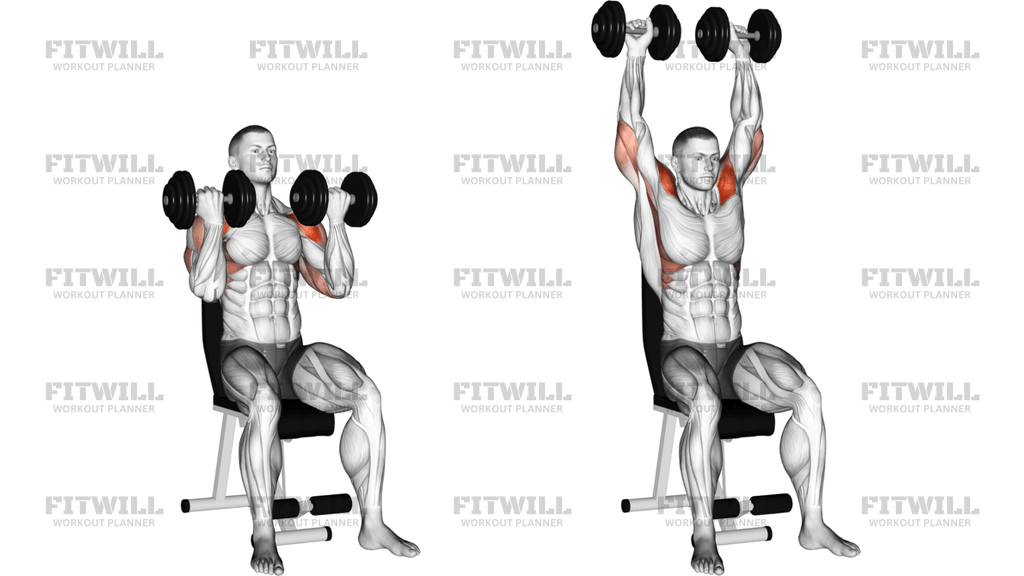
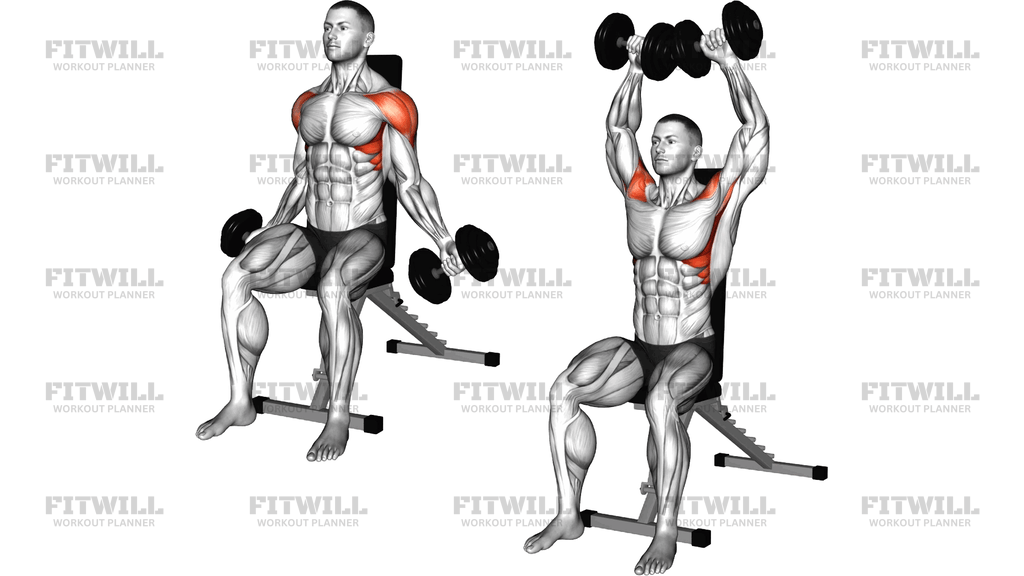
The Dumbbell Seated Around The World is a shoulder exercise where you sit upright on a bench with a dumbbell in each hand and sweep both weights from your sides up to overhead in one wide, continuous arc — like tracing a half circle around your body. Instead of pressing straight up or raising straight out to the side, the weights travel a curved path, blending elements of a lateral raise and an overhead press into a single smooth motion. The image shows the two key positions: dumbbells hanging at hip level at the start, and both arms fully extended overhead at the finish.
This movement is a solid choice for lifters who want more variety than standard presses and raises, and it works well as a finishing movement at the end of a shoulder session. Because the arc passes through multiple angles, the front shoulders do a large share of the work, with the side shoulders contributing as the arms move outward and upward. The upper chest assists as the arms rise toward the top, and the traps and upper back help control the shoulder blades throughout the sweep.
The seated setup matters more than it might seem. Sitting on a bench with back support removes momentum from the hips and legs, which forces the shoulders to do the lifting honestly. It also makes it easier to keep your torso upright and your ribs down, which protects your lower back and keeps the arc consistent from rep to rep. Using light dumbbells is not a limitation here — it is the point. The leverage changes constantly as the weights travel around the curve, so a weight you could press overhead easily may feel far heavier at the mid-arc position.
To execute it well, think of your arms as the hands of a clock sweeping from the 6 o'clock position up to 12 o'clock. Keep a slight, fixed bend in the elbows, turn your palms to face forward as you rise, and move both arms at the same speed so the dumbbells arrive overhead together. The top position should look like the finish of a dumbbell shoulder press: arms extended, weights close together above your head, shoulders packed.
Common use cases include adding volume to the delts without heavy spinal loading, rehearsing a full overhead path with light weight as part of a warm-up, and giving lifters with cranky shoulder joints a way to train the overhead range through a gentler, rotating path rather than a rigid straight press. Because the exercise is controlled and joint-friendly at sensible loads, it suits intermediates especially well, though careful beginners can learn it with very light dumbbells.
The main safety points are simple: keep the weight modest, never swing or lean back to help the dumbbells over the hard middle section, and stop the set as soon as your form breaks down. If you feel pinching at the top of the movement, reduce the range slightly or narrow the arc rather than pushing through discomfort.
[ Workout Log & Planner ]
Put your next workout in Fitwill
Keep your plan and training log ready when you are.


Instructions
- Sit on a bench with back support and plant your feet flat on the floor about hip-width apart, with your back upright against the pad.
- Hold a dumbbell in each hand with a neutral grip (palms facing your body) and let your arms hang straight down at your sides at hip level.
- Roll your shoulders back and down, brace your core lightly, and keep your head neutral with your gaze forward.
- Begin the arc by sweeping both dumbbells outward and forward and upward in a wide semicircle, as if drawing a circle around your body.
- Keep a slight bend in your elbows that stays the same throughout the rep, and gradually rotate your palms to face forward as the weights rise past shoulder height.
- Continue the curved path until both arms are fully extended overhead with the dumbbells close together above your head, mirroring the top of a shoulder press.
- Pause briefly at the top with your shoulders supporting the weights, not shrugged up toward your ears.
- Reverse the exact arc in a slow, controlled manner, letting the weights trace the same wide circle back down to your sides.
- Exhale as you sweep the dumbbells up and inhale on the way down.
- Reset your posture at the bottom for a moment, then start the next rep — avoid bouncing or using momentum out of the start position.
Tips & Tricks
- The mid-arc section, roughly at shoulder height, is where the leverage is hardest — if the dumbbells stall or drift forward there, the weight is too heavy.
- If your lower back arches as the weights climb, press your lower back gently against the bench pad and re-brace your core before continuing.
- A common mistake is turning this into a wide-grip press by shortening the arc; the weights should stay out wide during the first half of the lift, not travel straight up from your shoulders.
- If one dumbbell arrives overhead before the other, slow the tempo down and count a two-second sweep for each arm until they move symmetrically.
- Keep your wrists straight and firm rather than letting them cock back, which happens when the dumbbells get heavy and strains the forearms.
- Shrugging your traps early shifts work away from the delts — think of reaching out wide with your elbows before the weights come inward at the top.
- Start with a pair you could comfortably lateral raise for 12-15 reps; the arc makes the same load feel significantly harder than a press.
- If your shoulders pinch near the top, narrow the circle slightly so the dumbbells travel a smaller curve rather than forcing a fully wide path.
- Use this as a warm-up with very light dumbbells before pressing days, or as a burnout finisher after your main pressing work — both roles suit it, but not heavy low-rep loading.
Frequently Asked Questions
Which muscles does the Dumbbell Seated Around The World work?
The front shoulders do most of the lifting, with the side shoulders contributing as the dumbbells travel through the wide mid-arc. The upper chest, traps, and triceps assist as you reach the overhead position.
How is the Dumbbell Seated Around The World different from a regular dumbbell shoulder press?
A press moves the dumbbells straight up from shoulder height, while this exercise sweeps them in a wide semicircle from your sides all the way overhead. That curved path changes the resistance angle throughout the rep and trains the shoulders through a broader range.
Is the Dumbbell Seated Around The World suitable for beginners?
Yes, provided they start with very light dumbbells and focus on a smooth, symmetrical arc. The movement pattern is simple to learn, but the changing leverage makes it unforgiving of heavy loads.
Why should I sit on a bench with back support for this exercise?
The back support stops you from leaning back and using body English to swing the dumbbells past the difficult mid-arc point. It keeps the tension on the shoulders and protects your lower back from excessive arching.
What grip should I use on the dumbbells?
Start with a neutral grip, palms facing your body, with the dumbbells hanging at your sides. Let your palms rotate naturally to face forward as the weights rise so your shoulders can move through the arc without restriction.
What is the most common mistake in this exercise?
Going too heavy and turning the wide arc into a short, swingy press. Other frequent errors are shrugging the traps toward the ears and letting the two dumbbells travel at different speeds.
Can I do the Dumbbell Seated Around The World with a resistance band instead of dumbbells?
You can approximate it by anchoring a band under your feet and sweeping your arms in the same arc, though the resistance profile will differ. Dumbbells remain the better match for the smooth, changing leverage of the original movement.
Where should this exercise fit into my shoulder workout?
It works best as a warm-up with very light weights before pressing, or as a finishing movement after your main lifts. Treat it as a controlled, moderate-to-high-rep exercise rather than a heavy strength lift.
Should my elbows stay bent or straight during the arc?
Keep a slight, fixed bend in your elbows for the entire rep. Locking them straight stresses the elbow joints, and bending them more turns the movement into something closer to a swing.
Is it safe for my shoulders if I feel a pinch at the top?
A pinch is a signal to adjust, not to push through. Narrow the arc slightly, reduce the weight, and make sure you are not shrugging — if the discomfort persists, switch to a standard lateral raise or press pattern that stays pain-free.