Medicine Ball Lying Floor Close Press Catch
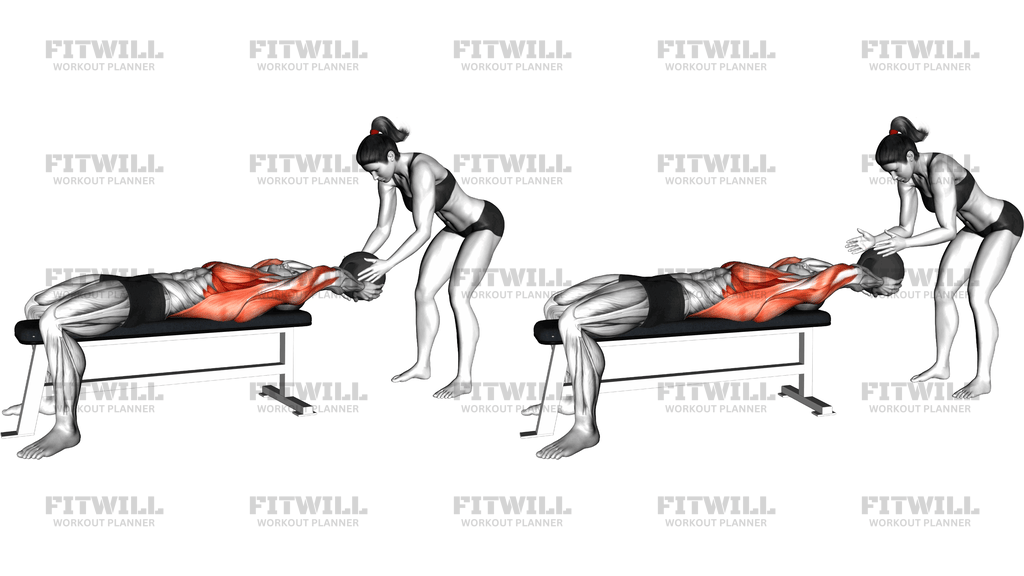
The Medicine Ball Lying Floor Close Press Catch is a partner-based pressing drill performed on the floor with a medicine ball. You lie on your back with knees bent and feet flat, and a partner stands or kneels just past the top of your head, placing the ball into your raised hands. Instead of a wide bench-press style press, this is a close press: your hands stay near each other on the ball and your elbows track close to your ribs, which shifts the workload toward the triceps while the chest and front delts assist.
The catch component is what separates this from a plain floor press. On each rep, the partner releases the ball from slightly above your extended hands, and you catch it, absorb its weight, and immediately press it back up. That brief deceleration forces your triceps and pressing muscles to control an incoming load rather than just push a static one, which is useful for contact sports, basketball, and any activity where you receive force as well as produce it.
The floor is an intentional part of the setup. Because the ground stops your upper arms at roughly parallel, the exercise is naturally shoulder-friendly and removes the need for a bench. Keeping the elbows tucked limits shoulder flare and reinforces the narrow-arm path that makes the triceps do most of the extending. This makes it a smart choice for home trainees without equipment beyond a medicine ball, and for lifters who want volume on the triceps without loading a barbell.
To execute it well, grip the ball on its sides with fingers spread, keep wrists stacked over the forearms, and press the ball straight up from the sternum area until elbows are almost locked. As the ball comes back down from your partner, meet it with firm hands rather than letting it slam into your palms, sink it under control to the lower chest, then drive it back up. Breathing should match the effort: exhale on the press, inhale as you receive and lower the ball.
Common use cases include partner circuits, warm-up activation before pressing day, and explosive upper-body finishers when the ball is thrown with some pace. Safety depends mostly on communication: agree on the timing of each drop before the first rep, keep the face and throat clear of the ball's flight path, and choose a ball weight you can catch smoothly for every rep without your elbows collapsing toward the floor.
[ Workout Log & Planner ]
Put your next workout in Fitwill
Keep your plan and training log ready when you are.


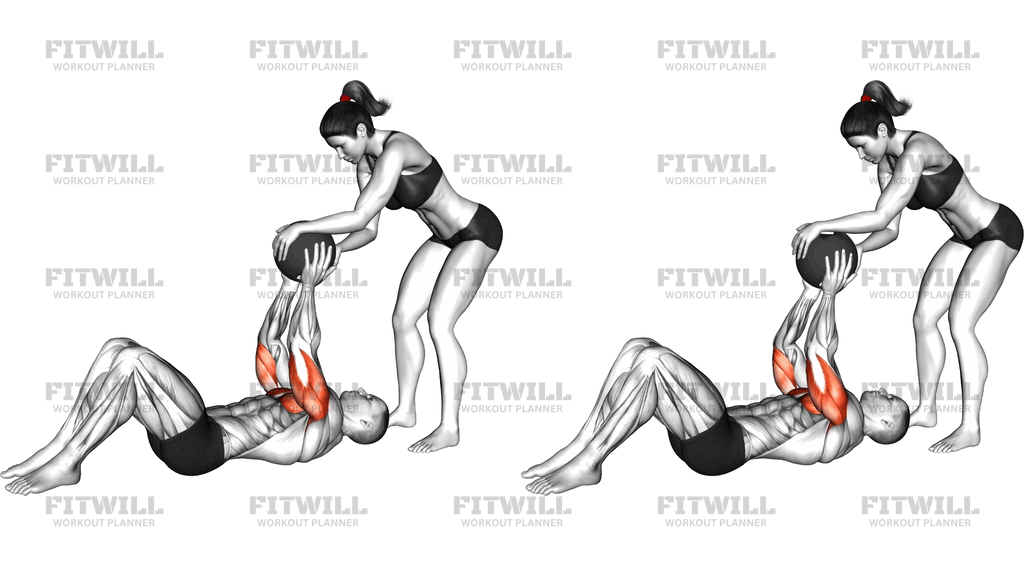
Instructions
- Lie flat on your back on the floor with knees bent and feet flat, hips and shoulder blades in contact with the ground.
- Have your partner stand just past the top of your head, holding a medicine ball ready to place or drop into your hands.
- Raise both arms toward the ceiling and grip the ball on its sides with hands close together, fingers spread and wrists stacked over the forearms.
- Brace your core lightly and press the ball up until your elbows are nearly straight, directly above your lower chest.
- On your partner's signal, receive the dropped ball with firm hands, absorbing its weight without letting it collapse your arms toward your face.
- Lower the ball under control with elbows staying close to your torso until the backs of your upper arms lightly touch the floor.
- Press the ball back up along the same narrow path, extending the elbows and squeezing the triceps at the top.
- Exhale as you press up and inhale as you catch and lower the ball.
- Complete the set, then hand the ball back to your partner before sitting up.
- Reset your position on the floor between sets if your hips or shoulders have drifted.
Tips & Tricks
- If the ball bounces out of your hands on the catch, the drop height or weight is too much for your current control, so ask your partner to release it from a few inches lower or use a lighter ball.
- Elbows drifting outward turns this into a wide chest press; cue yourself to brush your upper arms past your ribs on every rep to keep the triceps as the main driver.
- Keep your lower back from arching off the floor as you catch the ball. If it does, brace the abs harder or bend the knees a little more.
- Do not fully relax at lockout while your partner still has contact with the ball, or the sudden load will jar your elbows; stay slightly engaged through the whole rep.
- Catch with the whole hand wrapped on the sides of the ball, not just fingertips, so the wrists stay stacked and do not fold backward.
- Because the floor stops your elbows, there is no need to bounce the ball off the ground or your chest; a controlled touch is enough to keep tension on the triceps.
- Communicate every drop with a short verbal cue like 'ready' or 'down' so you are never surprised mid-press.
- If your shoulders feel pinched, angle your upper arms slightly toward your torso rather than pressing with elbows flared at ninety degrees.
Frequently Asked Questions
Which muscles does the Medicine Ball Lying Floor Close Press Catch work?
The triceps are the primary movers because the narrow hand position keeps the elbows tucked. The chest and front shoulders assist on the press, and the core stabilizes while you absorb the catch.
Why does this exercise use a partner instead of just pressing the ball alone?
The partner supplies the catch, meaning you decelerate an incoming load before pressing it back, which trains receiving force as well as producing it. You can do the close press alone, but you lose that reactive element.
How heavy should the medicine ball be for the Medicine Ball Lying Floor Close Press Catch?
Choose a ball you can catch smoothly without your hands getting knocked back toward your face. For most people that is somewhere between 4 and 10 pounds; control matters more than weight here.
Can beginners do the Medicine Ball Lying Floor Close Press Catch?
Yes, and it is actually a low-risk introduction to pressing because the floor limits the range of motion. Beginners should start with a light ball dropped from a very short height and focus on the tucked-elbow path.
How close should my hands be on the medicine ball?
Place your hands on the sides of the ball so they are nearly touching, close enough that your elbows stay in front of or beside your ribs. If your elbows flare wide, your grip is too broad for a close press.
What is the most common mistake in this movement?
Letting the elbows flare out and turning it into a wide press, which shifts work away from the triceps and strains the shoulders. A second frequent error is catching the ball with loose hands instead of firm, braced arms.
What can I substitute if I have no partner for the Medicine Ball Lying Floor Close Press Catch?
Perform the close-grip floor press with the ball, a dumbbell, or a kettlebell and simply lower and press under your own control. A self-toss a few inches up and catching it on the way down partially recreates the catch.
Is it safe for my shoulders since the ball comes from above my head?
The ball should be released over your extended hands above your lower chest, not over your face, and the floor stops your elbows at a safe depth. Keep your head slightly forward on the floor and agree on timing with your partner to avoid a ball landing near your face.
Should I fully lock out my elbows at the top of each rep?
Extend to a strong finish but keep a small amount of tension rather than slamming into a hard lockout, especially while the ball is dropping. This protects the elbow joint and keeps the triceps working through the catch.
Where should the ball touch at the bottom of the Medicine Ball Lying Floor Close Press Catch?
Lower it until the backs of your upper arms lightly contact the floor, which places the ball around your lower chest. Going further offers nothing extra because the floor, not your muscles, sets the endpoint.