Medicine Ball Single Leg Slam
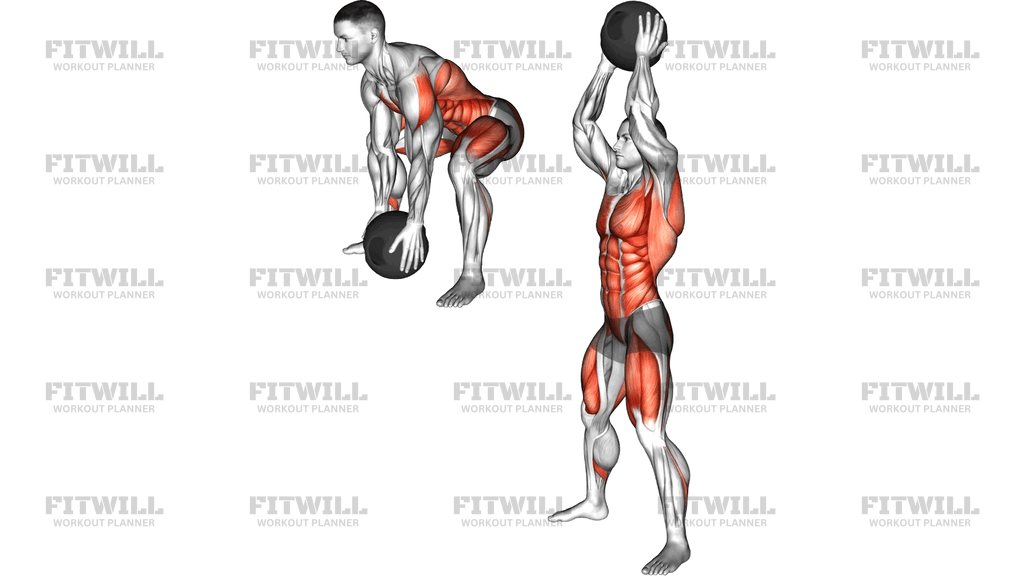
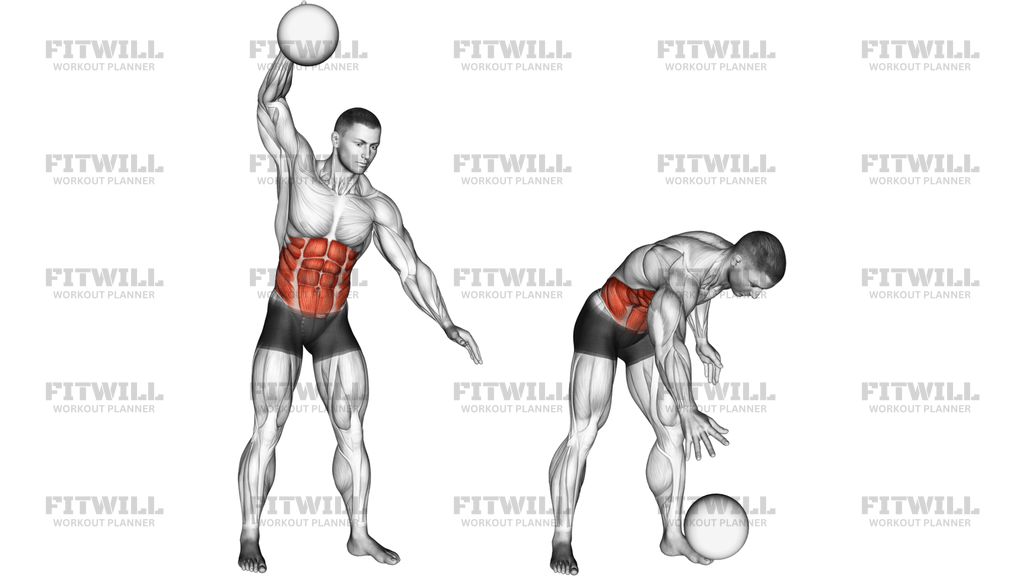
The Medicine Ball Single Leg Slam is a power exercise that combines an overhead ball slam with single-leg balance. You stand on one leg, hold a medicine ball overhead with both hands, then slam the ball down into the floor while staying controlled on your standing leg. The moment your foot leaves the ground, the exercise stops being just a slam and becomes a full-body stability challenge.
This movement trains explosive hip and trunk flexion through the abs and hip flexors, pressing and pulling strength through the shoulders and lats, and serious balance work through the foot, ankle, and hip of the standing leg. Because you are on one leg, your glutes and deep core have to work overtime to keep your pelvis level while your arms accelerate the ball toward the floor.
The single-leg setup is what separates this from a standard slam. On two feet, most people can muscle the ball down with their arms and let their lower back do the work. On one leg, any compensation shows up immediately: your hips shift, your arch collapses, or your trunk twists. That feedback is exactly why the exercise is useful — it forces you to generate power from a braced, aligned trunk rather than from momentum and luck.
To execute it well, think of the slam as a whole-body action. Raise the ball overhead and get tall through your standing leg, then drive the ball down by crunching your ribs toward your hip and snapping your hips forward, not by simply swinging your arms. Pick a ball weight you can control at speed; a ball that is too heavy turns the slam into a slow grind and pulls you off balance.
This exercise fits well in athletic conditioning circuits, core training blocks, and warm-ups for sports that demand single-leg power and trunk control, such as running, tennis, and field sports. It also works as a low-impact power option for people who want explosive core training without jumping.
Safety-wise, clear space around you and choose a floor that can take a medicine ball impact, such as rubber flooring. Keep your spine long as you raise the ball and hinge slightly rather than rounding or arching your lower back. If you wobble badly on one leg, master the two-legged slam and a static single-leg hold first, and stand near a wall or rack until your balance is consistent.
[ Workout Log & Planner ]
Put your next workout in Fitwill
Keep your plan and training log ready when you are.


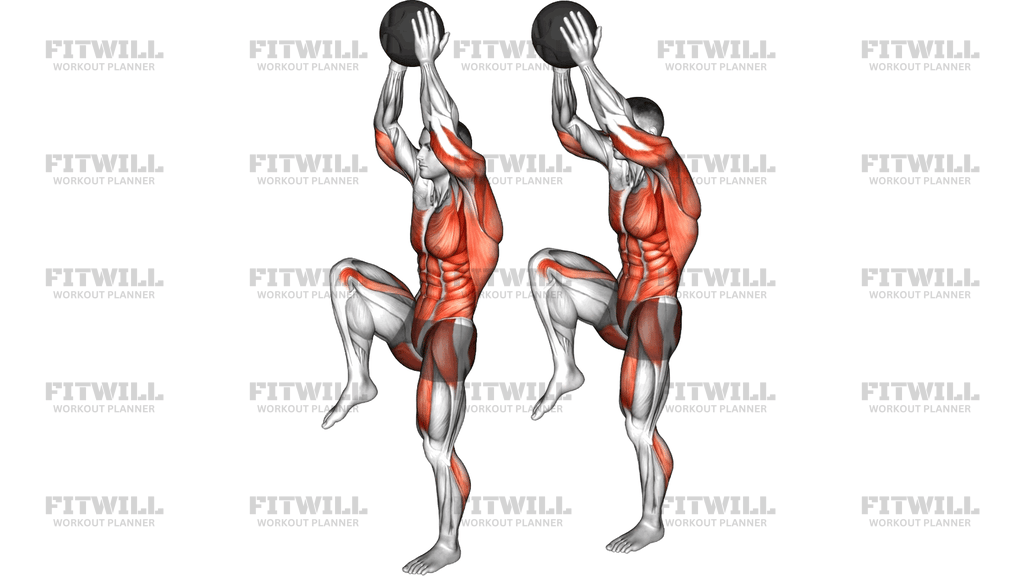
Instructions
- Stand on one leg with a soft bend in the knee, and hold a medicine ball with both hands directly overhead, arms extended.
- Lift your free leg so the knee is bent and held in front of you, and find your balance point through the middle of your standing foot.
- Brace your abs and squeeze the glute of the standing leg to keep your hips level before you start the slam.
- Take a breath in as you reach slightly taller with the ball overhead, keeping your ribs stacked over your pelvis.
- Exhale forcefully and slam the ball down into the floor slightly in front of your standing foot, driving the movement from your abs and hips as your arms follow through.
- Let the ball bounce or stop it on impact, then keep your eyes forward and stay balanced on the one leg instead of letting your free foot drop immediately.
- Pick the ball up with a slight hip hinge and a flat back, then press it back overhead to the starting position.
- Breathe in as you raise the ball, breathe out sharply on each slam.
- Complete all repetitions on one leg, then switch sides and repeat on the other leg.
- Reset your balance fully between reps if you start drifting or twisting rather than rushing through the set.
Tips & Tricks
- If you keep losing your balance forward on the slam, the ball is probably traveling too far in front of you — aim for a spot just in front of your standing foot instead of reaching for distance.
- Watch for the hip of your free-leg side dropping as you slam; that means the standing glute has switched off, so squeeze it harder and slow the tempo down.
- A common mistake is rounding the lower back as the ball comes overhead. If your ribs flare and your back arches, reduce the ball weight and reach only as high as you can with a tall spine.
- Dont let the slam become an arm swing. Cue yourself to crunch your chest toward your thigh so the abs and hips produce the power and the arms just guide the ball.
- Start with a lighter ball than you use for two-legged slams. The balance demand cuts your usable power significantly, and a heavy ball will drag your torso out of position.
- Keep a soft knee on your standing leg. Locking the knee makes the ankle stiff and turns every rep into a balance struggle.
- If single-leg balance is the limiting factor, practice the top position with the ball held overhead for 15-20 seconds per side before adding the slam.
- On soft or uneven flooring, test one slam at low speed first so you know how the ball rebounds before committing to full-power reps.
- Alternate which leg you start with each session so your weaker side gets trained with the same freshness as your dominant side.
Frequently Asked Questions
What muscles does the Medicine Ball Single Leg Slam work?
The primary movers are the abs and hip flexors, which drive the trunk and ball downward. Your shoulders, lats, and triceps guide the ball, while the glutes, quads, and deep core of the standing leg stabilize your whole body.
Is the Medicine Ball Single Leg Slam suitable for beginners?
Beginners should first learn the two-legged medicine ball slam and practice standing on one leg with the ball held overhead. Once both feel comfortable, start the single-leg version with a light ball and controlled speed.
How heavy should the medicine ball be for this exercise?
Choose a weight you can slam forcefully while staying balanced, usually noticeably lighter than what you would use for a regular slam. If the ball slows down your speed or pulls you off your standing leg, go lighter.
Why do I keep losing my balance when I slam the ball down?
The forward throw of the ball shifts your center of mass, so if you aim too far in front of you or let your torso collapse, you fall forward. Aim for a spot just in front of your standing foot, keep a soft knee, and squeeze the standing glute throughout the rep.
Should the raised knee stay up during the entire rep?
Yes, holding the knee up is what makes this a single-leg exercise, but you can lower the free foot briefly between reps to reset if your balance breaks down. Never let the free foot touch down in the middle of the slam itself.
Can I do the Medicine Ball Single Leg Slam if I have lower back issues?
Slams place a compressive load on the spine, especially when balance forces you to compensate. If you have a history of lower back problems, get clearance from a qualified professional and start with gentler anti-extension core work first.
What can I use instead of a medicine ball?
A slam-style medicine ball or a durable, non-bouncy ball is ideal because it can take repeated hard impacts. A sandbag or weighted ball can work in a pinch, but avoid anything rigid or fragile that could bounce unpredictably or damage the floor.
How many reps and sets should I do?
Because this is a power exercise, keep sets short and quality high — around 5-8 slams per side for 3-4 sets, resting enough to stay explosive. Stop the set when your balance or slam speed noticeably drops.
Should I slam the ball to the side or straight ahead?
Slam slightly in front of your standing foot, directly in line with your body. Slamming off to the side adds rotation your balanced stance cannot handle and is a common way people twist a knee or lose the rep entirely.
What floor surface works best for medicine ball slams?
Rubber gym flooring or turf handles repeated ball impacts best. Avoid slamming on concrete, tile, or thin hardwood, both for the sake of the floor and because unpredictable bounces can throw off your timing and balance.