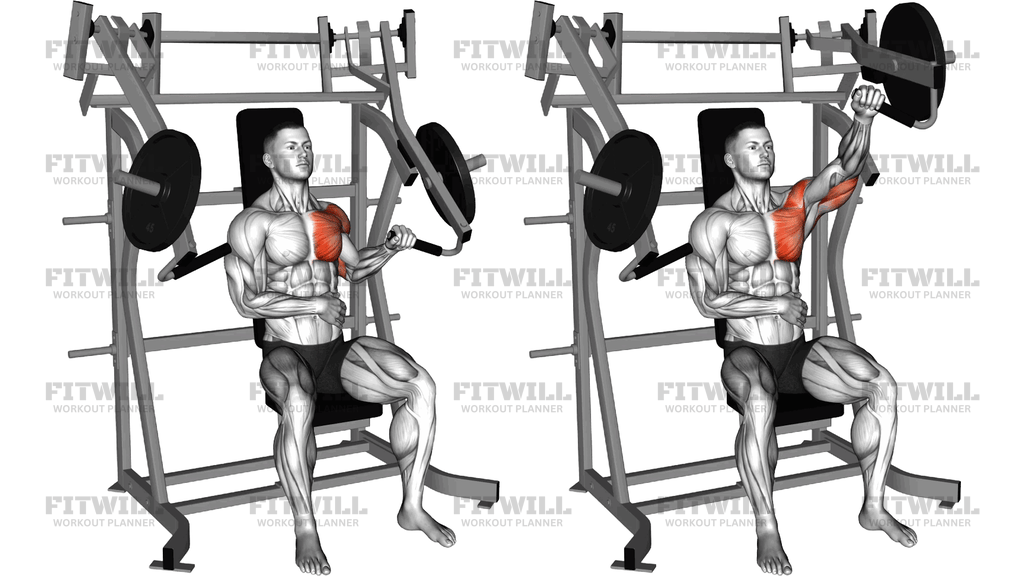
Lever Stack Seated Single Arm Chest Press
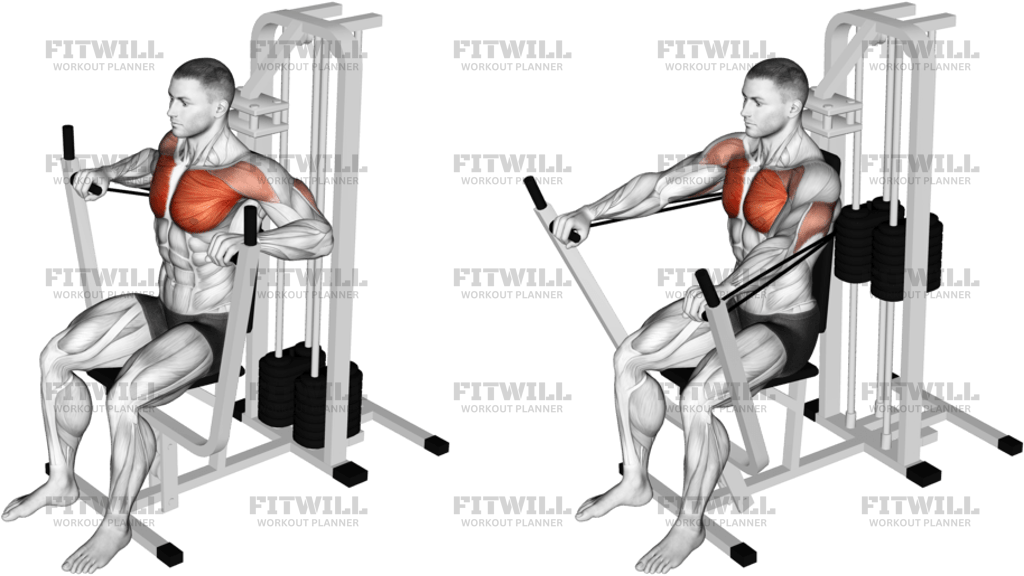
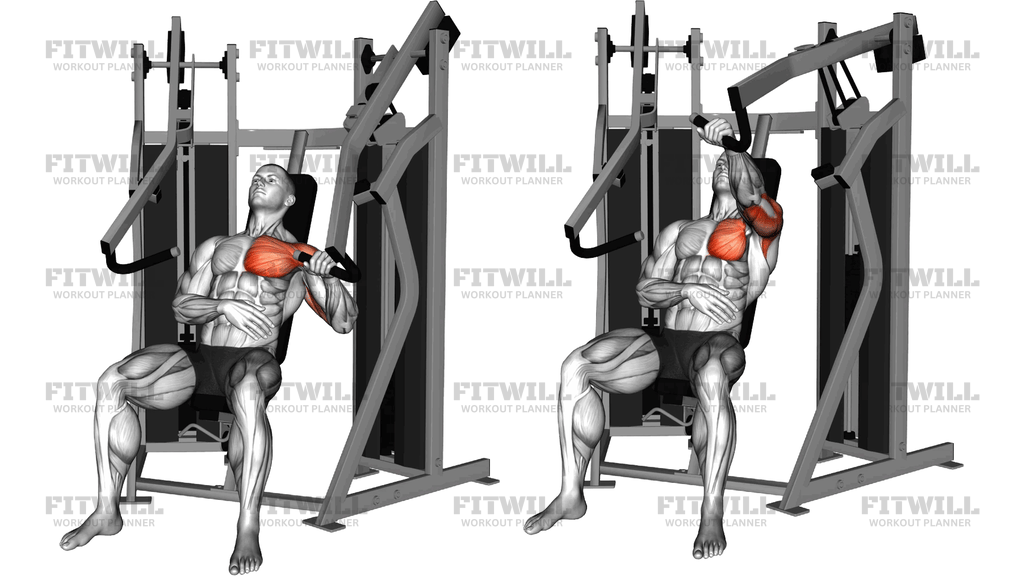
The Lever Stack Seated Single Arm Chest Press is a plate-loaded machine exercise performed one side at a time from a seated, slightly reclined position. You sit back against the machine's back pad, brace your free hand across your midsection, and drive the lever handle up and inward from chest height until your working arm reaches full extension. The converging arc of the lever mimics the natural path your hand travels during a pressing motion, which is what makes leverage-style chest machines feel smoother than a fixed bar path.
Working one arm at a time changes the exercise in a few useful ways. First, it exposes and helps correct side-to-side strength differences, since your stronger arm can no longer quietly do the extra work it hides during a two-arm press. Second, pressing while resisting slight rotation forces your core to hold your torso square to the pad, adding an anti-rotation demand you simply don't get from a bilateral machine press. Third, the bracing hand on your belly acts as a constant reminder to stop twisting as the weight gets heavy.
The primary work falls on the pectoralis major, particularly as the elbow drives forward and across the midline. The front delts assist throughout the upward press, and the triceps take over near the end as the elbow straightens. The serratus anterior and deep core musculature work isometrically to keep your shoulder blade and ribcage position stable under load.
Setup matters more here than on most machine presses because the single-arm lever will happily pull your torso out of position if you sit badly. Adjust the seat so the handle starts near mid-chest and your back, shoulders, and head stay in contact with the pad. Feet flat on the floor, knees bent to roughly ninety degrees, and your free hand planted across your stomach complete the position.
This exercise suits lifters of most experience levels. Beginners benefit from the guided path and the reduced coordination demand compared to a free-weight one-arm press. Intermediate and advanced lifters can use it as a finisher after barbell or dumbbell pressing, as a dedicated tool for chasing down a weaker side, or as a pressing option when a spotter isn't available. Because one arm works while the other braces, rest periods feel short, so pace your sets accordingly.
For safety, keep the movement within a range where your shoulder stays comfortable, don't let your lower back arch off the pad as you press, and lower the lever under control rather than letting it fall back. Start noticeably lighter than your two-arm pressing weight until the lever's feel and balance are familiar.
Fitwill
Log Workouts, Track Progress & Build Strength.
Achieve more with Fitwill: explore over 9600 exercises with images and videos, access built-in and custom workouts, perfect for both gym and home sessions, and see real results.
Start your journey. Download today!




Instructions
- Sit on the machine's seat and adjust its height so the lever handle lines up with the middle of your chest when your arm is bent.
- Plant both feet flat on the floor with knees bent about ninety degrees, and press your entire back, shoulders, and head against the back pad.
- Grip the handle with your working hand using a neutral or slightly angled palm-inward grip, keeping the elbow bent and tucked below chest height.
- Place your free hand flat across your midsection or lightly on the seat edge so you can feel whether your torso starts to twist.
- Brace your abdominal muscles and take a moderate breath before initiating the press.
- Drive the handle up and inward along the lever's natural arc, straightening your arm while keeping your shoulder blade pinned back against the pad rather than rounding forward.
- Press until the elbow is nearly straight and the handle has traveled across your midline toward the top position, then pause briefly without locking the joint hard.
- Lower the lever slowly back along the same path until your elbow returns to the starting position beside your chest, controlling the descent instead of letting the weight stack drop.
- Exhale as you press up, inhale as you lower, and keep the rhythm steady for every rep.
- Complete all repetitions on one side, then reposition and perform the same number on the other arm, finishing each set with a controlled return of the lever to rest.
Tips & Tricks
- If your torso rotates toward the pressing arm as the weight rises, the load is too heavy for your core to stabilize. Reduce the plates and recheck that your free-hand side of the back pad stays in contact throughout.
- The most common mistake on this machine is letting the shoulder roll forward at the top of the press. Keep the shoulder blade flat against the pad so the chest, not the front of the shoulder, finishes the movement.
- Don't flare the elbow out to a level far below the handle at the start. Keep the elbow roughly at nipple-to-chest line so the pressing arc comes from the shoulder joint, not a strained stretch.
- Because the lever balances differently than a barbell or dumbbell, your first set should be exploratory. Add weight in small jumps once the arc feels natural.
- If your lower back arches off the pad during hard presses, exhale more forcefully at the top and brace your ribs down before each rep.
- Match reps exactly between arms and always start with your weaker side. Use its count as the limit for the stronger arm to keep the sides balanced.
- Keep wrist alignment neutral, with the knuckles stacked over the forearm, rather than bending the wrist backward under the handle load.
- A brief pause at the fully extended position increases chest work at shorter muscle lengths and prevents bouncing off the stack between reps.
- If your seat height is right but the handle still feels off-line, recheck it at the bottom of the press rather than the top, since the machine's arc is fixed and the starting position defines the path.
Frequently Asked Questions
Which muscles does the Lever Stack Seated Single Arm Chest Press work?
The chest is the primary mover, with the front shoulders assisting through the press and the triceps straightening the elbow at the top. Your core and serratus also work to hold the torso square against the pad while one side is loaded.
Why press one arm instead of using both handles?
Single-arm pressing removes the compensation where a stronger side takes over, which makes it useful for fixing left-right imbalances. It also adds an anti-rotation challenge since your torso has to resist turning toward the working arm.
Is the Lever Stack Seated Single Arm Chest Press suitable for beginners?
Yes. The fixed lever path reduces coordination demands and no spotter is needed, so it's a good early pressing exercise. Start light to learn the arc before adding meaningful load.
How should my free hand be positioned during the set?
Place it across your stomach or lightly on the seat so it can both stabilize you and signal when your torso starts twisting. If you feel rotation, lighten the load rather than gripping harder.
Where should the handle start relative to my chest?
Roughly at mid-chest height with the elbow bent and below the handle line. If the handle starts near your collarbone or ribs, the seat height needs adjusting before you load any plates.
What's the most common mistake on this machine?
Rotating the torso toward the pressing arm and letting the shoulder roll forward off the pad at the top. Both reduce chest involvement and shift stress to the shoulder joint, so cut weight and keep your back flat against the pad.
What can I use if my gym has no leverage chest press?
A single-arm dumbbell bench press or a one-arm cable chest press from a seated or standing position covers the same pattern. Both still train the unilaterally loaded chest press with an anti-rotation demand.
How heavy should I go compared to a two-arm machine press?
Expect to use considerably less than half of your two-arm load at first, since one arm carries everything and your core must resist rotation. Build up over several sessions before pushing close to maximum effort.
Should I lock my elbow out at the top of each press?
Press to full or near-full extension but avoid snapping the joint into a hard lock, especially under heavy load. A brief controlled pause at the top with the arm straight is enough.
Is pressing up and across the body safe for the shoulder?
For most people the converging lever path is joint-friendly because it follows the shoulder's natural pressing arc. Keep the range within a pain-free window, keep the elbow from dropping too far below chest level at the start, and stop if you feel sharp discomfort.