Smith Incline Wide Grip Bench Press
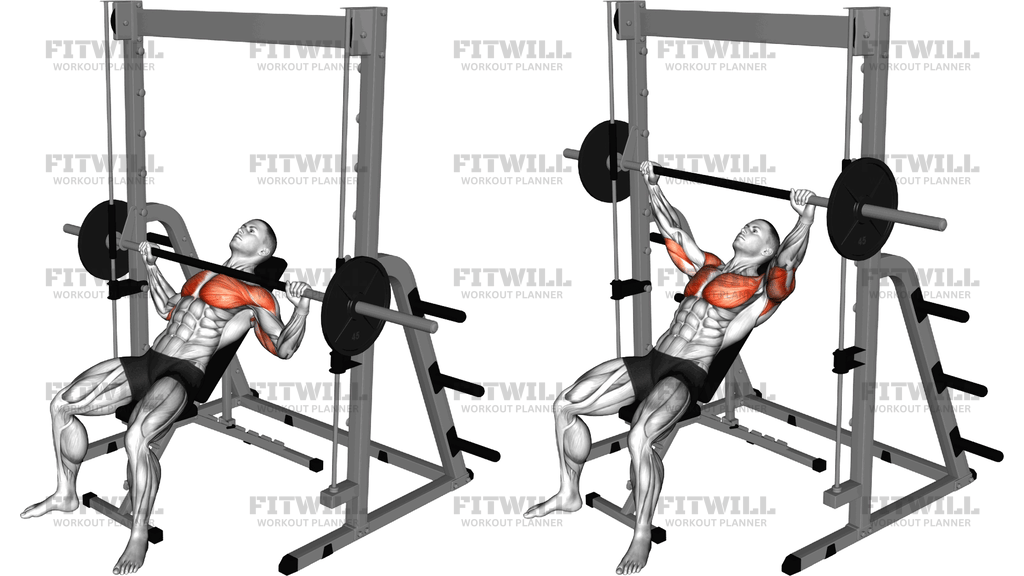
The Smith Incline Wide Grip Bench Press is an inclined pressing variation performed on a Smith machine with the bar set on an inclined bench, typically angled around 30 to 45 degrees. The wide hand placement, roughly one and a half to double shoulder width, shifts more of the work toward the upper portion of the chest while still calling on the front shoulders and triceps to finish each rep. Because the Smith machine bar travels on a fixed vertical track, you can focus entirely on pressing hard without spending effort stabilizing a free barbell.
This setup is especially useful for lifters who want to isolate the upper chest without a spotter. Incline pressing with a free bar can feel awkward when you are unracking a heavy weight from a reclined position, but the Smith machine lets you rotate the bar free, press, and lock it back onto the safety hooks with a simple wrist turn. That makes it a solid choice for solo training, high-rep finisher sets, and controlled tempo work where balance would otherwise be the limiting factor.
The incline angle is the key detail. Compared with a flat press, the angled torso places the shoulder joints in a position where the clavicular fibers of the pectoralis major do more of the work, and the wide grip reduces elbow bend range, which limits how much the triceps can take over. Expect to feel the work across the top of the chest near the collarbone, with support from the front delts.
Setup matters more here than on a flat press because the fixed bar path will not adjust to your body. Position the bench so that when you lower the bar, it touches down around your upper chest just below the collarbones, and your elbows travel slightly below torso level without pinching at the bottom. If the bench sits too far forward or back on the track, the bar will drift toward your neck or your lower chest, which is uncomfortable and inefficient.
To execute it well, plant your feet flat on the floor, keep your upper back and hips on the bench, and pull your shoulder blades down and back so you press from a stable base. Lower the bar under control to the upper chest, let the elbows flare out to roughly 45 to 70 degrees, then press up and slightly back until the arms extend without locking hard. Exhale on the way up, inhale on the way down.
In practice, this exercise fits well as a main upper-chest lift on a push day or as a secondary press after a heavier free-weight movement. Start lighter than you would on a barbell incline press to learn the fixed path, and never set your face directly under the descending bar until you have confirmed the bar will land on your chest, not your throat.
[ Workout Log & Planner ]
Put your next workout in Fitwill
Keep your plan and training log ready when you are.


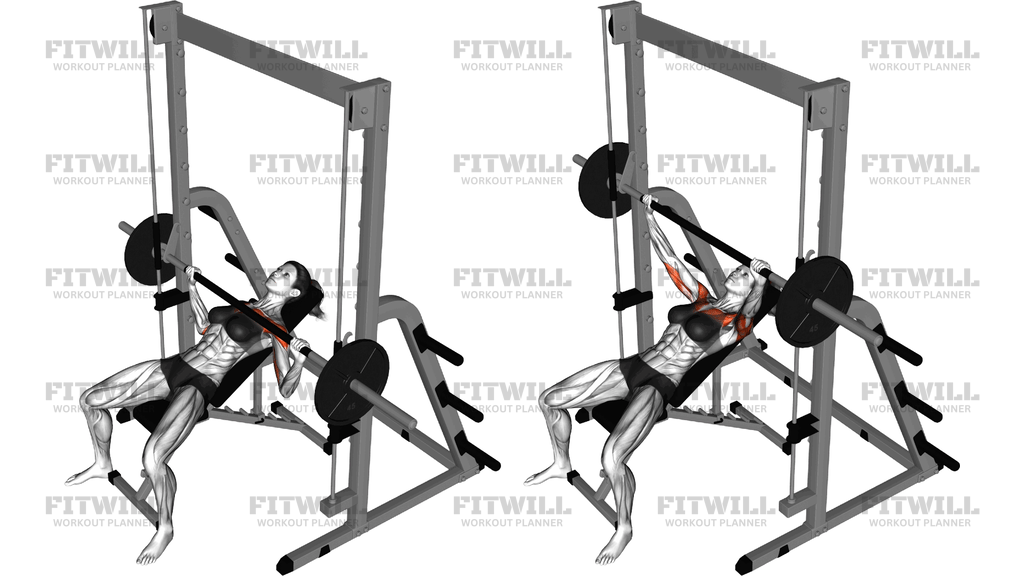
Instructions
- Set an incline bench to roughly 30 to 45 degrees and place it centered under the Smith machine bar so the bar will lower to your upper chest.
- Sit back on the bench with your feet flat on the floor, your head and upper back in contact with the pad, and your hips planted on the seat.
- Grip the bar wider than shoulder width, about one and a half to two times shoulder width, with your wrists stacked directly over your elbows.
- Rotate the bar to release it from the safety hooks and hold it directly above your upper chest with your arms extended.
- Pull your shoulder blades down and back into the bench and brace your core before beginning the descent.
- Inhale and lower the bar in a slow, controlled line until it lightly touches your upper chest, just below the collarbones, with elbows flared to roughly 45 to 70 degrees.
- Press the bar straight up along the Smith machine track while exhaling, driving until your arms are extended but not forcefully locked out.
- Pause briefly at the top, keep tension in your chest, then begin the next repetition.
- After your final rep, rack the bar by rotating it back onto the hooks before relaxing your grip or sitting up.
- Sit up slowly and adjust the bench or bar height if the bar did not track cleanly to your upper chest on the first set.
Tips & Tricks
- If the bar touches your neck or clavicle area, the bench is positioned too far up the track; slide it down slightly and retest with an empty bar.
- If the bar lands low on your sternum, the bench is too far forward or the angle is too shallow; move the bench back or raise the incline one notch.
- Do not bounce the bar off your chest on this movement; the fixed vertical path means any rebound drives straight down into your upper chest.
- A grip wider than comfortable shortens the range but strains the wrists and shoulders; choose a width where your forearms stay roughly vertical at the bottom.
- Keep your shoulder blades retracted through the whole set; letting them slide forward turns this into a front-delt press and reduces upper-chest involvement.
- Because the Smith machine removes stabilizing demands, it is easy to load more than your incline press allows; progress in small jumps and control the negative.
- If your hips rise off the bench to help the press, the weight is too heavy or your feet are positioned too far back; lower the load and plant your feet earlier.
- Use a false thumbless grip only if your gym's bar allows a secure hook; wrapping your thumbs around the bar is the safer default for a press directly over your face.
- Treat the first warm-up set as a path check: unrack, lower slowly, and confirm the bar tracks to your upper chest before adding plates.
Frequently Asked Questions
Which muscles does the Smith Incline Wide Grip Bench Press work?
The primary muscle is the upper chest, specifically the clavicular head of the pectoralis major. The front shoulders assist throughout the press and the triceps extend the elbows, especially toward lockout.
Why use a wide grip instead of a normal grip on the incline press?
The wider grip reduces elbow bend and keeps the forearms more vertical, which favors the upper chest and limits how much the triceps contribute. Many lifters feel the work higher on the chest with this hand placement.
Is the Smith Incline Wide Grip Bench Press good for beginners?
Yes, because the fixed bar path removes the balance demands of a free barbell and the safety hooks let you rack the bar at any point. Beginners should still start with just the bar to learn where the fixed path lands on their chest.
What incline angle should I set the bench to?
Around 30 to 45 degrees works for most people. Lower angles shift work toward the mid chest, while steeper angles increase front shoulder involvement and can feel like an overhead press.
Where should the bench be positioned on the Smith machine track?
Place it so the bar lowers to your upper chest, just below the collarbones, and your elbows can drop slightly below torso level without jamming. Always verify with an unloaded bar before adding weight.
Can I train alone safely with this exercise?
Yes, this is one of the main advantages of the Smith machine version. If a rep stalls, rotate the bar back onto the hooks at any height, so no spotter is required.
What is the most common mistake on this exercise?
Setting the bench in the wrong spot on the track, so the bar descends toward the throat or lands on the lower chest. Another frequent error is lifting the hips off the bench to press the weight up, which flattens the angle and changes the target.
How heavy should I go compared with a regular incline barbell press?
Start lighter even though the Smith machine feels more stable, because the fixed vertical path is less forgiving than the slightly angled path of a free-weight press. Build up gradually over several sessions.
What can I substitute if my gym has no Smith machine?
A wide-grip incline barbell press on an incline bench, a wide-grip incline dumbbell press, or incline presses on a leverage chest machine all train the same upper-chest region. Free-weight versions require more stabilization or a spotter.
How many sets and reps work well for this movement?
It fits well as a main upper-chest lift for 3 to 4 sets of 6 to 10 reps, or as a controlled finisher for 2 to 3 sets of 10 to 15 reps. Keep the descent slow regardless of the rep range.