Front Plank To Toe Tap
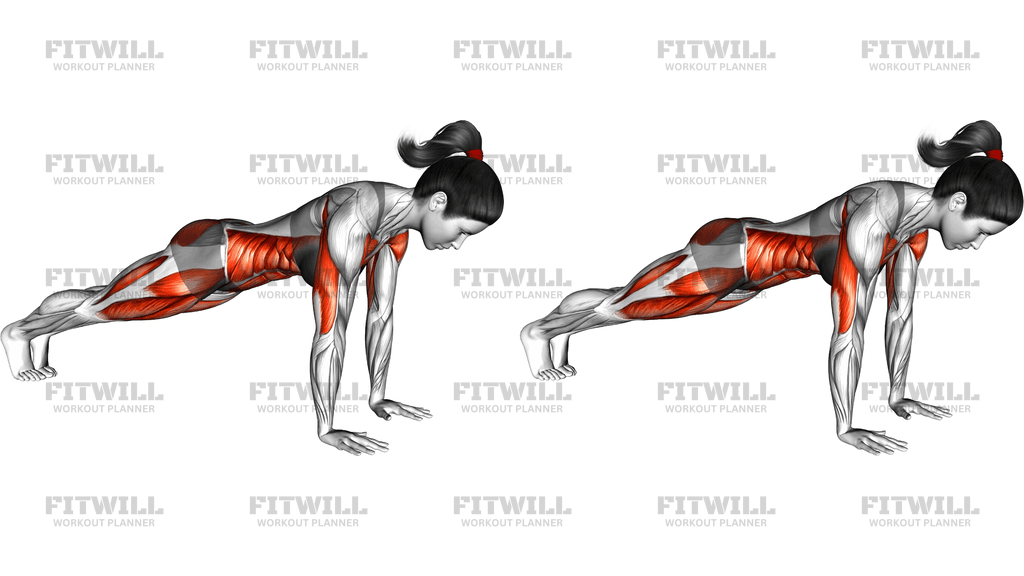
Front Plank To Toe Tap is a dynamic core exercise performed from a straight-arm plank position. Instead of holding a static plank, you lift one foot off the floor and tap your toe out to the side, then return it and switch legs. The image shows the classic high plank setup: hands stacked under the shoulders, arms straight, body forming one long line from head to heels, with weight supported on the balls of the feet. That arm position is what separates this from a forearm plank variation — the straight arms raise the demand on the shoulders and make it easier to keep the hips level throughout the movement.
This exercise works as a plank with a controlled leg action layered on top. The deep core and abs have to brace hard to stop your hips from swaying every time a foot leaves the floor, while the glutes and outer hips control the tap out to the side and bring the foot back under you. Your shoulders and triceps hold you up the entire time, so you will feel them working too, especially as the set gets longer. Because only one foot is loaded at a time, the anti-rotation demand is noticeably higher than in a standard front plank.
Front Plank To Toe Tap suits a wide range of trainees. Beginners use it as a progression from a static plank once they can hold good form for thirty seconds or more. More advanced lifters and general gym-goers use it as a warm-up primer or as part of a core circuit, since the constant small shifts keep the abs under tension without needing any load. It is also common in group training and home workouts because it needs nothing more than floor space and, ideally, an exercise mat to cushion the hands and toes.
Setup matters more than speed here. Place your hands directly under your shoulders with fingers spread, and set your feet roughly hip-width apart before you start. If your hands drift forward or your hips sit too high, you lose the flat body line and the leg taps stop challenging your core. Before each rep, squeeze your glutes, brace your abs as if bracing for a light punch, and pull your shoulder blades down away from your ears — this creates the stable base the movement depends on.
To execute it well, shift your weight slightly and lift one foot just a few inches off the floor. Reach that foot out to the side and gently tap your toe on the floor, keeping the tapping leg relatively straight and your hips square to the floor the whole time. Return the foot to its starting spot under your hips, re-establish your plank line, then repeat on the other side. Slow, deliberate taps beat fast, bouncy ones — the slower your foot moves, the harder your core has to work to keep your torso still.
The most common faults are hips rocking side to side, the lower back sagging as fatigue builds, and the tapping foot swinging wide with no control. If your hips start tilting, narrow the tap distance or slow the tempo. If your lower back dips, shorten your sets and rest before form breaks down. Stop the set when you can no longer keep a straight line — quality reps with a braced trunk are what make this exercise effective, not the total number of taps.
[ Workout Log & Planner ]
Put your next workout in Fitwill
Keep your plan and training log ready when you are.


Instructions
- Place an exercise mat on the floor and set up on your hands and knees, then walk your hands forward until your arms are straight and stacked directly under your shoulders.
- Step both feet back so your body forms a straight line from head to heels, balancing on the balls of your feet with them about hip-width apart.
- Spread your fingers wide, press the floor away, and pull your shoulder blades down so your upper back stays flat rather than sinking between the shoulders.
- Brace your abs and squeeze your glutes to lock in the plank position before any movement starts.
- Shift your weight slightly and lift one foot two to three inches off the floor.
- Reach that foot out to the side and tap your toe gently on the floor, keeping the leg mostly straight and your hips square to the ground.
- Return the foot to its starting position under your hip and pause until your plank line is fully restored.
- Repeat the tap with the other foot, alternating sides for the desired number of reps.
- Exhale as you tap the toe out, inhale as you draw the foot back to center.
- When finished, lower your knees to the mat to come out of the plank rather than letting your hips collapse first.
Tips & Tricks
- Imagine a glass of water balanced on your lower back — if it would spill during a tap, your hips are rotating and you need to slow down and brace harder.
- Keep the tap distance short at first; a six-inch reach with a still torso trains your core more than a wide swing that tips your hips.
- If your wrists ache, press through the bases of your fingers and the heel of your hand instead of dumping weight onto the wrist joint, or use a mat or folded towel under the palms.
- A common mistake is letting the shoulders creep up toward the ears as fatigue sets in — reset the shoulder blades down and back between reps.
- Point the toes of the tapping leg lightly so the foot glides out and back; a floppy, heavy foot usually means the glutes have stopped controlling the leg.
- Do not hold your breath — the taps should sync with steady breathing, exhaling on each outward reach.
- If your lower back starts to sag, that is your cue to end the set; sagging shifts the load from your abs to your lumbar spine.
- For an easier version, perform the taps from a forearm plank or drop to your knees between reps while you build plank endurance.
- Count reps per side rather than total so both sides of your core get equal work — most people naturally favor one leg.
Frequently Asked Questions
Which muscles does Front Plank To Toe Tap work?
The primary muscles are the abs and deep core stabilizers, which brace to keep your torso still while one foot is off the floor. The obliques, glutes, and outer hips control the side tap, while the shoulders and triceps support your body weight throughout the plank.
Is Front Plank To Toe Tap suitable for beginners?
Yes, as long as you can already hold a solid straight-arm plank for around twenty to thirty seconds. Beginners should use a short tap distance and fewer reps per side, focusing on keeping the hips level rather than tapping wide.
Why do my hips rock side to side during the toe taps?
Hip rocking means your core is not bracing hard enough to resist the shift of the lifting leg. Slow the tempo, reduce how far you reach the foot out, and consciously squeeze the glutes on both sides before each tap.
How far out should I tap my toe in the Front Plank To Toe Tap?
A tap of roughly six to twelve inches to the side of your standing foot is enough for most people. The exact distance matters less than keeping your hips square and your plank line intact.
What can I use if I have no exercise mat?
You can perform the movement on carpet or a folded towel, which cushions the hands and the balls of your feet. Hard flooring works too, but a mat makes longer sets more comfortable on the wrists.
Can I do Front Plank To Toe Tap on my forearms instead of straight arms?
Yes, a forearm version is a valid easier progression. Dropping to the forearms reduces the shoulder demand and gives you a wider base, which makes keeping the hips steady noticeably simpler.
How is Front Plank To Toe Tap different from a regular plank?
A regular plank holds both feet planted, while Front Plank To Toe Tap alternates lifting each foot to tap out to the side. Removing one contact point at a time raises the anti-rotation demand on your core and adds work for the hip abductors.
How many reps and sets should I do?
Start with eight to twelve taps per side for two to three sets, resting as needed between sets. Once your hips stay perfectly still at that volume, progress by slowing the tempo or adding reps rather than tapping faster.
Is it safe for my lower back?
It is generally safe when your trunk stays braced and your body holds a straight line. If your lower back sags or arches as you fatigue, end the set — that position shifts stress from the abs to the lumbar spine.
Should I keep the tapping leg straight or bent?
Keep the leg mostly straight with a soft knee so the glutes and hips control the movement. A sharply bent knee turns the tap into a quick leg flick that bypasses the hip muscles the exercise is meant to train.