4 Way Single Leg Hop (Version 2)
The 4 Way Single Leg Hop is a single-leg plyometric drill where you balance on one foot and hop repeatedly in four different directions — typically forward, backward, and out to each side — before switching legs. Unlike a straight-ahead hop, the four-way version forces you to absorb and re-produce force in multiple planes, which is exactly what your ankles, knees, and hips have to do in real sport and daily movement.
This drill is especially valuable for runners, court-sport athletes, and anyone rehabbing or bulletproofing a lower body after an ankle or knee issue, because single-leg landing exposes left-right differences that two-legged jumps hide. If one leg wobbles, drifts, or lands noticeably louder than the other, that asymmetry becomes obvious and trainable.
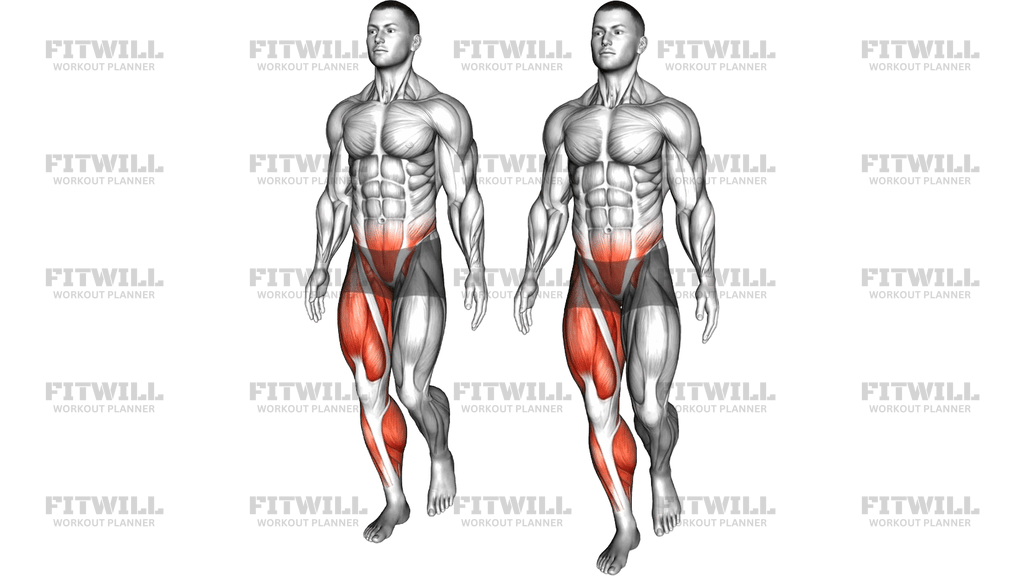
The main work comes from the quadriceps and calves, which drive the take-off and cushion each landing, while the glutes and hamstrings control the hip as you decelerate. Just as important, the smaller muscles around the ankle and hip work overtime to keep you stacked over one foot as the direction changes under you.
Setup matters more than speed here. Pick a firm, non-slip surface with clear space in all four directions, keep the non-working leg slightly behind or beside you, and start each hop from a quarter-squat stance with your weight mid-foot. A tall, braced torso lets you change direction cleanly; a collapsed chest pulls your landing mechanics apart.
Execute each hop as a quick, controlled bounce: push the floor away, land softly on the ball of the foot with a bent knee, and immediately redirect into the next direction. Think of staying low and springy rather than jumping for height. Quality of landing is the whole point of the drill — a quiet, stable foot on every contact.
Use the 4 Way Single Leg Hop near the start of a lower-body session as activation, or at the end of a warm-up before running or jumping workouts. Two to four rounds of a few hops in each direction per leg is plenty; the goal is crisp, accurate contacts, not exhaustion. Stop the set as soon as your landings get noisy or your balance breaks down.
[ Workout Log & Planner ]
Put your next workout in Fitwill
Keep your plan and training log ready when you are.


Instructions
- Stand on a firm, non-slip surface with clear space around you, and shift your weight fully onto one foot, lifting the other foot slightly off the floor behind you.
- Let your arms hang naturally at your sides or hold them in front of your chest for balance, and soften the working knee into a shallow quarter squat with your weight over the middle of the foot.
- Brace your core and keep your chest tall and your gaze forward so your torso stays stacked over the working hip.
- Hop forward a short distance — roughly the length of your own foot to shin — and land on the same leg on the ball of your foot with the knee bent and tracking over the toes.
- Without pausing, hop backward to your starting spot, absorbing the landing the same quiet way.
- Next, hop out to the side, stick the landing briefly, then hop back across the midline to the opposite side, and return to center.
- Keep every hop low and quick; the aim is a soft, controlled contact with the foot pointing straight ahead each time you land.
- Breathe steadily throughout — exhale on each take-off, inhale on the landing — rather than holding your breath.
- Complete the planned number of hops in all four directions, then set the free foot down, reset your stance, and switch to the other leg.
- Rest briefly between legs, and end the set as soon as your landings become loud or your balance starts to drift.
Tips & Tricks
- If you wobble on every landing, you are probably hopping too far — cut the distance in half until you can stick each contact before progressing.
- Listen to your landings: a slapping or stomping sound means the calf and quad are not absorbing the landing, so lower the height and think of landing like a spring, not a stamp.
- Watch where your working knee points on lateral hops; if it caves inward, cue yourself to push the knee out over the pinky toe as you land.
- Keep the lifted leg still and slightly behind you — swinging it around for momentum is a sign the working hip is doing less than it should.
- If you keep drifting forward on backward hops, you are leaning your torso; re-brace your core and imagine your head traveling straight up and down.
- Do this drill before heavy lifting or running, not after fatigue, because sloppy single-leg landings under tired legs are where form falls apart fastest.
- Start on a stable floor before trying the drill on grass, a mat, or an unstable surface — the softer the surface, the harder the ankle stabilizers work.
- Count contacts, not time; three to five clean hops per direction per leg builds better control than rushing a long set.
- If one side is clearly weaker or noisier, give the weaker leg one extra set and always start your rounds on that side while you are fresh.
Frequently Asked Questions
What muscles does the 4 Way Single Leg Hop work?
The quadriceps and calves drive the take-offs and absorb the landings, while the glutes and hamstrings control the hip during deceleration. The small stabilizers around the ankle and hip work continuously to keep you balanced as the direction changes.
How far should I hop in each of the four directions?
Start with short hops of roughly one to two foot-lengths in each direction. The distance should allow you to land quietly and stick the contact without your upper body folding forward.
Is the 4 Way Single Leg Hop suitable for beginners?
Beginners can do it, but it is wise to first master two-leg hops and static single-leg balance. Starting with small, low hops and holding each landing for a beat makes the drill much more manageable.
Why hop in four directions instead of just straight ahead?
Straight-line hopping only trains forward-backward force, while the four-way version adds lateral and rotational demands. This better matches the cutting, sidestepping, and uneven footing you encounter in sport and everyday life.
How many sets and hops should I do?
Two to four rounds of three to five hops in each direction per leg is a solid dose. Stop the set when your landings become loud or your balance breaks down, because quality contacts are what build stability.
What is the most common mistake in this drill?
The most common errors are hopping for height instead of control, letting the knee cave inward on side hops, and letting the torso lean forward. Fix them by staying low, pushing the knee over the toes, and keeping your chest tall.
Can I use the 4 Way Single Leg Hop for knee or ankle rehab?
It is frequently used in later-stage rehab to rebuild single-leg landing control, but you should only add it when cleared by a physical therapist or doctor and when you can already hop and land on two legs without pain.
What can I substitute if single-leg hopping is too hard right now?
Try two-leg hops in four directions, single-leg hops straight ahead only, or step-up and single-leg balance drills. Once those feel stable and quiet, progress back to the four-way version.
Should my free leg do anything during the hop?
Keep it lifted slightly off the floor and relatively still behind or beside your body. Swinging it for momentum reduces the balance and stabilizing demand on the working leg.
What surface is best for the 4 Way Single Leg Hop?
A firm, non-slip surface such as a gym floor is ideal to start. Grass or a thin mat adds stabilizing difficulty and can be gentler on the joints, but only introduce it once your landings are consistently controlled.