Resistance Band Standing Arms Circle
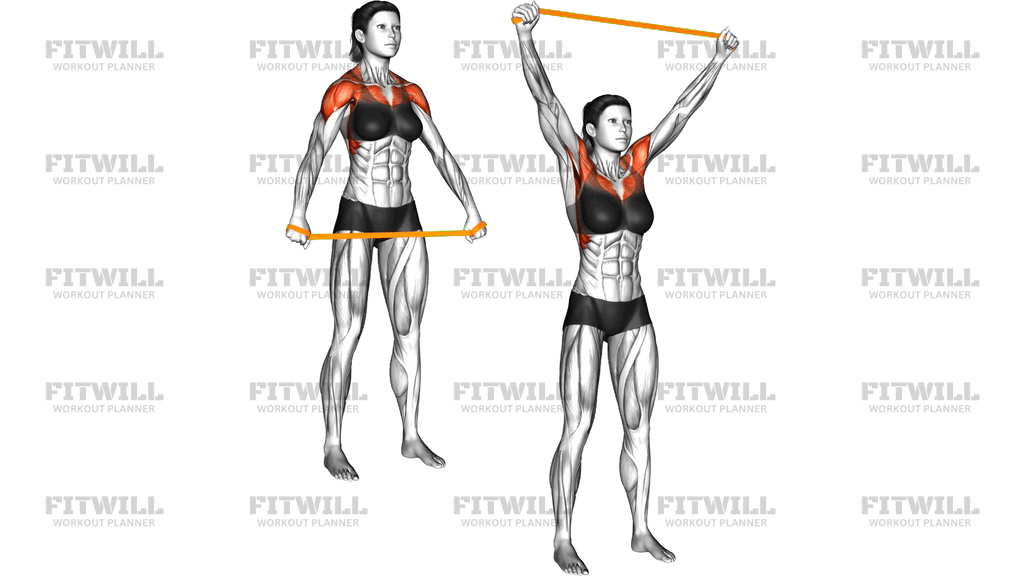
Resistance Band Standing Arms Circle is a shoulder-focused mobility and activation drill where you hold a resistance band taut between both hands and sweep your straight arms in a wide arc from your thighs up overhead and back down, tracing a large circle in front of your body. The band stays under tension the entire time, so your shoulders work against resistance through the whole path rather than only where gravity pulls, which is what separates this from a bodyweight arm circle.
The setup is simple but the tension choice matters. You stand with feet about hip-width apart, grip the band a little wider than shoulder-width, and keep it pulled snug so there is visible resistance before you even start moving. If the band is too loose, your arms just drift through empty space; if it is too tight, your elbows bend and your shoulders shrug up toward your ears to finish the arc. Start with a light band and only progress once you can keep your arms straight and shoulders relaxed through every rep.
This movement mainly trains the deltoids, especially the front and middle portions, with the upper chest assisting as the arms travel up and the upper back and traps stabilizing the shoulder blades. Because the arms stay long and move through a broad range, it doubles as a dynamic warm-up for pressing, pulling, or throwing, and it is a common choice for desk workers whose shoulders feel stiff after long hours of sitting.
To execute it well, brace your core softly, keep your ribs stacked over your pelvis, and move at a tempo you can control — roughly two to three seconds up, two to three seconds down. Breathe in on the way up and out on the way down, and let the circle come slightly in front of your body rather than forcing your arms behind your head at the top. Your torso should stay upright; if you find yourself leaning back or arching your lower back to get overhead, that is a sign the band is too heavy or your range is being forced.
Practical use cases include pre-workout shoulder activation, rehab-style overhead mobility work, and low-impact upper body training at home where a full weight setup is not available. Because the resistance comes from the band itself, you can easily adjust difficulty by widening or narrowing your grip — a wider hold increases tension, a narrower hold eases it — which makes the exercise easy to scale for nearly anyone.
[ Workout Log & Planner ]
Put your next workout in Fitwill
Keep your plan and training log ready when you are.


Instructions
- Stand tall with your feet hip-width apart and hold a resistance band in both hands with an overhand grip, hands set a little wider than shoulder-width so the band hangs with slight tension at thigh level.
- Pull the band taut by gently drawing your hands apart until you feel steady resistance across the band while your arms hang straight at your sides.
- Brace your core lightly, keep your chest tall, and relax your shoulders down away from your ears.
- Keeping both elbows locked straight, sweep your arms out to the sides and up in a wide arc until your hands meet overhead and the band stretches above your head.
- Pause briefly at the top with the band still under tension and your biceps alongside your ears.
- Reverse the arc in the same wide path, lowering your straight arms back down to your thighs without letting the band go slack.
- That full up-and-down sweep counts as one circle; repeat for your target number of repetitions, then reverse direction if you are circling backward or continue forward circles as programmed.
- Inhale as your arms rise and exhale as they lower, keeping the breath smooth rather than held.
- Between sets, reset your grip width and re-tension the band before starting the next set so every rep starts from the same position.
Tips & Tricks
- If your shoulders shrug toward your ears as your arms pass shoulder height, the band is likely too strong — switch to a lighter band or widen your grip to reduce tension.
- Bent elbows are the most common breakdown on this drill; straighten your arms fully and treat the arms as one long lever from shoulder to hand.
- Do not let the band go slack at the bottom of each circle, because the tension-free zone is where form quietly slips and the shoulders stop working.
- Keep your lower back quiet: if you arch and lean back to force your hands overhead, reduce the range slightly instead of compensating with your spine.
- Circle in a smooth, even tempo rather than whipping your arms; momentum on a banded circle does nothing except yank your shoulder joints at the top and bottom.
- Your hands should travel in a wide arc out to the sides, not straight up in front of your chest — a narrow path turns the drill into a band front raise and changes which muscles work.
- If one shoulder lifts higher than the other at the top, slow down and watch yourself in a mirror to even out the path; uneven circles usually point to a tighter side.
- Wrist discomfort usually means you are bending at the wrist to chase the band; keep your knuckles roughly aligned with your forearm throughout the circle.
Frequently Asked Questions
Which muscles does Resistance Band Standing Arms Circle work?
The shoulders are the primary movers, especially the front and middle deltoids, with the upper chest assisting on the way up and the upper back and traps stabilizing the shoulder blades throughout the circle.
How wide should my grip be on the band for Resistance Band Standing Arms Circle?
Start slightly wider than shoulder-width. A wider grip stretches the band more and increases resistance, while a narrower grip makes the circle easier, so you can tune the difficulty just by moving your hands.
Is Resistance Band Standing Arms Circle good for beginners?
Yes, it is one of the friendliest shoulder drills to start with because a light band offers gentle resistance and the movement path is natural. Beginners should favor a light band and slow, controlled circles over heavy tension.
Should I circle my arms forward or backward in this exercise?
Both directions work — forward circles emphasize the front of the shoulders and chest on the way up, while backward circles feel great for opening the chest and shoulders. Many people do half the set in each direction.
Why do my elbows keep bending during Resistance Band Standing Arms Circle?
Bent elbows almost always mean the band tension is too high for your current shoulder strength or mobility. Use a lighter band or widen your grip so you can keep the arms straight through the entire arc.
Can I use this exercise as a warm-up before pressing or pulling?
Absolutely — a set or two of controlled circles with a light band raises blood flow to the shoulders and takes them through a large range of motion, which makes it a solid lead-in to overhead presses, band pull-aparts, or upper body training in general.
How many reps should I do of Resistance Band Standing Arms Circle?
For warm-up purposes, 10 to 15 smooth circles per direction works well. As a standalone strengthening set, aim for 12 to 20 reps with a band that lets you keep strict form on every circle.
Is it safe if my shoulders click or feel pinched during the circles?
Some harmless clicking can happen, but if you feel sharp pain or pinching, shrink the circle so your hands stop below the uncomfortable range, reduce the band tension, or switch to a smaller arc and consult a professional if the discomfort persists.
What can I substitute if I do not have a resistance band?
Bodyweight arm circles are the closest substitute and still work as a warm-up, though you lose the constant tension. Light dumbbells or small plates can add resistance, but the band's outward pull is what makes this version unique, so a band is worth having.