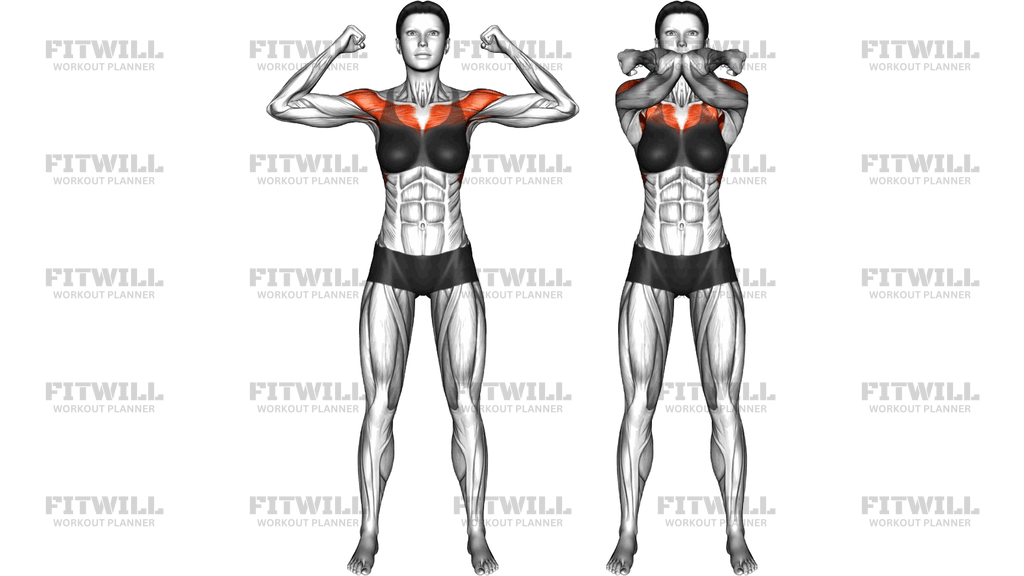
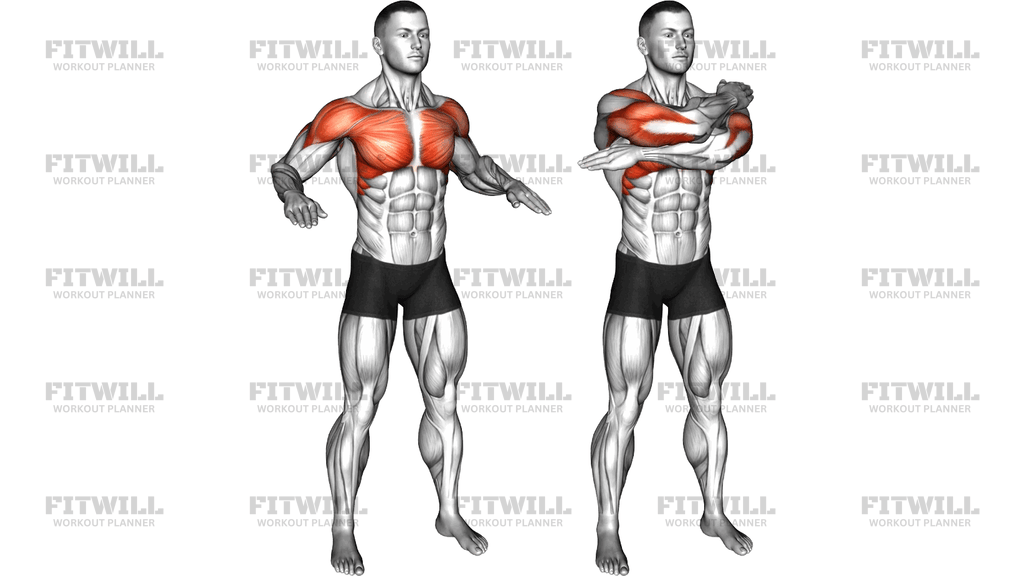
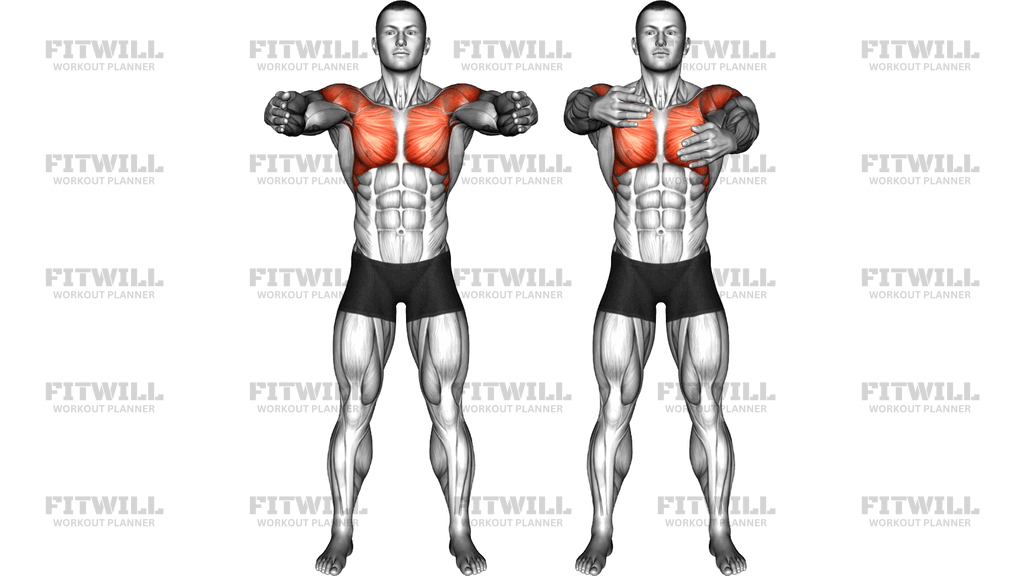
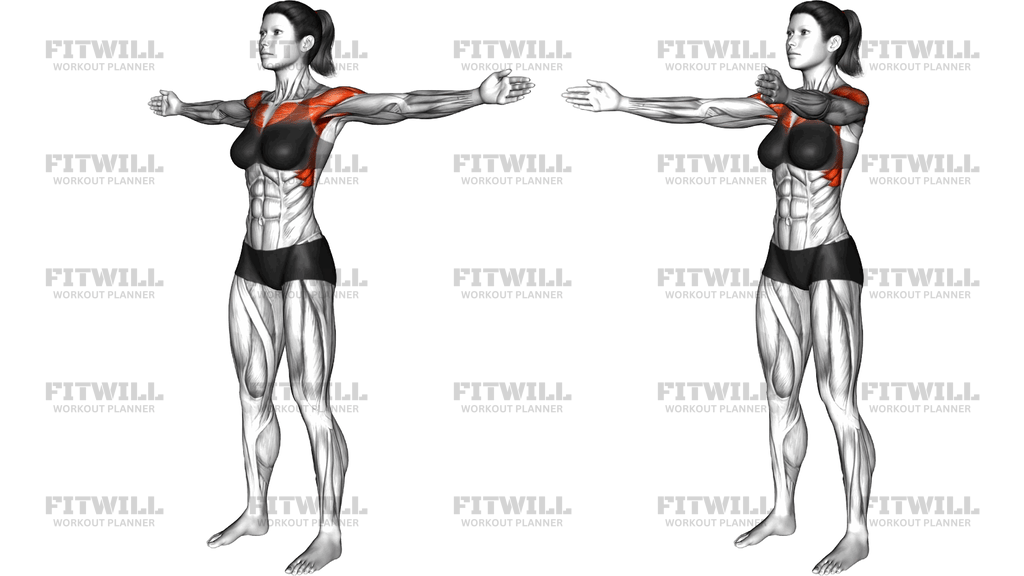
Resistance Band Standing Chest Press
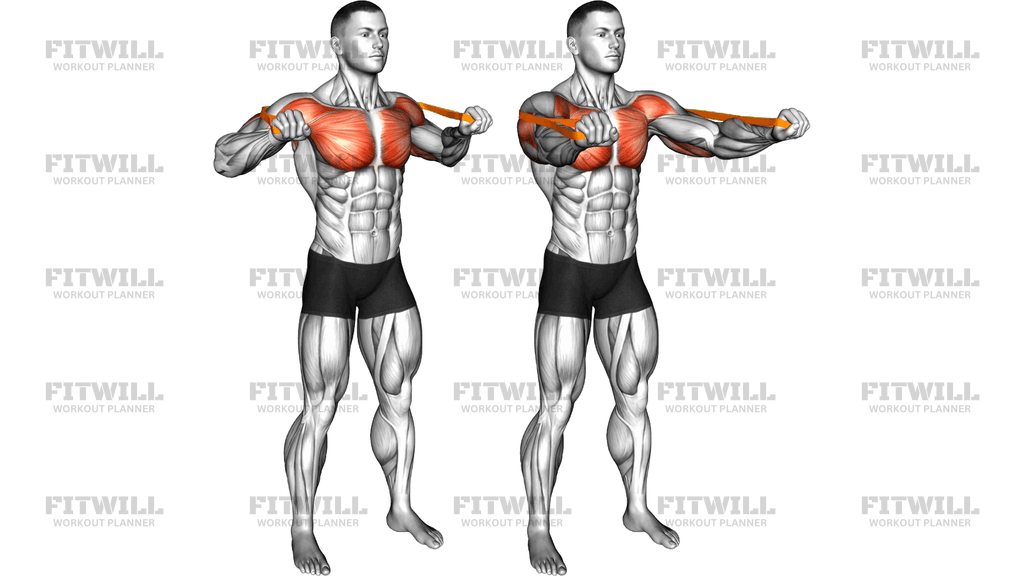
The Resistance Band Standing Chest Press is a horizontal pressing movement performed upright, with the band looped behind your upper back and both ends gripped at chest height. Instead of pushing against a loaded sled or dumbbells, you push against the elastic tension of the band, which gets heavier the further your hands travel from your chest. That changing resistance profile is the defining feature of the exercise and the main reason lifters choose it over a traditional bench press.
The movement targets the pectorals as the prime movers, with the front delts assisting at the shoulder and the triceps extending the elbows at the end of each press. Because you are standing rather than lying back, your core has to brace to stop the band from pulling you backward, and your shoulder blades are free to move forward as you press. That scapular movement is something a bench press does not allow, and it makes this version useful for training the serratus anterior and the muscles that control the shoulder blade.
Setup matters more here than with most pressing variations. The band must sit across the upper back at roughly armpit level so the pulling direction matches the line of a chest press. If the band rides too high toward your neck or too low toward your mid-back, the resistance angle shifts and the shoulders end up doing work the chest should be handling. Grip width should mirror the position you would use on a press: hands slightly wider than the elbows, forearms stacked vertically at the start.
Execution is straightforward but deserves attention. From the chest-height starting position, press both hands forward and slightly toward each other until the arms are extended at chest height, squeeze briefly, then let the hands travel back under control until they reach the sides of the chest again. Exhale on the press, inhale on the return, and keep the wrists straight the whole way.
This exercise suits home lifters with no bench, travelers working in hotel rooms, anyone in rehab or return-to-training phases who needs joint-friendly pressing, and experienced gym-goers looking for a high-rep finisher after barbell or dumbbell pressing. Because band tension scales with band thickness and stretch, it is easy to match the difficulty to your level by adjusting grip position on the band or stepping to change how much slack you start with.
[ Workout Log & Planner ]
Put your next workout in Fitwill
Keep your plan and training log ready when you are.


Instructions
- Stand tall with your feet about hip-width apart and place the middle of a resistance band across your upper back, letting it sit just under the armpits.
- Grip one end of the band in each hand at chest height, with elbows bent and tucked slightly below shoulder level and palms facing the floor or angled inward.
- Take up the slack until you feel light tension with your hands beside your chest, then brace your core and pull your ribs down so the band cannot arch your lower back.
- Press both hands forward in a slight inward arc, as if pushing a sled away, keeping the band pressed against your upper back throughout.
- Finish with arms fully extended at chest height, hands roughly in line with the middle of your chest, and squeeze the chest for a moment.
- Slowly let your hands travel back toward your chest, resisting the band's pull instead of letting it snap your arms home.
- Exhale as you press forward and inhale as your hands return to the starting position.
- Complete your reps, then release the tension in a controlled way by bringing one hand across your body before letting go of the other end, so the band does not snap against you.
Tips & Tricks
- If the band slips up toward your neck during the set, widen your grip or reposition it slightly lower on the shoulder blades; a band riding near the neck turns the press into a shoulder-dominant movement.
- Keep your elbows from flaring straight out to the sides. Aiming them about 45 degrees down from shoulder level protects the shoulder joint and keeps the pecs in their strongest line.
- Do not lean your torso forward to help finish hard reps. If your chest starts collapsing toward your hands, the band is too strong or you have too little slack; switch to a lighter band instead.
- Straighten the wrists at the top. Bent-back wrists at full extension are a sign the band tension is pulling your hands out of alignment, which strains the forearms over time.
- To make the exercise harder without changing bands, choke up your grip to shorten the band or start with more pre-stretch before the first press.
- Let the shoulder blades glide forward at the end of each press rather than holding them pinned; this protraction trains the serratus anterior and is one of the advantages of standing band pressing.
- If one side lags behind the other, slow down and check that both hands travel the same distance. Uneven band length in your grip is a common cause of one-sided pressing.
- Stand on the band's slack or shorten it if the excess length dangles behind your legs, where it can catch under your feet on the return.
Frequently Asked Questions
Which muscles does the Resistance Band Standing Chest Press work?
The chest is the primary muscle, with the front delts assisting the press and the triceps straightening the elbows. The core and serratus anterior also work to keep your torso stable and let the shoulder blades move forward at the top.
How is the Resistance Band Standing Chest Press different from a bench press?
The resistance increases as your arms extend instead of staying constant, and you are upright rather than lying down, so your shoulder blades are free to move forward. That makes it easier on the shoulder joint in many cases and adds training for the muscles around the shoulder blade.
Where exactly should the band sit during the Resistance Band Standing Chest Press?
Across the upper back, just under the armpits at about bra-line or upper chest-blade level. This keeps the band's pull aligned with the direction of a chest press so the pecs, not the shoulders, do most of the work.
Is the Resistance Band Standing Chest Press good for beginners?
Yes. It is one of the most forgiving pressing patterns because band tension is smooth, there is no weight to drop, and difficulty is easy to adjust by changing band thickness or grip position. Beginners should start with a light band and focus on keeping the ribs down and wrists straight.
Why do my shoulders feel the Resistance Band Standing Chest Press more than my chest?
This usually means the band has ridden up toward your neck or your elbows are flaring out to the sides. Lower the band to just under the armpits, angle your elbows about 45 degrees from your torso, and press along a line in front of the middle of your chest.
Can I do the Resistance Band Standing Chest Press with one arm at a time?
You can, but the band will try to rotate your torso toward the working side, so brace your core hard and consider holding the non-working hand against your chest for stability. Alternating arms is a good way to expose and fix side-to-side strength differences.
What can I use instead of a Resistance Band Standing Chest Press?
A cable machine chest press or fly is the closest substitute, followed by push-ups, which train a similar horizontal pressing pattern. Dumbbell floor presses work if you have no standing option but no bench.
How do I make the Resistance Band Standing Chest Press harder?
Use a thicker band, shorten it by choking up your grip, or start each rep from more pre-stretch. You can also slow the return phase to three or four seconds, since the eccentric portion is where you feel the band pulling you back.
Is it safe to let the band snap back quickly between reps?
No. Letting the band yank your hands back removes the eccentric portion of the rep and can pull you off balance or whip the band into your arms. Always control the return and release the tension carefully at the end of the set.