Resistance Band Bent Over Reverse Fly
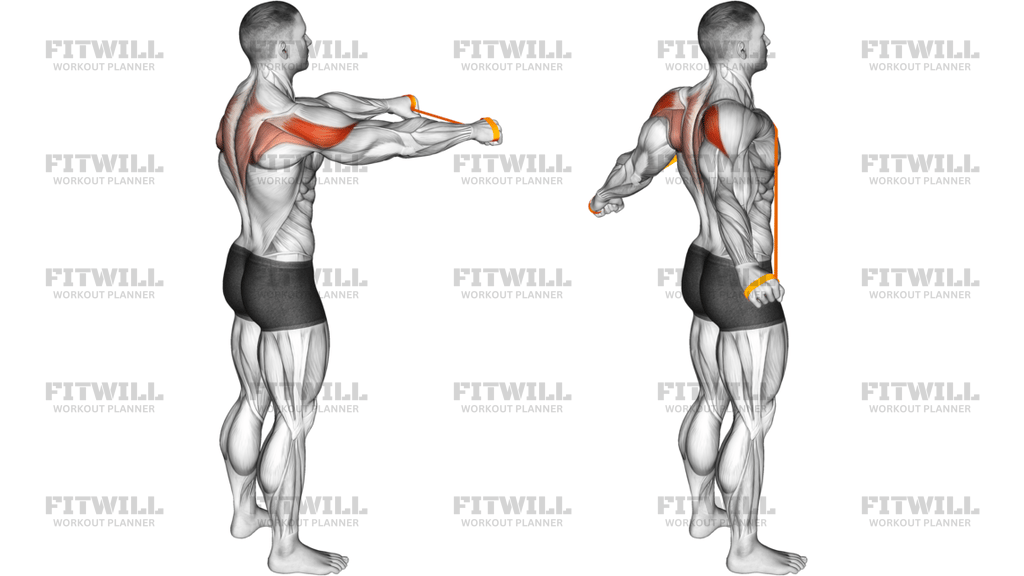
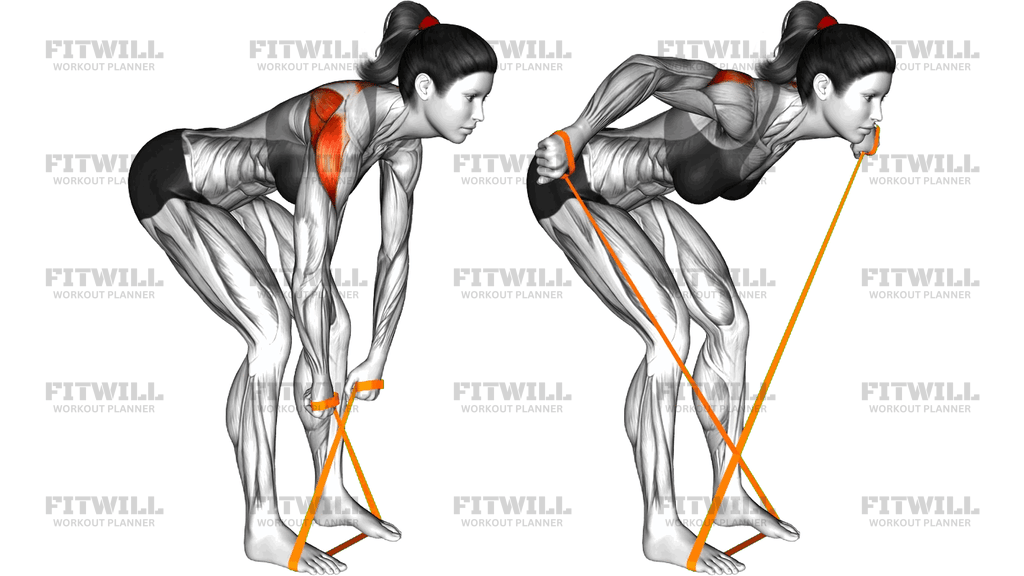
The Resistance Band Bent Over Reverse Fly is a hinged, bent-over movement that trains the rear shoulders and upper back by sweeping the arms out wide against band tension. You anchor a resistance band under both feet, hinge forward at the hips until your torso is close to parallel with the floor, and raise your arms out to the sides until they reach roughly shoulder height. The band provides resistance that gets heavier as your arms rise, which matches the strength curve of the rear delts nicely.
This exercise fills a gap that most training programs leave open. Pressing and pulling exercises tend to emphasize the front of the shoulders and the lats, while the rear delts and rhomboids get comparatively little direct work. Because these muscles control shoulderblade retraction and rearward arm movement, they matter for balanced shoulder development and for maintaining healthy, stable shoulders when you press overhead or train chest.
The setup is the whole game here. Your hinge position determines how much your lower back works and how honestly your rear delts have to do their job. Anchor the band firmly under both feet, keep a soft bend in the knees, and push your hips back until your chest angles toward the floor with a flat, supported back. If you round forward or let the hinge collapse as you fatigue, the movement stops being a rear delt exercise and becomes a lower back endurance test.
Execution is simple but easy to rush. Start with the arms hanging straight down, elbows soft, and open the arms out to the sides in a wide arc rather than pulling them back behind you. Lead with the elbows slightly, stop at or just above shoulder height, and squeeze the shoulderblades together for a beat before lowering under control. The band should feel hardest at the top, so a brief pause there is where the set is actually won.
Because it needs nothing more than a band and a little floor space, this movement fits nearly anywhere. It works well as a warm-up before upper body sessions, as a high-rep finisher after pressing work, or as a standalone answer for people who sit at a desk and never train the muscles that pull their shoulders back. Beginners can start with a light band and a partial range, while more experienced lifters can slow the tempo or add a pause to make a modest band feel surprisingly demanding.
The main safety points concern your back and your range. Keep the hinge tall and the spine neutral, and if your lower back starts doing the work, stand up, reset, and continue with a shorter set. Stop the arm raise at shoulder height rather than forcing the arms higher, and never let momentum or a bouncing torso swing the band into position.
[ Workout Log & Planner ]
Put your next workout in Fitwill
Keep your plan and training log ready when you are.


Instructions
- Place the resistance band under the middle of both feet, standing with feet roughly hip-width apart so the band cannot slip off during the set.
- Grip one end of the band in each hand. For more tension, cross the band between your legs and hold the opposite end in each hand; for less tension, hold the same side in each hand.
- Hinge at the hips and push your glutes back until your torso is angled 45 degrees or lower toward the floor, with a soft knee bend and a flat back.
- Let the band hang so your arms point straight down, palms facing in toward each other, elbows slightly bent.
- Brace your core as if bracing for a light punch, and keep your neck in line with your spine by looking at a spot on the floor a foot or so in front of you.
- Raise both arms out to the sides in a wide arc, leading with the elbows, until your arms reach about shoulder height.
- Pause for one second at the top and squeeze your shoulderblades toward each other without shrugging up toward your ears.
- Lower your arms slowly back down along the same wide path until the band returns you to the hanging start position.
- Exhale as you raise the arms, inhale as you lower them.
- Finish the set by standing up slowly with a flat back before letting go of the band, so the band releases under control instead of snapping your torso upright.
Tips & Tricks
- If your torso rises as you lift the band, the weight of the set has shifted to your lower back. Rest, then continue with fewer reps and steady torso height.
- Crossing the band under your feet roughly doubles the starting tension. If your shoulders shake before mid-height, use the uncrossed grip or a lighter band first.
- Aim your elbows slightly back and out rather than straight out from the shoulders. This keeps the rear delts as the drivers instead of the side delts.
- Do not pull the band back behind your hips. A reverse fly travels in a wide sideways arc; if your hands drift behind your body, reduce the range.
- Stop at shoulder height. Pulling higher than that turns the exercise into a trap-heavy shrug-off and adds little to the rear delts.
- Keep a small bend in the elbows the entire time and do not change it. Straightening and re-bending the elbow turns the set into a triceps and grip exercise.
- If your shoulders creep toward your ears at the top, consciously press them down and away before each rep begins.
- Grip the band with your fingers relaxed rather than strangling it. A death grip fatigues your forearms before the rear delts ever get their work.
- Choose a band that lets you control the last third of the lowering phase. If the band yanks your arms down, the eccentric is doing the training for you.
Frequently Asked Questions
What muscles does the Resistance Band Bent Over Reverse Fly work?
The rear shoulders are the primary movers, with the rhomboids and mid-traps working to pull the shoulderblades together. Your lower back and core stay active the whole time to hold the bent-over position.
Why should I cross the band under my feet in the Resistance Band Bent Over Reverse Fly?
Crossing the band increases the tension at the start of each rep, which is helpful when your band is very light. If the starting position already feels tight, hold the same side in each hand instead for a more manageable setup.
Is the Resistance Band Bent Over Reverse Fly good for beginners?
Yes, as long as the hinge position is comfortable. Beginners should start with a light band, keep the torso at a higher 45-degree angle, and use the uncrossed grip until the rear delts feel the work clearly.
How far should I raise my arms in the Resistance Band Bent Over Reverse Fly?
Stop when your arms reach about shoulder height and form a wide T with your torso. Going higher shifts the effort into the upper traps and adds strain without improving rear delt involvement.
My lower back gets tired before my shoulders during the Resistance Band Bent Over Reverse Fly. What should I change?
Raise your torso to a higher angle, push your hips back further so your skeleton supports you instead of your back muscles, and take shorter sets. You can also sit on a bench and lean onto your thighs for extra support.
How is the Resistance Band Bent Over Reverse Fly different from a dumbbell reverse fly?
The band is hardest at the top of the rep and easiest at the bottom, which is the opposite of dumbbells. That makes the top-end squeeze the challenge and often makes lighter band work feel harder than expected.
How many reps should I do of the Resistance Band Bent Over Reverse Fly?
Sets of 12 to 20 reps work well, since the movement targets small muscles with modest resistance. Choose a band that leaves two or three clean reps in reserve at the end of each set.
Can I do the Resistance Band Bent Over Reverse Fly every day?
Light-band, moderate-rep sessions can be frequent because the rear delts recover quickly, but treat heavier or high-tension sets like normal strength training and give them a day or so before repeating.
What can I use if I do not have a band for the Resistance Band Bent Over Reverse Fly?
Light dumbbells or even filled water bottles work with the same hinge and arc. You can also use cable handles set low, though you will need to stand between the pulleys to match the outward path.
Is it safe to do the Resistance Band Bent Over Reverse Fly with shoulder pain?
Mild muscle effort is normal, but sharp or pinching pain is a signal to stop. Reduce the range to pain-free heights, slow the tempo, and check with a professional if the discomfort keeps returning.