Dumbbell Lu Raise
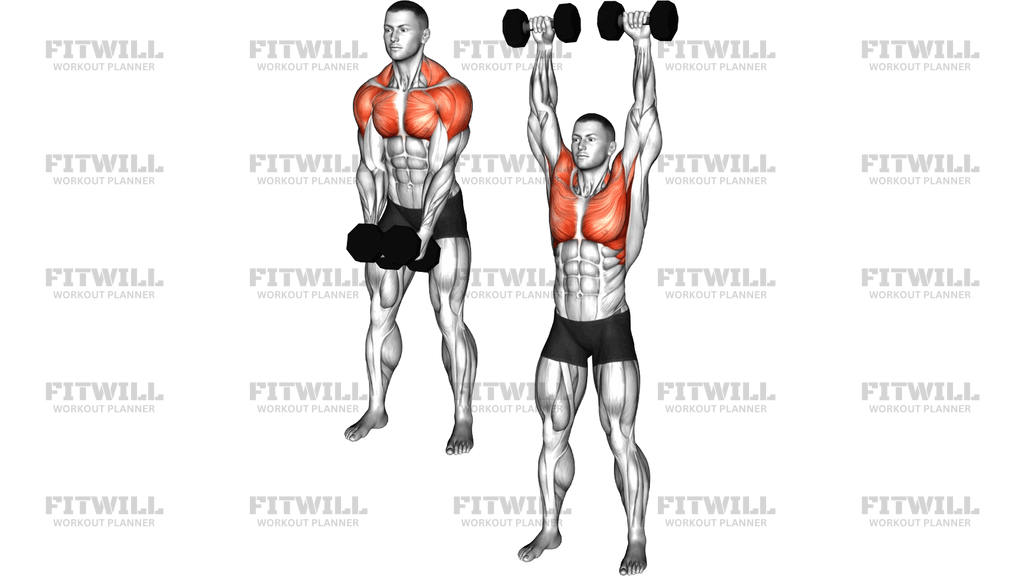
The Dumbbell Lu Raise is a straight-arm front raise that carries the dumbbells all the way from your thighs to a locked-out overhead position. Named after the Chinese weightlifter Lu Xiaojun, it takes the ordinary front raise and stretches it through a much longer range, so your front shoulders work from the bottom of the lift to full extension overhead. The arms stay nearly straight the entire time, which forces the shoulders and upper chest to do the moving instead of letting the elbows and forearms take over.
This exercise suits lifters who want stronger, more stable overhead pressing, and it is especially popular with Olympic weightlifters and CrossFit athletes because the overhead finish closely mirrors the lockout of a snatch or jerk. Bodybuilders use it as a burnout or high-rep finisher for the front delts, and general lifters find it useful for building the shoulder endurance that pressing, carrying, and throwing all depend on.
The main work is done by the front delts, with the upper portion of the chest assisting as the arms travel up and past shoulder height, and the upper traps and scapular stabilizers controlling the shoulder blades as the arms reach overhead. Because the arms stay straight, the grip and forearms also get a surprising amount of work just holding the dumbbells steady through a long arc.
Setup matters more than it looks. Stand tall with the dumbbells resting against the front of your thighs, feet about hip-width apart, and your ribcage stacked over your pelvis. If you arch your lower back or lean back as the weights rise, you turn a shoulder exercise into a lower-back exercise. Bracing your abs before the first rep sets the frame for everything that follows.
Execution is simple but demanding. Raise both dumbbells forward and up in a smooth arc with straight arms until your hands are directly over your shoulders, then lower them under control back to your thighs. The temptation is to swing or use momentum once fatigue sets in, so treat the last few reps with the same care as the first. Choose a weight you can lift cleanly for your target reps; this movement punishes ego weights.
Common use cases include accessory work after presses, prehab for overhead athletes, and shoulder conditioning circuits. Because each rep travels through a long range with a light-to-moderate load, it pairs well with heavier pressing movements and adds volume to the shoulders without hammering the elbow joints the way some pressing variations can.
[ Workout Log & Planner ]
Put your next workout in Fitwill
Keep your plan and training log ready when you are.


Instructions
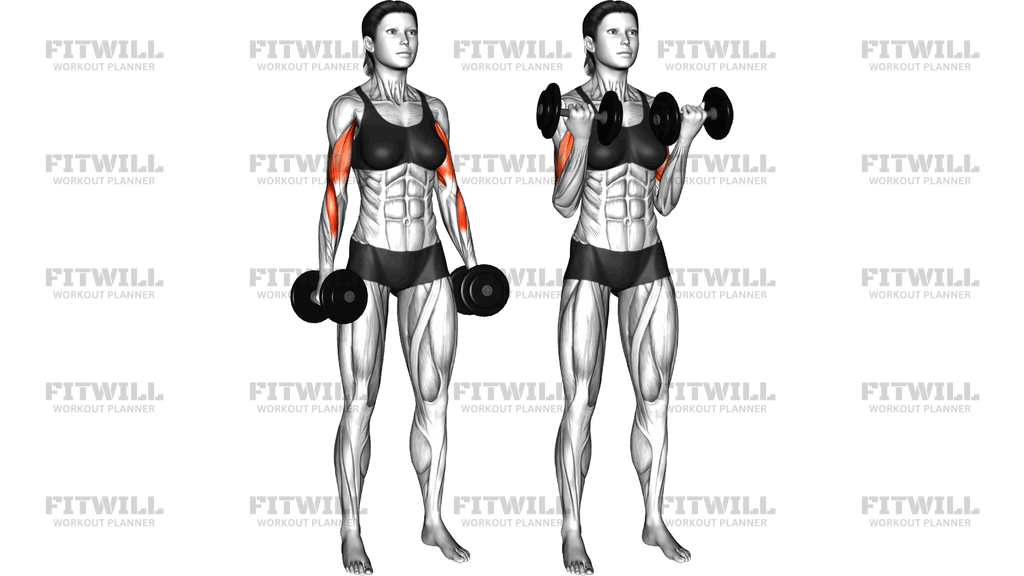
- Stand with your feet hip-width apart and hold a dumbbell in each hand with an overhand (pronated) grip, letting the dumbbells rest against the front of your thighs.
- Roll your shoulders back, keep your arms straight with a soft bend in the elbows, and set your ribcage directly over your hips so you are not leaning back before you even start.
- Brace your abdominal muscles and squeeze your glutes lightly to lock your torso in place for the whole set.
- Raise both dumbbells forward and up in a smooth arc, keeping the weights in front of your body and roughly shoulder-width apart.
- Continue lifting until your arms are fully extended directly overhead, with your biceps near your ears and the dumbbells stacked over your shoulders, not drifting forward.
- Pause briefly at the top, keeping your shoulder blades stable rather than shrugging the weights up with your traps.
- Lower the dumbbells along the same arc in front of you with control until they touch or nearly touch your thighs again.
- Exhale as you raise the weights and inhale as you lower them, keeping your breathing steady throughout the set.
- Reset your brace between reps if your torso position slips, and stop the set when your form breaks rather than when the weights stop moving.
Tips & Tricks
- The most common mistake is turning this into a momentum swing by leaning back as the dumbbells pass chest height. If your torso rocks, drop the weight by one size and rebuild.
- Keep the elbow bend minimal and constant. Once the elbows start bending and straightening, you are doing a partial press instead of a Lu Raise and the front delts stop owning the movement.
- Finish with the dumbbells directly over your shoulders, not out in front. An overhead finish keeps the upper back and shoulders engaged, while a forward finish strains the lower back.
- Control the descent just as much as the lift. Letting the dumbbells drop toward your thighs wastes half the rep and is the fastest way to irritate the shoulder.
- Your grip will often fail before your shoulders do on this exercise. Chalk or a firmer grip helps, but if your forearms are burning early, that is a sign to slow the tempo rather than rest mid-set.
- Keep the dumbbells a few inches apart rather than clanging them together at the top; touching them at lockout usually means your shoulders have collapsed inward.
- This works well as a finisher after overhead or bench pressing with light weight and higher reps, around 12-20 per set, rather than as a heavy first exercise.
- If your shoulders pinch at the top, narrow the arc slightly and make sure your palms stay facing back or neutral at the start, not rotated forward.
- Warm up the shoulders with a few arm circles or band pull-aparts first, since straight-arm raises from the thigh put a long lever load on a cold joint.
Frequently Asked Questions
What muscles does the Dumbbell Lu Raise work?
The front shoulders do most of the work, with the upper chest assisting as the arms pass shoulder height. The upper traps and the muscles that stabilize the shoulder blades stay active through the overhead finish.
How is the Dumbbell Lu Raise different from a normal front raise?
A standard front raise stops around eye or shoulder height, while the Lu Raise continues with straight arms all the way to a locked-out overhead position. That longer range adds work for the shoulders at lockout and keeps the upper back engaged throughout.
Why do my arms have to stay straight during the Dumbbell Lu Raise?
Straight arms turn the dumbbells into a long lever, which forces the front delts to move the load instead of the elbows and triceps. Bending the elbows shortens that lever and turns the movement into a partial dumbbell press.
Is the Dumbbell Lu Raise good for beginners?
Yes, as long as the weight is light and the range is controlled. Beginners should master the standing front raise first, then extend the range overhead once they can keep their lower back from arching.
Why does my lower back feel the Dumbbell Lu Raise?
That usually means you are leaning back or arching to help the dumbbells overhead. Brace your abs, squeeze your glutes, and slightly reduce the weight so your shoulders, not your spine, move the load.
How heavy should I go on the Dumbbell Lu Raise?
This is a leverage-disadvantaged movement, so it needs less weight than presses or lateral raises. Most lifters do best with light-to-moderate dumbbells for 12-20 controlled reps.
Can I do the Dumbbell Lu Raise seated?
Seated versions limit the arc because the dumbbells start at thigh level and your torso cannot assist, but a seated version on a bench is a valid way to remove any leaning or swinging from the lower body.
What can I use instead of dumbbells for the Dumbbell Lu Raise?
A plate held in both hands, a barbell with light plates, or a resistance band anchored under your feet all work. The key is keeping the arms straight and the path in front of the body toward overhead.
Is the Dumbbell Lu Raise safe for the shoulders?
For healthy shoulders with a reasonable weight, yes. If you have a history of shoulder impingement, start with a shorter range that stops below the painful arc and progress overhead gradually, keeping the descent slow.