Dumbbell Standing Side Leg Kick
The Dumbbell Standing Side Leg Kick is a single-leg hip exercise performed upright, with one hand braced on a bench for balance and a dumbbell held in the free hand at your side. From a tall standing position, you sweep one leg back and out to the side in a controlled arc, then bring it back in without letting it touch down between reps. It looks simple, but the balance demand plus the added load makes the standing hip work harder than most bodyweight leg swings ever will.
This movement targets the muscles on the outside of the hip, especially the gluteus medius and upper glute fibers, which control how your femur sits in the hip socket every time you stand, walk, or run. The obliques and deep core also stay busy the whole time, because when one leg leaves the floor and a weight hangs on the same side, your trunk has to fight to stay level. If your hip drops or your torso leans away from the working leg, that is the stabilizing work revealing itself.
The setup matters more than people expect. The bench gives you just enough support to stay honest: light fingertip contact, not a lean. The dumbbell in the hand on the same side as the working leg acts as a counterweight and adds a small lateral pull, which forces the standing hip to resist collapsing inward. Keep your standing knee soft rather than locked, and your ribs stacked over your pelvis.
To execute it well, think of the kick as an arc, not a swing. Drive the leg back and outward from the hip, keeping the toes pointing roughly forward or slightly out, and stop at the height you can reach without your torso tipping sideways. Pause briefly at the top, then lower the leg under control until it hovers just off the floor before starting the next rep. Momentum is the enemy here; a slow, deliberate arc with a light dumbbell beats a fast, sloppy swing with a heavy one.
This exercise fits well as a warm-up activation drill before squats, lunges, or running, and it also works as a focused finisher on lower body days when you want extra hip work without heavy loading. It is particularly useful for people who spend long hours sitting, since seated habits tend to leave the side hips undertrained. Because you hold the bench for support, it is accessible to beginners, but the single-leg balance and loaded offset keep it relevant for more experienced lifters as well.
Keep the volume reasonable and stay honest about the load. A dumbbell you can barely hold will shift your attention away from the hip and toward your grip and shoulder. If you feel the work in your lower back or the outside of your standing knee rather than the side of the working hip, shorten the range and slow the tempo before adding any weight.
Fitwill
Log Workouts, Track Progress & Build Strength.
Achieve more with Fitwill: explore over 9600 exercises with images and videos, access built-in and custom workouts, perfect for both gym and home sessions, and see real results.
Start your journey. Download today!




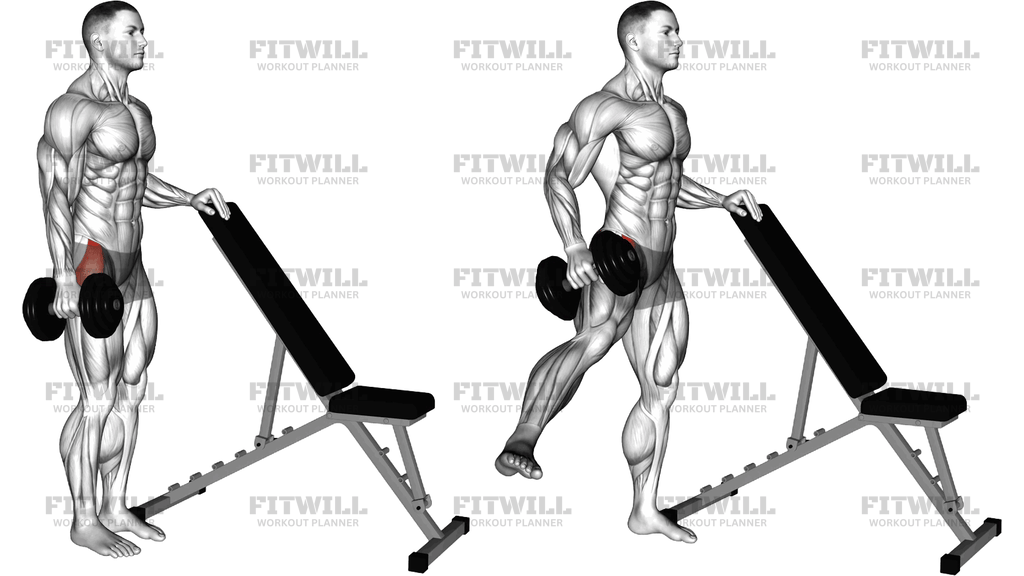
Instructions
- Place an adjustable bench beside you with the top pad at roughly hip height, and stand tall alongside it with your feet together.
- Grip the top of the bench with one hand for light support, and hold a dumbbell in your other hand, letting it hang at your side with your arm relaxed.
- Shift your weight onto the leg nearest the bench and lift the opposite foot slightly off the floor so the loaded side is the free-hanging leg.
- Brace your core, keep your chest tall, and set your shoulders level so your pelvis is not already tilted before you start.
- Sweep the free leg back and out to the side in a smooth arc, leading with the heel and keeping the toes pointing forward or slightly out.
- Stop the kick at the highest point you can reach without your torso leaning away or your hip hiking up, and pause there for a beat.
- Lower the leg slowly back toward the floor, stopping just short of touching down so tension stays on the working hip.
- Exhale as you kick out, inhale as you bring the leg back in, keeping the breathing steady throughout the set.
- Complete all reps on one side, then switch hands on the bench and dumbbell and work the other leg.
Tips & Tricks
- Keep your fingertip contact with the bench light; if you notice yourself dragging on it or leaning into it, the balance work has taken over the hip work.
- The most common mistake is swinging the leg for height. A kick that reaches hip height with a level pelvis trains the side hip far better than one that flies up while your torso tips sideways.
- Watch for your standing knee caving inward as the leg kicks out. Push the standing foot evenly into the floor and keep that knee tracking over the middle of the foot.
- Do not let the hip of the working side hike up toward your ribs to gain range. That substitution shifts work away from the gluteus medius, so think of lengthening the leg rather than lifting it.
- Choose a dumbbell light enough that your grip and shoulder never become the limiting factor. This is a hip exercise, and heavy loads usually just pull your torso out of alignment.
- If you feel it in your lower back, shorten the arc and re-brace your abs. Overarching during the kick is a sign the range has exceeded your control.
- Keep your neck relaxed and your gaze forward rather than looking down at your feet, which helps your balance system stay oriented.
- Slow the lowering phase deliberately. The return arc under tension is where most of the side-hip strength is actually built.
Frequently Asked Questions
Which muscles does the Dumbbell Standing Side Leg Kick work?
The primary work comes from the side of the hip, mainly the gluteus medius and upper glute fibers, as they lift the leg back and out. Your obliques and deep core stabilize your trunk, and the standing leg's hips and calves handle the balance demand.
Why hold the dumbbell in the hand on the same side as the kicking leg?
That placement adds load to the working side and creates a slight lateral pull your standing hip has to resist. It also acts as a counterweight that can make the arc feel smoother once you are comfortable with the balance.
Can beginners do the Dumbbell Standing Side Leg Kick?
Yes, and the bench makes it beginner-friendly because you always have a balance reference. Start with no dumbbell or a very light one and a short arc, then add load only when you can keep your pelvis level for a full set.
How high should I kick my leg during the movement?
Only as high as you can go while keeping your torso upright and your hips level. For most people that lands somewhere between 30 and 45 degrees; chasing more height usually means your trunk is compensating.
Why does my standing leg shake or my knee drift inward?
That is the standing hip fatiguing and losing control of the femur. Reduce the range or the weight, keep a soft bend in the standing knee, and press the whole foot into the floor rather than the outer edge.
What can I substitute if I do not have a bench?
You can brace lightly against a wall, a squat rack upright, or a sturdy chair in the same way. The key is light fingertip support at about hip height, not something you lean your weight into.
Should I do the Dumbbell Standing Side Leg Kick before or after my main lower body lifts?
It works well as an early activation drill before squats, lunges, or running, when you want the side hips switched on. As a loaded finisher, keep the sets short and the tempo slow so fatigue does not wreck your balance.
How many reps and sets should I use?
Two to three sets of 10 to 15 controlled reps per side is a practical range. Because the muscle is small and the movement is balance-dependent, prioritize quality over adding load quickly.
Is it safe for my knees and lower back?
With a soft standing knee, a braced trunk, and a range you control, the movement is low impact on both areas. Stop and tighten up your form if you feel twisting sensations in the standing knee or straining in your lower back.