Bodyweight Row In Doorway
The Bodyweight Row In Doorway turns an ordinary open doorway into a rowing station. You grip both sides of the door frame at roughly waist-to-chest height, lean back with your arms fully extended, and pull your body forward until your chest approaches your hands. It is one of the simplest horizontal pulling patterns available when you have no bar, rings, or suspension trainer at home.
This movement primarily trains the muscles of the upper and mid back — the rhomboids and mid-traps that pull your shoulder blades together — along with the lats, the rear deltoids, and the biceps, which assist as the elbows bend. Your grip and forearms work hard just to hold the frame, and your core keeps your body in a straight line from head to heels as you lean back and pull. The highlighted areas in the movement are the rear shoulder and mid-back region, which is exactly where most people are weakest from desk work and pressing-focused training.
The setup is what makes or breaks this exercise. A sturdy, open doorway with a solid frame is essential — never use a loose door, a frame that moves, or a door that could swing shut on your hands. Your body angle controls the difficulty: the more you lean back and the closer your feet are to the frame, the harder the pull; a more upright torso reduces the load. Because you can adjust that angle in small increments, the movement scales well from complete beginners to stronger trainees.
To execute it well, think of driving your elbows down and back toward your ribs rather than simply bending your arms. Lead the pull with your shoulder blades, keep your wrists neutral, and bring your chest toward the frame until your hands are roughly level with your lower ribs. Lower yourself back to the starting lean under control instead of letting gravity dump you backward — the lowering phase builds strength just as much as the pull.
This is a go-to option for home workouts, travel training, or as a first step toward pull-ups and inverted rows. It also works well as a warm-up activation drill before heavier back training, since a few controlled reps in a doorway wake up the scapular retractors without fatiguing you.
Safety-wise, test the frame with a light pull before committing your full weight, keep your feet planted so you can catch yourself if your grip slips, and stop if you feel any pinching in the shoulders. If balance is an issue, stand closer to the frame and keep one foot slightly ahead of the other for a wider base.
[ Workout Log & Planner ]
Put your next workout in Fitwill
Keep your plan and training log ready when you are.


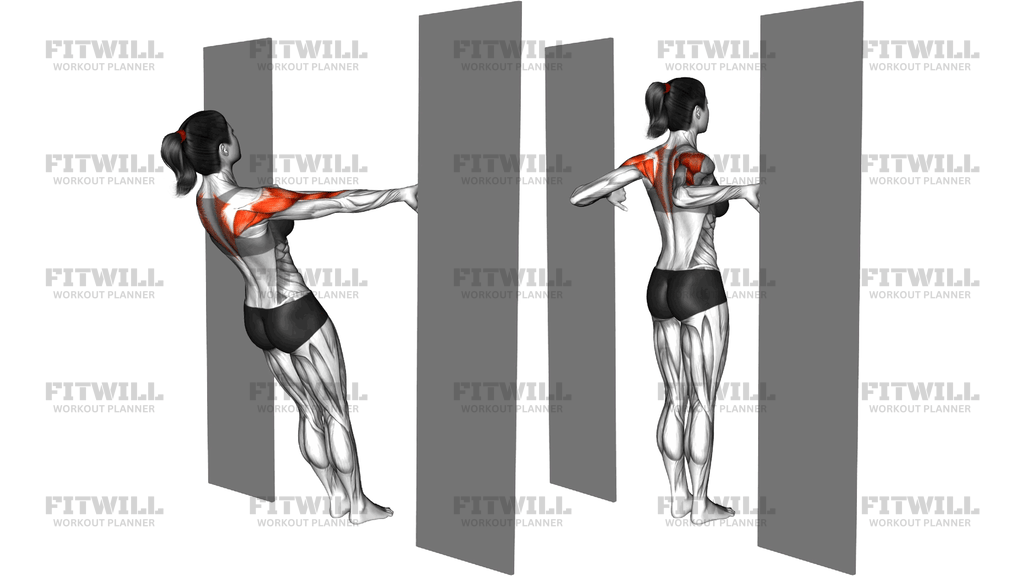
Instructions
- Find an open doorway with a solid, sturdy frame and no door in the way, or stand the door wide open and secure it so it cannot swing closed.
- Stand facing through the doorway and grip both sides of the frame with an overhand grip at roughly waist-to-chest height, hands slightly wider than shoulder width.
- Walk your feet back and lean your body backward until your arms are fully extended and your body forms a straight line from head to heels, feet flat on the floor with one foot slightly forward for balance.
- Brace your core and squeeze your glutes so your hips do not sag or pike as you hang in the lean-back position.
- Pull yourself toward the frame by driving your elbows down and back past your ribs, leading the movement with your shoulder blades.
- Continue until your chest or upper abdomen approaches your hands and your shoulder blades are fully squeezed together.
- Pause for a beat at the closest point, then slowly extend your arms and let your body lean back to the starting position without dropping quickly.
- Exhale as you pull in, inhale as you lower back under control.
- Complete your reps, then step forward carefully and release the frame only once you are upright and stable.
Tips & Tricks
- If your hands slide on a smooth or painted frame, use a towel or wear gloves — a slipping grip is the most common failure point in this doorway setup.
- The most frequent mistake is shrugging your shoulders up toward your ears as you pull; instead, press them down and back so the mid-back does the work.
- Do not let your hips shoot forward or your lower back arch as you pull in — the body should travel as one rigid plank from head to heels.
- Adjust difficulty with foot position before changing anything else: walking your feet closer to the frame and leaning back more makes each rep noticeably harder.
- Bending your wrists so your knuckles face you mid-rep usually means the load is too heavy; drop to a more upright angle and keep the wrists in line with the forearms.
- Keep your elbows around 30–45 degrees from your torso rather than flaring them straight out to the sides — this tracks better with the frame and is friendlier to the shoulders.
- Partial range is a common trap: if you cannot bring your chest close to your hands, reduce the lean instead of cutting the rep short.
- Always test the frame with a light pull before your first full rep, and never do this exercise in a doorway where a door could swing shut on your fingers.
- If your forearms fatigue before your back, that is normal early on — it means your grip is the limiting factor, so build up gradually rather than muscling through with a loose hold.
Frequently Asked Questions
What muscles does the Bodyweight Row In Doorway work?
It primarily targets the mid and upper back — the rhomboids and mid-trapezius — with strong assistance from the lats, rear deltoids, and biceps. Your forearms and grip also work throughout to hold the door frame.
Is the Bodyweight Row In Doorway safe for beginners?
Yes, it is actually one of the most beginner-friendly rowing variations because you control the resistance by adjusting how far you lean back. Start nearly upright, master the pull, and gradually increase the lean as you get stronger.
How do I make the Bodyweight Row In Doorway harder?
Walk your feet closer to the door frame so you lean back at a steeper angle, which places more of your bodyweight on your arms. You can also elevate your heels on a low step or slow down the lowering phase.
Why does my grip give out before my back during this exercise?
Holding a smooth door frame demands a lot from the forearms, especially at a steep lean. Use a towel wrapped around each side of the frame or training gloves, and stand more upright until your grip catches up.
Can I use this exercise to work toward pull-ups?
Absolutely — horizontal pulling builds the mid-back and lat strength that supports vertical pulling. Once you can handle a deep lean for solid sets here, assisted pull-ups become a natural next step.
What kind of doorway do I need for the Bodyweight Row In Doorway?
You need a solid, firmly mounted frame in an open doorway with nothing blocking the swing-through. Never use a loose frame, a door that can swing shut, or a hollow frame that flexes under a light test pull.
How far back should I lean when performing the Bodyweight Row In Doorway?
Lean only as far as you can while keeping your body in a straight line and completing a full pull to your chest near your hands. A steep lean with half reps is less productive than a moderate angle done through the full range.
My shoulders pinch at the top of the pull — what should I change?
Keep your elbows closer to a 30–45 degree angle from your torso instead of flaring them wide, avoid shrugging, and reduce your lean slightly. If pinching continues, stop and switch to a variation with rings or a bar that lets you set the hand height.
What can I substitute if I don't have a suitable doorway?
Any sturdy surface you can safely grip at waist height works — a table edge, a railing, or a bar set low in a power rack. The key is keeping the same horizontal pulling angle with a straight body line.