Plank Knee Tap
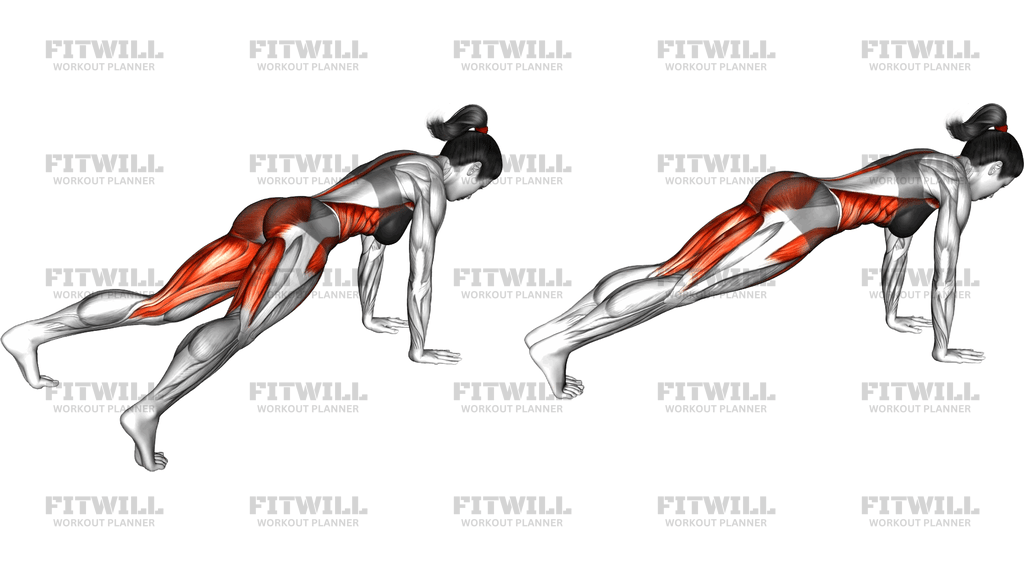
The Plank Knee Tap is a core stability exercise performed from a forearm plank position. Instead of holding a static plank, you lower one knee at a time to the floor, tap it lightly, and return it to the straight-leg position before switching sides. The movement looks simple, but because you keep one knee down at a time while the rest of your body holds a rigid line, your trunk has to constantly resist rotation and side-bending. That anti-rotation and anti-lateral-flexion demand is exactly what makes it more challenging than it appears.
This exercise is a great step between a static plank and more advanced plank variations like shoulder taps or plank reaches. It suits beginners building plank endurance, intermediates who can hold a solid 30- to 45-second plank but need more dynamic core work, and anyone recovering intensity gradually after time away from training. It is also a practical choice in circuit training and home workouts because it needs nothing more than a mat and a small patch of floor.
The primary work comes from the deep core, especially the transverse abdominis, which braces the trunk like a corset every time a knee drops and the body's support changes. The obliques work to stop your hips from swaying side to side, the hip flexors control the knee as it travels down and lifts back up, and the glutes and quads keep the working leg extended and stable. Your shoulders, chest, and upper back hold you up on the forearms throughout, so the upper body gets a genuine isometric challenge as well.
Setup matters more than speed here. Place your elbows directly under your shoulders, forearm angle roughly neutral, and set your feet about hip-width apart so you have a stable base before you start tapping. Squeeze your glutes, brace your abs as if bracing for a light push, and tuck your pelvis slightly so your lower back is long rather than arched. If you begin the rep from a sagging or piked position, the knee tap will simply reinforce that faulty posture, so reset your line every time before moving.
To execute well, think of the knee as touching down as lightly as possible. Lower it under control, let it kiss the floor rather than drop onto it, and drive it straight back up to meet the other leg. Keep your hips level the whole time; the moment one hip lifts or dips noticeably, you have lost the core demand and turned the exercise into a hip movement. Breathe steadily, exhaling as the knee goes down and inhaling as it returns, and alternate sides with an even rhythm. Finish the set when your hips start to twist or your lower back starts to arch, not just when your shoulders get tired.
The Plank Knee Tap fits well as a second or third core exercise in a strength session, as a finisher after compound lifts, or as part of a timed circuit where you tap for 20 to 40 seconds. It is also a smart teaching tool: because one knee is always close to the floor, the risk is low, yet the bracing skill it trains transfers directly to squats, deadlifts, and overhead pressing, where a stable trunk is what keeps your spine supported under load.
[ Workout Log & Planner ]
Put your next workout in Fitwill
Keep your plan and training log ready when you are.


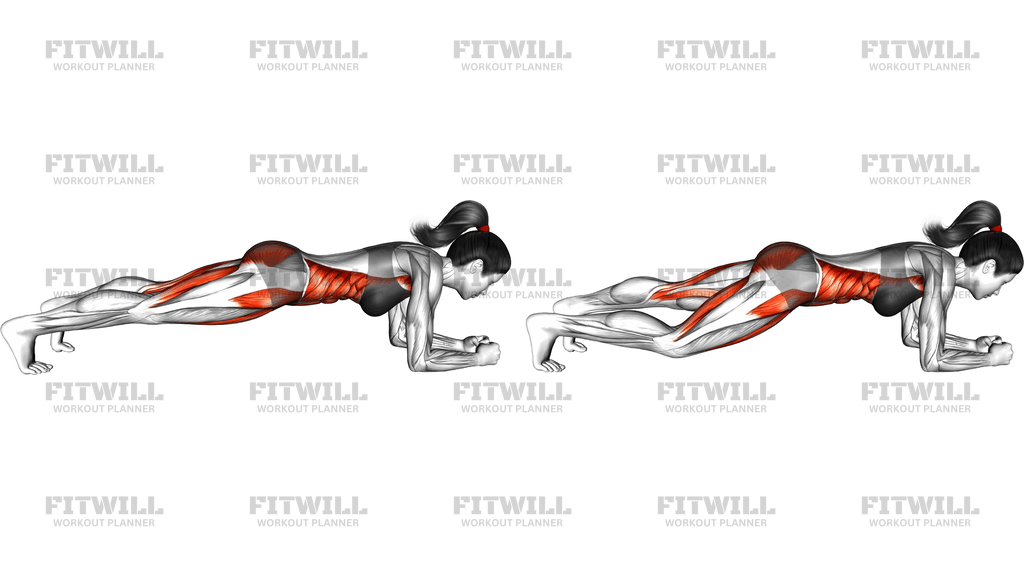
Instructions
- Set up on an exercise mat in a forearm plank: elbows stacked directly under your shoulders, forearms flat on the mat with hands relaxed or lightly clasped, legs extended behind you.
- Place your feet about hip-width apart, balls of your feet on the mat, and form a straight line from head through hips to heels before moving.
- Brace your core by pulling your belly button slightly toward your spine, squeeze your glutes, and tuck your pelvis a touch so your lower back stays long.
- Exhale and slowly lower one knee toward the floor, keeping the hips facing down and level rather than rotating open.
- Tap the knee lightly to the mat without letting your weight sink into it or your hips sag.
- Drive that knee back up to the straight-leg plank position, re-bracing as it lifts.
- Lower the opposite knee with the same control, continuing to alternate sides in an even rhythm.
- Breathe continuously throughout, exhaling on each knee lowering and inhaling on each return.
- Keep your neck neutral by looking at the mat a short distance in front of your hands.
- End the set by stepping or lowering your knees down to rest once your hips begin to twist or your lower back starts to arch.
Tips & Tricks
- If your hips sway side to side with each tap, widen your feet to hip-width or slightly wider; a narrower stance makes the anti-rotation demand much harder than your core may be ready for.
- A common mistake is letting the hips pike up as the knee comes down. Cue yourself to push the floor away with your forearms and keep the chest slightly ahead of the hands to hold the plank line.
- The knee should tap, not thump. If you are dropping onto the kneecap, slow the lowering phase and think of touching down with the quad just above the knee.
- Keep the foot of the working leg relaxed and let the knee bend; forcing the leg rigid makes the hip flexors snatch the movement and pulls your torso out of position.
- Do not hold your breath. Many people brace so hard on the knee tap that they stop breathing, which fatigues you quickly and spikes tension in the neck and shoulders.
- If your elbows drift forward of your shoulders as the set goes on, reset them under your shoulders between reps. A forward-drifting elbow shortens the lever and strains the front of the shoulder.
- Alternate sides with a deliberate rhythm, for example one tap every two seconds, rather than rushing; speed hides lost hip position in this exercise.
- If a knee tap feels too hard, lower one knee only halfway for the first week, or perform the same pattern from a high plank with hands on a bench to reduce the load.
- Stop the set when form breaks, not when the clock says so. Ten clean taps with level hips build more core control than thirty sloppy ones.
Frequently Asked Questions
What muscles does the Plank Knee Tap work?
The primary muscles are the deep core, particularly the transverse abdominis, with strong support from the obliques and lower abs. The hip flexors move the knee down and back up, while the glutes, quads, shoulders, and upper back hold the plank position isometrically.
Is the Plank Knee Tap suitable for beginners?
Yes, provided you can already hold a forearm plank for about 20 to 30 seconds with good form. Beginners can start with slower taps, a wider foot stance for stability, or partial-range knee lowers before progressing to full taps.
Why do my hips rotate when I tap one knee down?
Rotation usually means the core is fatigued or your base is too narrow. Widen your feet to hip-width or beyond, lighten the tap, and consciously press both forearms evenly into the mat; if rotation persists, end the set and rest.
Should my knee rest on the mat or just touch it?
It should just touch. A light tap keeps tension in the core and hip flexors, whereas resting your weight on the knee turns the exercise into a modified plank and reduces the training effect.
How is the Plank Knee Tap different from a static plank?
A static plank trains constant bracing, while the knee tap adds alternating load shifts that force your trunk to resist rotation and side-bending every rep. That makes it more dynamic and generally harder, even though the knee briefly contacts the floor.
How many reps or how long should I perform the Plank Knee Tap?
A good starting point is 10 to 20 alternating taps, or 20 to 40 seconds of continuous work, for 2 to 3 sets. Prioritize level hips and light taps over reaching a rep count or time target.
Can I do the Plank Knee Tap if my knees are sensitive?
Use a thicker mat or fold a towel under the tapping side, and focus on feather-light contact rather than firm touches. If direct knee contact is still uncomfortable, substitute shoulder taps from a high plank, which train a similar anti-rotation demand.
Why do my shoulders burn more than my abs during this exercise?
The shoulders and upper back support your whole body weight on the forearms for the entire set, so they fatigue quickly if your plank base is weak. Push the floor away actively to share the load through your chest and upper back, and build up time under tension gradually.
Is it safe for my lower back?
When performed with a braced core, tucked pelvis, and level hips, the Plank Knee Tap is a low-risk core exercise. The main caution is letting the lower back sag or arch as fatigue builds, so stop the set as soon as you cannot maintain a straight line.