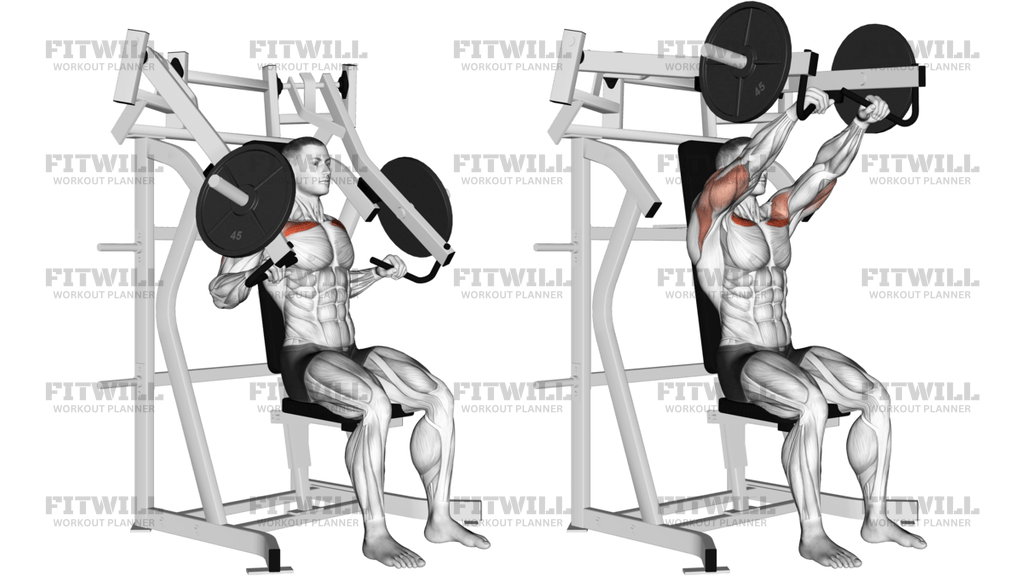
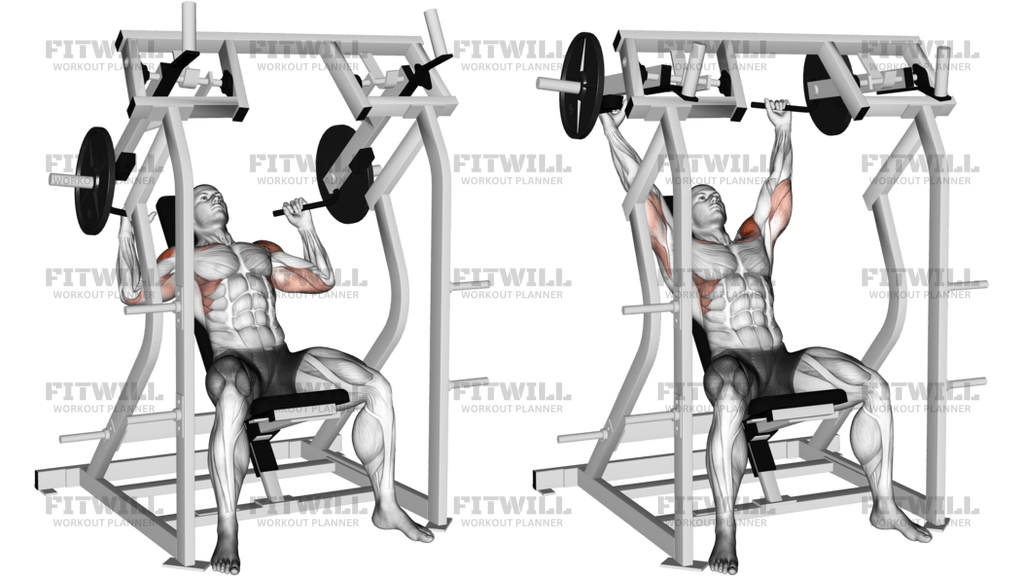
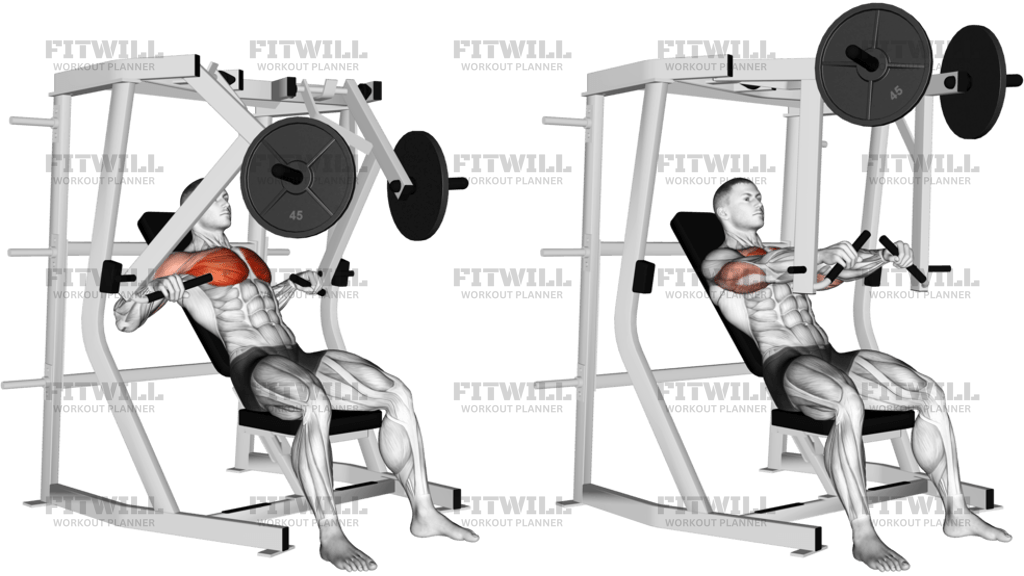
Lever Stack Seated Single Arm Shoulders Press
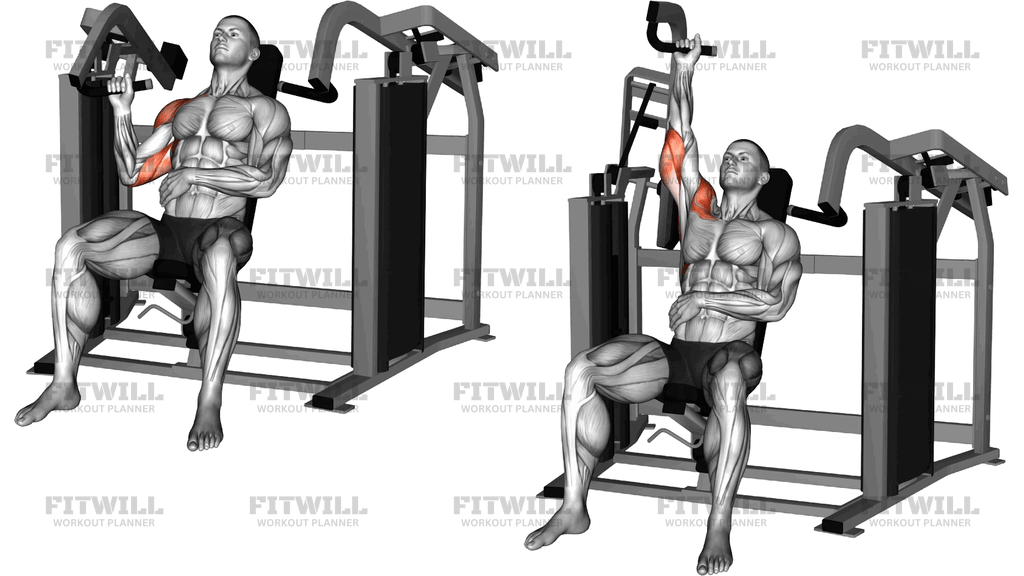
The Lever Stack Seated Single Arm Shoulders Press is a machine-based overhead press performed one arm at a time on a plate-loaded leverage unit. You sit on the machine's seat with your back against the pad, take hold of the single lever handle at shoulder height, and press it up and slightly inward until your arm is extended overhead, then lower it back under control. Because the handle travels on a fixed lever arm, the resistance follows a set arc, which lets you focus entirely on driving the weight rather than stabilizing a free-moving dumbbell.
Training one side at a time is the main selling point here. If one shoulder is stronger or stiffer than the other, a bilateral press lets the strong side quietly do more of the work. The single-arm version exposes and gradually corrects that imbalance. The free hand resting across your torso also gives you a built-in feedback tool: if it drifts, you are twisting, which tells you the working side is compensating.
The primary work is done by the front of the shoulder, with the side delts assisting through the mid-range and the triceps finishing the lockout. The upper traps and serratus engage near the top as the shoulder blade rotates upward, and your core works isometrically to stop the loaded side from pulling your torso into a lean. The machine's backrest removes much of the lower back demand you would face standing, which makes this a practical choice for lifters who want direct shoulder volume without heavy spinal loading.
This movement fits well as a main pressing exercise for beginners who are not yet comfortable controlling dumbbells overhead, and as an accessory for intermediate and advanced lifters chasing balanced delt development or rehabbing around unstable free-weight pressing. It is also a favorite at the end of a shoulder or push day, when fatigue makes the guided path of a machine safer than a barbell.
Setup details matter more than most people assume. Adjust the seat so the handle starts roughly level with your ear or the top of your shoulder when your elbow is bent to about 90 degrees. Sit too low and the lever starts behind your head; sit too high and you lose range at the bottom. Keep your feet planted, your back in contact with the pad, and let the leverage arm do what it is designed to do: a smooth, consistent arc from shoulder to lockout.
[ Workout Log & Planner ]
Put your next workout in Fitwill
Keep your plan and training log ready when you are.


Instructions
- Sit on the machine's seat and plant both feet flat on the floor about hip-width apart, with your hips pushed back into the seat and your lower back in contact with the backrest.
- Grip the single lever handle with one hand using a neutral or slightly angled overhand grip, and set the seat height so the handle sits at shoulder level with your elbow bent roughly 90 degrees.
- Rest your free hand against your stomach or the front of your torso to brace and keep your shoulders square to the machine.
- Brace your core lightly and pull your ribs down so your torso does not arch away from the pad before you start the press.
- Press the handle up along the machine's fixed arc, letting your elbow travel forward and slightly inward until your arm is nearly straight overhead.
- At the top, keep a small bend in the elbow rather than snapping into a hard lock, and reach slightly toward the ceiling so the shoulder blade rotates upward.
- Lower the handle slowly along the same path until your elbow is back at shoulder height and just below it, without bouncing out of the stretched position.
- Exhale as you press up and inhale as you lower the handle back to the start.
- Complete all reps on one side, then switch hands, adjust your grip, and repeat the same rep count on the other arm.
- After your final rep, guide the lever back to the starting rest position and let the weight stack settle fully before standing up.
Tips & Tricks
- If your torso twists toward the working arm as you press, the weight is too heavy or you are rushing the top half of the rep; reduce the load and keep the free hand pressed firmly against your stomach as a checkpoint.
- Avoid dropping your elbow behind your torso at the bottom. On a leverage machine the fixed arc can pull the shoulder into an uncomfortable stretched position, so stop the descent when your elbow is at or just below shoulder height.
- Do not flare the handle far out to the side. The machine dictates the path, so your job is to keep the wrist stacked over the elbow instead of fighting the arc.
- Keep the backrest contact throughout. If your lower back rounds or your head juts forward at lockout, cue yourself to press toward the ceiling rather than forward.
- Start with your weaker arm first and match its rep count with the stronger side, rather than doing extra reps on the strong arm and widening the gap.
- The seat height is the most commonly skipped adjustment. Spend two minutes on it; a handle that starts at your ear makes the whole rep feel smooth, while the wrong height makes even light loads feel awkward.
- Pause for a beat at the bottom of each rep if you tend to bounce, since the machine's momentum can hide lost tension at the shoulder.
- Keep your neck relaxed and your gaze straight ahead. Craning up to watch the handle at lockout usually comes with an arched back and shrugging.
Frequently Asked Questions
Which muscles does the Lever Stack Seated Single Arm Shoulders Press work?
The front shoulders do most of the pressing, with the side shoulders assisting and the triceps extending the elbow at lockout. The upper traps and the muscles around the shoulder blade also work to rotate the scapula upward as your arm goes overhead.
Is the single-arm machine press good for beginners?
Yes. The fixed lever path removes the balance demands of a dumbbell overhead press, so a beginner can learn the overhead pressing motion with light load and build confidence before moving to free weights.
Why should I press one arm at a time instead of both together?
Single-arm reps prevent your stronger side from compensating for the weaker one, which is common on two-arm presses. Over time this helps even out strength and size differences between your left and right shoulders.
What should my free hand do during the Lever Stack Seated Single Arm Shoulders Press?
Rest it across your stomach or the front of your torso. This braces the trunk, keeps your shoulders level, and gives you instant feedback: if that hand slides or your chest rotates, you are twisting under load.
How high should I set the seat?
Adjust it so the handle sits roughly at shoulder or ear height when your elbow is bent about 90 degrees at the start. Too low and the lever starts behind your head; too high and you lose the bottom of the range.
Can I use this press if standing overhead presses bother my lower back?
Often yes, since the machine's backrest supports your spine and the guided path removes the stabilization load. Set the weight conservatively at first and keep your back flat against the pad throughout each rep.
What is the most common mistake on this machine?
Leaning sideways or twisting the torso to help the handle up, especially near the end of a set. The fix is simple: lighten the load, keep the free hand braced on your midsection, and stop the set when your form drifts.
What can I substitute if my gym has no leverage press machine?
A seated one-arm dumbbell press on an upright bench is the closest match, followed by a seated cable press with a single handle. Both train the same single-arm pattern, just with more stability demand on your part.
How heavy should I go on the Lever Stack Seated Single Arm Shoulders Press?
Pick a load you can press through the full arc without your torso twisting or your lower back leaving the pad. Because the machine stabilizes the weight for you, it is easy to jump up too fast, so progress in small plate increments.