Band Assisted Dip
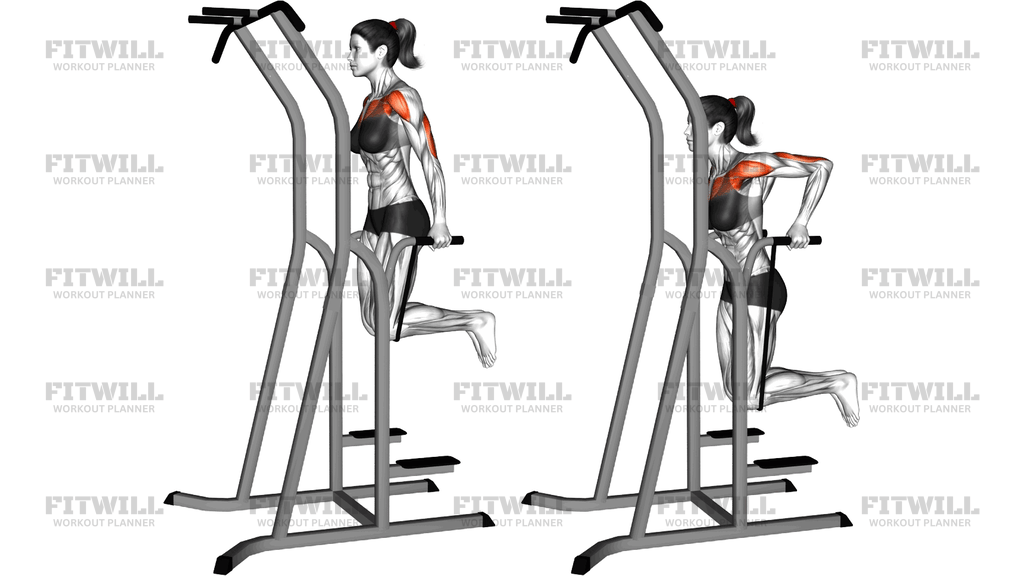
The Band Assisted Dip is a bodyweight dip performed on parallel bars with a resistance band looped around the station and your knees or shins. The band stretches as you lower and pulls you back up on the way out, offsetting part of your bodyweight so the movement becomes manageable before you can handle your full load. It is one of the most practical progressions toward a full unassisted dip.
This exercise primarily trains the triceps, with strong involvement from the chest and the front of the shoulders. The key benefit over machine-assisted dips is that the band forces you to stabilize your own body: your shoulders, elbows, and core have to control the path, which builds the joint control you need for freestanding dips later on.
Setup matters more than most people expect. The band must be anchored securely to the dip station and positioned under your knees or shins at the right tension. Too much assistance and you never truly load the pressing muscles; too little and your form collapses into shrugged shoulders and partial reps. Take a moment to test the band tension before committing to a set.
To execute well, support yourself on the bars with arms extended, bend your knees so they rest in the band, and keep your torso leaning slightly forward. Lower under control until your elbows reach roughly ninety degrees or your upper arms are about parallel to the floor, then press back up to full elbow extension without locking out hard. Keep the elbows tracking roughly over the wrists rather than flaring wide.
The Band Assisted Dip suits beginners building toward their first dip, anyone returning from a layoff who has lost pressing strength, and intermediate lifters who want higher-rep dip volume without excess joint stress. As you get stronger, move to a lighter band, shift the band position slightly toward your shins for less leverage, or add a slow pause at the bottom.
A few safety points go a long way. Check that the band is undamaged and firmly seated on the anchor point before every set, and step into and out of the band while standing on the station's foot platform rather than while hanging. If your shoulders roll forward or you feel pinching at the bottom of the dip, reduce the depth before you reduce the assistance.
[ Workout Log & Planner ]
Put your next workout in Fitwill
Keep your plan and training log ready when you are.


Instructions
- Anchor a resistance band securely to the base or frame of a dip station, then grip the parallel bars with your palms facing inward and press up to full arm extension so your feet leave the ground.
- Bend your knees behind you and hook them into the hanging loop of the band, letting the band support part of your bodyweight while you balance on your hands.
- Brace your core, pull your shoulders down away from your ears, and lean your torso slightly forward with a proud chest.
- Inhale and lower your body by bending the elbows, keeping them pointing back and staying roughly over your wrists.
- Descend until your upper arms are about parallel to the floor or your elbows reach roughly ninety degrees.
- Exhale and press through your palms to straighten the elbows, driving back up until your arms are fully extended without slamming the joints into lockout.
- Pause briefly at the top, re-set your shoulder position, and repeat for your target reps.
- When finished, lower one foot onto the station's foot platform to unload the band before stepping your knee out of it.
Tips & Tricks
- If the band slips down your shin mid-set, your knee placement is too shallow; hook the band above the knee joint or at mid-shin so it cannot roll off as you bend.
- Avoid descending with shrugged shoulders. If your shoulders creep toward your ears at the bottom, you are going deeper than your current strength or band tension allows.
- Choose a band tension that lets you complete eight to twelve clean reps. If you cannot control the lowering phase for at least two seconds, the assistance is too light.
- Do not let the elbows flare straight out to the sides; this shifts stress to the shoulder joint. Think about squeezing the bars inward slightly as you press.
- Keep a small forward torso lean rather than staying bolt upright. A perfectly vertical trunk shortens the chest's range and can pinch the front of the shoulder at depth.
- Resist the urge to bounce out of the bottom. The stretched band makes rebounding tempting, but a controlled pause at the bottom builds far more pressing strength.
- If your wrists ache at the top, check that your grip is centered on the bars and that you are pressing through the heel of the palm, not hanging on the fingers.
- Progress by thinning the band every few weeks rather than jumping straight to unassisted dips; a two-band or single-light-band step makes the transition smoother.
Frequently Asked Questions
What muscles does the Band Assisted Dip work?
The triceps are the primary mover, with the chest and front shoulders assisting throughout the press. Your core also works to keep your hanging body stable on the bars.
Where should I loop the resistance band for Band Assisted Dips?
Anchor one end to the dip station frame near the base and place the other end across one or both knees, or at the shins. Higher on the leg gives more assistance and better stability; at the shins it gives less.
Is the Band Assisted Dip good for beginners?
Yes, it is one of the best entry points to dipping. The band lets you practice the full range of motion and joint position with a load you can actually control while you build pressing strength.
How is a Band Assisted Dip different from an assisted dip machine?
A machine supports you at a fixed assist level and stabilizes the path for you, while a band assistance level changes through the range and you must stabilize your own body. The band version therefore transfers more directly to unassisted dips.
How deep should I go in the Band Assisted Dip?
Lower until your upper arms are roughly parallel to the floor or your elbows reach about ninety degrees. Going deeper is fine only if you can keep your shoulders pulled down and pain-free at the bottom.
Why do my shoulders shrug up during Band Assisted Dips?
That usually means the assistance is too light or you are descending past your controlled range. Use a thicker band, cut the depth slightly, and consciously press your shoulders down away from your ears before each rep.
What can I use instead of a Band Assisted Dip?
An assisted dip machine, bench dips with feet on the floor, or negative-only dips where you jump to the top and lower slowly all work. Chair or bench dips are the easiest no-equipment substitute.
How do I progress away from band assistance?
Gradually switch to lighter bands, or use a light band for your last sets only. Once you can do several clean full-range reps with a very thin band, start practicing unassisted dips for low reps.
Is it safe to use a worn or stretched-out resistance band for this exercise?
No. Inspect the band for cracks or thin spots before every session and replace it if damaged, since a snapping band under load can cause a hard fall. Always anchor it securely and mount the station using the foot platform, not while hanging in the band.