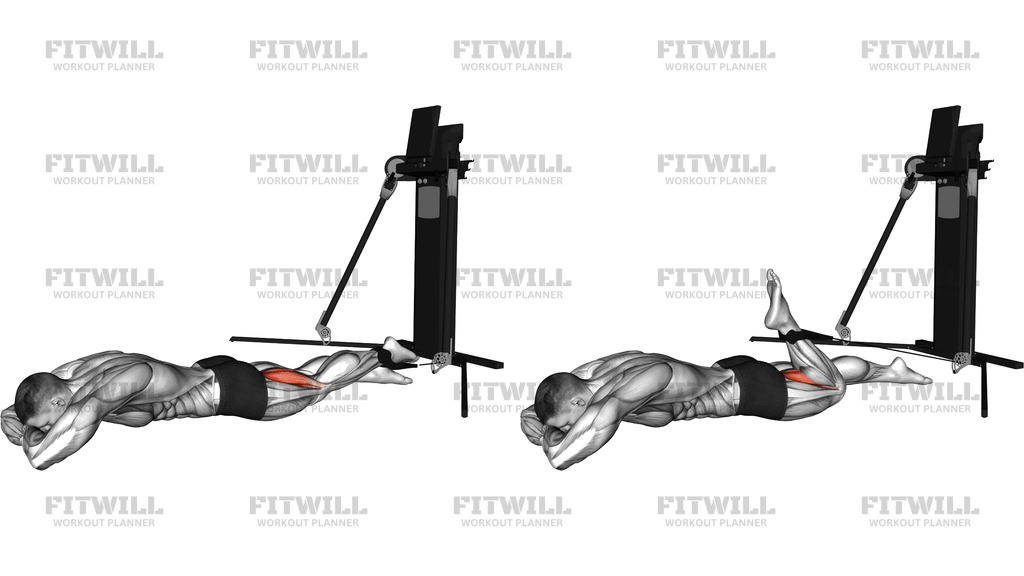
Cable Prone Single Leg Curl (Version 3)
The Cable Prone Single Leg Curl is a single-leg hamstring isolation exercise performed lying face down on the floor with an ankle strap attached to the low pulley of a cable machine. You position yourself a short distance away from the pulley so the cable runs taut along your lower leg, then curl one knee from a fully extended position up toward your glutes while the other leg stays relaxed on the floor. Because each leg works on its own, the cable provides smooth, even tension through the entire range of motion, including the fully stretched position at the bottom where the hamstring is hardest to load with free weights.
This movement trains the hamstrings primarily through knee flexion, with the calves assisting as the knee bends and the glutes working lightly to keep the hips pressed down and stable. Working one leg at a time exposes and corrects side-to-side strength differences, which is something a bilateral lying leg curl machine cannot reveal. It is a useful option for lifters who want extra hamstring volume without a dedicated leg curl machine, or for rehab-style training where controlled, light-to-moderate single-leg loading is appropriate.
Setup matters more here than in most hamstring exercises. Your distance from the pulley determines whether the cable pulls at a useful angle: too close and the resistance drops off at the top, too far and the cable drags your leg backward or lifts your hips. Keep the strap snug around the ankle just above the ankle bone so it cannot slide during the curl. Because you are lying directly on the floor, a mat or the padded floor of a cable station makes the position comfortable enough to focus on the working muscle.
Execution should be slow and deliberate. Press the non-working leg and your hips into the floor to stop your pelvis from tipping as you curl, then bend the knee fully until the heel comes close to the glutes. The temptation is to swing the leg or let the hips rise to help the cable along, and both habits shrink the hamstring's workload. A brief pause at the top, followed by a slower lowering phase, makes even a modest weight feel demanding.
The Cable Prone Single Leg Curl fits well at the end of a leg session as a finishing movement, as a supplement to stiff-leg deadlifts or Romanian deadlifts for balanced hamstring development, or as the primary knee-flexion exercise when a leg curl machine is unavailable. Start lighter than you think you need, since the cable's continuous tension makes each rep harder than a machine rep at the same load, and progress by adding small increments once you can control the full range without your hips shifting.
[ Workout Log & Planner ]
Put your next workout in Fitwill
Keep your plan and training log ready when you are.


Instructions
- Attach an ankle strap to one ankle and clip it to the low pulley of a cable machine, then set the weight stack to a light starting load.
- Lie face down on a mat with your head away from the machine and position yourself so the cable runs taut and pulls straight back along your lower leg when your knee is extended.
- Rest your forehead or folded arms on the floor, let the non-working leg lie relaxed behind you, and point the strapped foot so the cable clears your other leg.
- Brace your core lightly and press both hips and the non-working leg into the floor so your pelvis cannot rotate during the set.
- Exhale and curl the strapped leg by bending the knee, pulling the heel up toward your glutes until the knee is fully flexed.
- Pause for a beat at the top and squeeze the hamstring without letting the cable stack slam back down.
- Inhale and lower the leg slowly under control until the knee is straight and the hamstring reaches a full stretch.
- Complete all repetitions on one leg, then unclip or re-strap and repeat the same number of reps on the other leg.
- Between sets, recheck your distance from the pulley and strap position so every set starts from the same alignment.
Tips & Tricks
- If your hips lift off the floor as you curl, the weight is too heavy or you are pulling with the whole leg instead of bending the knee; drop the load and think about shortening the thigh, not lifting the heel.
- Adjust your distance from the machine before your first set: if the stack clangs at the bottom or tension vanishes at the top, slide a foot closer or farther until the cable stays loaded through the whole rep.
- Keep the strap just above the ankle bone; wearing it on the calf changes the pull direction and makes the calf do more of the work.
- Do not let the working knee drift out to the side as fatigue builds; keep the thigh in line with the hip so the hamstring, not the hip rotators, drives the curl.
- Make the lowering phase about two to three seconds; the eccentric is where this exercise delivers most of its benefit and rushing it turns the set into a momentum game.
- Plantarflexing the foot (pointing the toes) usually makes the curl feel cleaner, while pulling the toes up lets the gastrocnemius contribute more at the knee.
- Because you are on the floor rather than a padded bench, pad your knee or the front of your thigh if hard flooring makes you shift position mid-set.
- Swap legs with minimal rest between them to keep the sets balanced, and always start with your weaker leg so it sets the rep target.
- Avoid locking the knee hard at the bottom of each rep; stop just short of full lockout to keep tension on the hamstring rather than the joint.
Frequently Asked Questions
Which muscles does the Cable Prone Single Leg Curl work?
The hamstrings on the working leg are the primary movers as they flex the knee. The calves assist with knee flexion, and the glutes and core work isometrically to keep the hips pressed down and the pelvis stable.
How far should I lie from the cable machine during the Cable Prone Single Leg Curl?
Far enough that the cable stays taut with your knee straight, but close enough that it pulls roughly along the line of your lower leg rather than dragging your hip backward. A good test is whether tension holds through the entire curl without the stack settling at the top.
Is the Cable Prone Single Leg Curl suitable for beginners?
Yes, provided the load starts very light and the focus stays on controlled reps with the hips pinned to the floor. Beginners often benefit from it because the single-leg setup immediately shows if one side is weaker or moves differently.
Why do my hips rise during the Cable Prone Single Leg Curl?
Rising hips usually mean the weight is too heavy or the cable is pulling at an angle that drags the pelvis. Shift slightly closer to the pulley, reduce the load, and consciously press the front of the thigh and the non-working leg into the floor on every rep.
What can I use instead of an ankle strap for this exercise?
A cable handle can be looped around the ankle in a pinch, but it tends to slip and is less secure than a proper strap. If no strap is available, a lying or seated leg curl machine is the closest substitute for the same knee-flexion pattern.
Should I do the Cable Prone Single Leg Curl before or after squats and deadlifts?
It works best after your main compound lifts, when the hamstrings are already warmed up and you can isolate them without compromising heavy lifting. Using it first would fatigue the hamstrings right before exercises that depend on them for stability.
How many reps and sets should I use for the Cable Prone Single Leg Curl?
Two to four sets of 10 to 15 reps per leg covers most goals, since the exercise is isolation work with continuous tension. If you are using it as a finishing movement, higher rep sets with a slow lowering phase are a productive choice.
Is it safe for the knees to bend fully against cable resistance?
For healthy knees, full knee flexion under light-to-moderate cable load is a normal and well-tolerated range, similar to any leg curl machine. If you have a current knee issue, limit the range to a pain-free arc and confirm the approach with a qualified professional first.
Why does one leg feel stronger than the other in the Cable Prone Single Leg Curl?
Side-to-side differences are common and often show up first in single-leg work. Train each leg with the same sets and reps, starting with the weaker side, and let the stronger side match that target rather than doing more reps.