Cable Bent Over Row
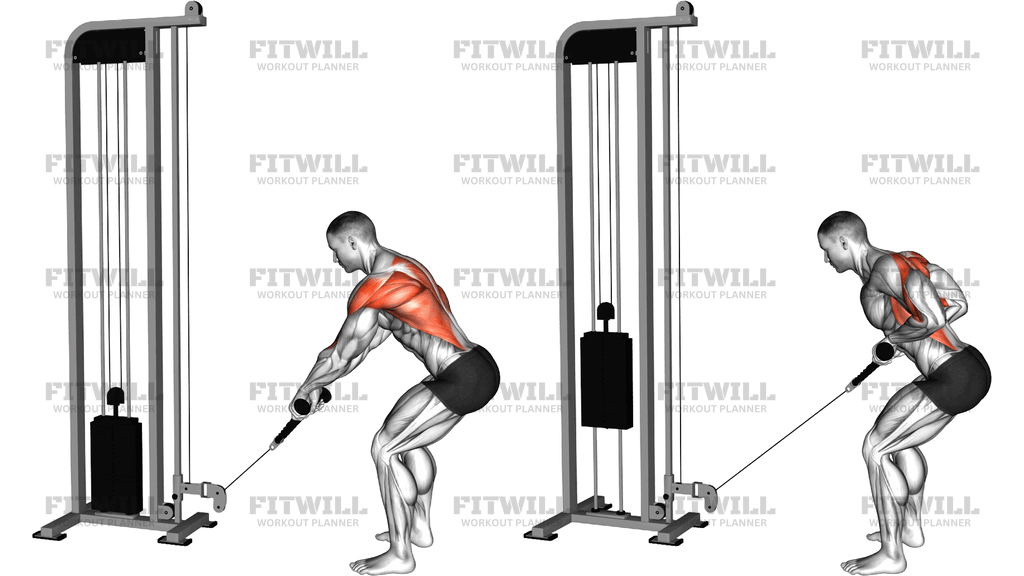
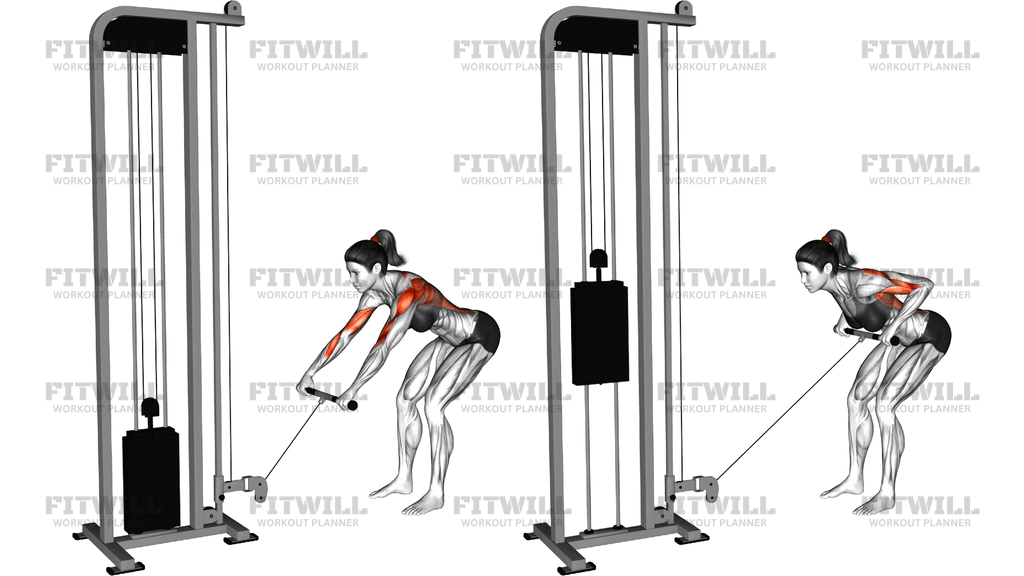
The Cable Bent Over Row is a horizontal pulling exercise performed standing at a cable machine with the pulley set to its lowest position. You hinge forward at the hips until your torso is angled well toward the floor, then draw a straight bar from the low pulley up toward your lower ribcage. Because the cable pulls forward and down from your hands toward the machine, your upper back has to work hard to pull against that angle, which is exactly what makes this movement so effective for building thickness across the mid-back.
The main muscles at work are the rhomboids and mid-trapezius, which pull the shoulder blades back and together at the top of each rep. The lats assist as the elbows drive past the torso, the rear deltoids help move the upper arms, and the biceps and forearms handle much of the gripping and elbow bending. Your spinal erectors and glutes also work isometrically the whole time to hold the bent-over position, so this exercise quietly trains your posterior chain even though the bar is the only thing moving.
Compared with a barbell row, the cable version offers a few real advantages. The resistance stays smooth and constant through the entire range, including at the top where a barbell row is often easiest, and the cable's line of pull lets you adjust by stepping closer or farther from the machine. There is also no heavy barbell to round over at the start of the set, which many lifters find friendlier on the lower back. The trade-off is that you still have to hold a hinge, so setup and torso position matter just as much here as they do with free weights.
To execute the movement well, set the pulley to the bottom, grab the bar with a shoulder-width overhand grip, and walk back until the cable is taut and pulling slightly forward. Push your hips back and let your chest travel toward the floor until your torso sits somewhere between 30 and 45 degrees above horizontal, with a flat back and soft knees. From there, row the bar into your lower abdomen, squeezing your shoulder blades together at the top before letting the weight pull your arms back to full extension in a slow, controlled stretch.
This exercise suits anyone working on mid-back development, posture-correcting pulling volume, or a row variation that does not require loading a barbell off the floor. It fits well as a main back movement on cable-focused days or as a secondary row after heavier free-weight pulling. The most common pitfalls are standing too upright and turning it into a shrug, yanking the weight with momentum, and letting the hinge collapse as fatigue sets in. Keeping the load honest and the torso angle fixed solves most of these problems.
[ Workout Log & Planner ]
Put your next workout in Fitwill
Keep your plan and training log ready when you are.


Instructions
- Set the pulley on the cable machine to its lowest position and attach a straight bar.
- Grab the bar with an overhand grip about shoulder-width apart, then step back until your arms are extended and the cable is taut, pulling slightly forward on your hands.
- Push your hips back and hinge forward until your torso is angled between 30 and 45 degrees above the floor, with a flat back, soft knees, and your weight spread across your whole foot.
- Let the weight pull your arms straight down toward the pulley so you feel a stretch across your upper back, and brace your core before the first rep.
- Exhale and row the bar up into your lower abdomen, driving your elbows back close to your ribs rather than flaring them wide.
- At the top of the pull, squeeze your shoulder blades together and hold the contraction for a beat without shrugging your shoulders toward your ears.
- Inhale and lower the bar slowly back along the same path until your arms are fully extended and the cable stays taut.
- Keep your torso angle fixed throughout the set; do not stand up taller as you pull or swing your upper body for momentum.
- Complete all reps on one side of the machine, then release the bar with control, reset your grip and stance, and step away only after the weight stack has settled.
Tips & Tricks
- If you find yourself rising out of the hinge as the set gets hard, the weight is too heavy; reduce the load until you can hold the same torso angle from first rep to last.
- Think about pulling the bar to your hip crease or lower belly, not your chest. Rowing too high shifts work toward the shoulders and turns the movement into an upright row.
- Keep a soft bend in your knees at all times. Straight legs will pull on your hamstrings and make it harder to keep your lower back flat in the hinge.
- Do not let your shoulder blades creep up toward your ears as you pull. Start each rep by drawing them down and back before the elbows bend.
- Use a false grip with your thumbs wrapped but your wrists neutral, so your forearms stay in line with the cable instead of bending back at the top.
- Chalk or lifting straps are worth using if grip gives out before your back does, since losing the bar mid-rep in a bent-over position is both annoying and risky.
- Choke up slightly on the bar or take a half step closer to the machine if the cable drags on your thighs; the bar should travel clear of your legs on every rep.
- On the stretched position at the bottom, let the cable pull your shoulder blades forward slightly before starting the next pull. Cutting this short shrinks the working range.
- If your lower back fatigues before your upper back, try finishing the last reps with a slightly higher torso angle rather than rounding your spine to keep pulling.
Frequently Asked Questions
Which muscles does the Cable Bent Over Row work the most?
The rhomboids and mid-traps across your upper back do the bulk of the work, with the lats and rear deltoids assisting as the elbows drive back. Your biceps, forearms, and spinal erectors are heavily involved in supporting roles.
How far forward should my torso be during the Cable Bent Over Row?
Aim for a torso angle roughly 30 to 45 degrees above the floor. Going steeper makes it easier to stay in position but reduces the row's emphasis; the key is that whatever angle you choose, it should not change from rep to rep.
Is the Cable Bent Over Row safe for people with lower back sensitivity?
The bent-over position does load the lower back isometrically, so anyone with a history of back issues should start light and keep the hinge strict. If holding the position is the limiting factor, a seated cable row gives a similar pulling pattern with the spine supported.
What is the most common mistake with this exercise?
Standing too upright and pulling the bar toward the chest with shrugged shoulders. Fix it by hinging to your planned angle, targeting the lower abdomen, and consciously pulling the shoulder blades down and back before each rep.
Should I use an overhand or underhand grip on the Cable Bent Over Row?
An overhand, shoulder-width grip is the standard and favors the mid-back evenly. An underhand grip lets the lats and biceps contribute more, so it works as a variation but changes the emphasis.
Can beginners do the Cable Bent Over Row?
Yes, and the cable's light increments make it a good place to learn hip hinging with a row. Beginners should start with a modest weight, master the bent-over setup first, and only add load once the torso angle stays rock solid for a full set.
How does the Cable Bent Over Row differ from a barbell bent-over row?
The cable provides constant tension and pulls at a fixed forward angle, while a barbell's resistance is vertical and heaviest at the sticking point. The cable version also spares you the initial lift of a loaded bar off the floor, though the total load you can handle is usually lower.
What can I substitute if the low pulley station is busy?
A dumbbell or barbell bent-over row, a seated cable row, or a resistance band row anchored at waist height all train the same horizontal pull. The closest match in feel is a band row done in the same hinged position.
Why does my grip fail before my back feels worked?
In a bent-over position the forearms fight the cable's constant tension the whole time, so grip often gives out first. Wrap your thumbs firmly, slow the tempo rather than squeezing harder, or use lifting straps once your back is the true limiting factor.
How close should I stand to the cable machine?
Stand far enough back that the cable is taut and the bar travels clear of your thighs without the cable rubbing your shins or the machine. If the bar drags on your legs, take a half step back so the line of pull stays unobstructed.