Cable Seated One Arm Concentration Curl
The Cable Seated One Arm Concentration Curl is a single-arm biceps isolation exercise performed with a low pulley and a single handle attachment. You sit on a flat bench beside a cable machine, brace the back of your working upper arm against your inner thigh, and curl the handle up through a strict arc while the cable pulls continuously from below. The cable version differs from the classic dumbbell concentration curl because the resistance stays tensioned through the entire rep, including the stretched position at the bottom where a dumbbell tends to go slack.
This movement works the biceps brachii as the primary muscle, with the brachialis underneath and the brachioradialis of the forearm contributing, especially when you use a neutral or semi-neutral grip on the handle. Because the elbow is pinned against the inner thigh, it removes most of the momentum, body English, and shoulder swing that let other curl variations drift away from the biceps. That makes it one of the cleanest ways to feel a single arm working on its own.
It is particularly useful for lifters who want to fix a side-to-side size or strength difference, since each arm is trained separately with identical setup and range. It also suits people who struggle to feel their biceps in standing curls, because the seated, braced position forces the upper arm to stay still. Bodybuilders commonly place it at the end of an arm session as a finishing movement, where the constant cable tension and strict form deliver a strong pump without heavy loading.
The setup matters more here than in most curls. Your foot should be planted wide enough that the working elbow can rest firmly against the inner thigh, and your torso should lean slightly forward from the hips rather than slouching. If the elbow drifts off the thigh or the shoulder starts to lift the handle, the biceps loses its isolation and the set loses its point. Keep the trunk braced and let the forearm do the only moving.
Execute each rep by curling the handle up toward the same-side shoulder, squeezing hard at the top, and lowering slowly until the arm is nearly straight. Keep the wrist neutral and avoid letting the cable snap the arm back down at the bottom. Because the working side is braced and the other hand can rest on your opposite thigh or hip for balance, the exercise is surprisingly stable, but start light to learn the path before adding meaningful load.
[ Workout Log & Planner ]
Put your next workout in Fitwill
Keep your plan and training log ready when you are.


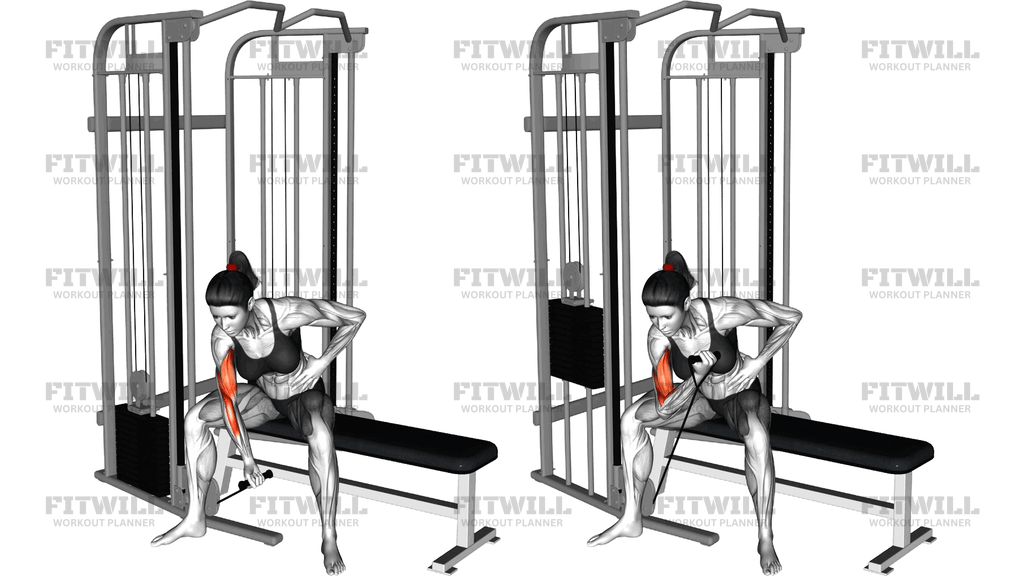
Instructions
- Attach a single handle to the low pulley of a cable machine and place a flat bench roughly a foot in front of the pulley, facing it.
- Sit on the bench with your feet planted wide and flat, then grab the handle with your right hand and lean forward so the back of your right upper arm rests firmly against the inside of your right thigh.
- Let your left hand rest on your left thigh or hip for support, and settle into a slight forward lean from the hips with your back straight and your core braced.
- Start with the working arm extended down toward the pulley and a light bend in the elbow so the cable is already under tension.
- Exhale and curl the handle up in an arc toward your right shoulder, keeping the elbow glued to the inner thigh and the wrist straight.
- Pause at the top and squeeze the biceps for a moment when the handle is near shoulder height.
- Inhale and lower the handle under control until the arm is almost fully extended, stopping just short of letting the weight stack rest.
- Complete all reps on the right arm, then switch the handle to your left hand, brace the left elbow against the left inner thigh, and repeat for the same number of reps.
- After your final rep, release the handle and let the stack settle gently before standing up from the bench.
Tips & Tricks
- If your elbow keeps sliding off the thigh, widen your stance and push the knee slightly outward; a stable brace point is what separates a true concentration curl from a sloppy seated curl.
- The most common mistake is pulling the shoulder into the movement at the start of the rep. If you see the working shoulder rise toward your ear, drop the weight and think of the upper arm as a fixed hinge with only the forearm moving.
- Let the wrist curl or bend backward at the top, and the forearm takes over the work. Keep the knuckles aligned with the forearm and think of the hand as a hook on the handle.
- Do not straighten the arm so aggressively at the bottom that the weight stack clanks down. Hovering just above rest keeps tension in the biceps and protects the elbow joint from a sudden jerk.
- Because the cable pulls at an angle from below, the hardest point of this variation is near full extension rather than mid-range. Lower the load a notch if the bottom third of each rep feels uncontrolled.
- Match every setup detail when you switch arms, including bench distance, foot width, and seat position, so both sides get an identical stimulus for balanced development.
- Choose a weight you can pause with at the top for a full second. If the load forces you to swing your torso, the braced position is no longer doing its job.
- Keep your forward lean coming from the hips, not a rounded lower back. Sit tall through the chest and hinge over the working arm instead of collapsing toward the handle.
Frequently Asked Questions
Which muscles does the Cable Seated One Arm Concentration Curl work?
The biceps brachii is the primary mover, supported by the brachialis and brachioradialis of the forearm. The braced elbow means almost no shoulder or back muscles assist, which is exactly what makes the exercise so isolating.
Why use a cable instead of a dumbbell for concentration curls?
A dumbbell goes slack at the bottom when the arm hangs straight, but the low pulley keeps tension on the biceps through the entire range. You also get a smooth, consistent resistance curve that is easy to control at light loads.
Is the Cable Seated One Arm Concentration Curl good for beginners?
Yes, and it is often better for beginners than standing curls because the braced position removes momentum and makes it obvious when form breaks. Start with a light weight to learn the elbow-on-thigh setup before progressing.
How do I position my elbow correctly on my thigh?
Sit with the working-side foot planted wide and lean forward until the back of the upper arm, just above the elbow, presses against the inner thigh. The elbow should stay in contact for every rep; if it floats forward or off the leg, readjust your stance.
Should I curl the handle toward my shoulder or across my body?
Curl it in a natural arc toward the shoulder on the same side as your working arm. Crossing toward the midline usually means the elbow has slipped off the thigh and the biceps is no longer doing all the work.
What is the most common mistake with this exercise?
Using the shoulder to heave the handle up at the start of the rep, which lifts the upper arm off the thigh. The fix is a lighter weight and the mental cue that only the forearm moves while the upper arm stays pinned.
How many sets and reps should I do per arm?
Two to four sets of 10 to 15 reps per arm works well, typically as a finishing movement after heavier compound or standing curl work. Keep the reps equal on both sides to address any strength imbalance.
Can I do this exercise without a cable machine?
The closest substitute is a dumbbell concentration curl seated on a bench with the elbow against the inner thigh. You lose the constant bottom-position tension of the cable, but the movement pattern and braced setup are the same.
Is it safe for the elbows or wrists?
The braced, seated position puts minimal stress on the joints as long as the weight stays moderate and the arm lowers under control. Avoid bouncing the handle out of the stretched bottom position, and keep the wrist straight rather than curled.
Should the non-working hand do anything during the set?
Rest it on your opposite thigh or hip to stabilize your torso and keep your shoulders level. Avoid planting it on the bench or pushing into your leg, since that lets you cheat the torso into the curl.