Cable One Arm Preacher Curl
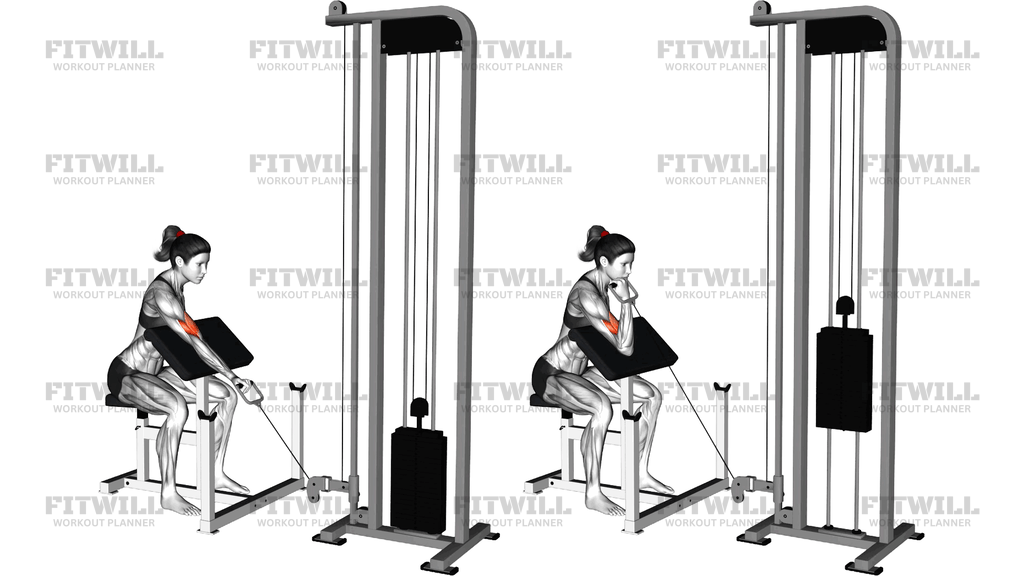
The Cable One Arm Preacher Curl is a single-arm biceps exercise performed on a preacher bench positioned in front of a low cable pulley. You sit with the back of your upper arm pressed firmly against the angled pad, hold a single handle attached to the low pulley, and curl the handle up toward your shoulder while the cable pulls downward and back against your effort. Unlike a dumbbell preacher curl, the cable keeps tension on the biceps through the entire range, including the stretched bottom position where free-weight versions tend to lose resistance.
This movement is especially useful for fixing left-to-right strength differences. Because each arm works on its own, your stronger side cannot quietly take over the load, which is a common problem during barbell curls. It is also a good choice for anyone who wants constant tension at the fully lengthened position of the biceps — the point where the arm hangs down over the pad and the elbow is nearly straight. That stretched, loaded position is hard to load safely with dumbbells and is one of the main reasons lifters use this setup.
The primary muscle at work is the biceps brachii, with the brachialis and brachioradialis assisting, and the forearm flexors working to hold the handle. The preacher pad does more than provide comfort: it fixes your upper arm angle and removes the ability to swing, lean, or use shoulder momentum to cheat the weight up. That makes the exercise demanding but honest — if the pad is set correctly and your armpit is seated over the top of it, the biceps have to do the work on their own.
Setup matters more here than in most curl variations. Sit close enough to the machine that the cable runs cleanly from the low pulley to your hand without rubbing the frame, and position your armpit snugly over the top edge of the pad with the back of your upper arm flat against it. If your shoulder is creeping up off the pad or your elbow is drifting forward, the setup is off and the exercise becomes a partial shoulder flexion movement rather than a curl.
Execute the rep by flexing the elbow to draw the handle up toward the front of your shoulder, keeping the back of your arm glued to the pad the whole way. Pause briefly at the top, then lower the handle under control until the arm is nearly straight. Do not let the cable yank your arm down into a slam at the bottom — the eccentric is where much of the benefit lives. Breathe in on the way down, exhale as you curl, and complete all reps on one side before switching arms.
[ Workout Log & Planner ]
Put your next workout in Fitwill
Keep your plan and training log ready when you are.


Instructions
- Attach a single handle to the low pulley of a cable machine and position a preacher bench so the pad faces the pulley.
- Select your weight, take the handle in one hand, and sit on the bench facing the machine with your feet flat on the floor.
- Drift your armpit over the top of the pad and lay the back of your upper arm flat against it, letting your arm extend down toward the pulley.
- Grip the handle firmly, keep a slight bend in the working elbow, and let the cable pull the arm into a gentle stretch before starting.
- Brace your trunk, keep your chest tall, and hold the pad with your free hand for stability.
- Curl the handle up in a smooth arc toward the front of your shoulder, keeping the back of the upper arm pressed to the pad at all times.
- Squeeze the biceps at the top for a moment without letting the elbow slide forward off the pad.
- Lower the handle slowly back down until the arm is nearly straight, feeling the cable's tension in the stretched position.
- Exhale as you curl up and inhale as you lower the weight, keeping your breathing steady throughout the set.
- Finish all reps on one arm, then reset your position on the pad and complete the same number of reps on the other side.
Tips & Tricks
- If your elbow lifts off the pad as you curl, the weight is too heavy or you are pulling with the shoulder — reduce the load and focus on bending only the elbow.
- Keep the armpit seated over the top edge of the pad; if your whole shoulder rides up onto the pad, you shorten the range and lose the stretched-position tension.
- Do not fully lock the elbow out at the bottom and rest between reps — stop just short so the cable keeps pulling on the biceps.
- Because the cable resists you on the way down too, take 2–3 seconds on the lowering phase; dropping the handle quickly lets the stack collapse and wastes the eccentric.
- Start with your weaker arm first and match its reps with the stronger side to balance out any size or strength difference over time.
- If the cable rubs against your leg or the bench frame, shift your seat position closer to the pulley or adjust your torso angle until the cable path is clear.
- Avoid twisting the wrist as you curl — keep the grip neutral and steady so the forearm flexors aren't doing a side job during the rep.
- Choose a weight you can control for at least 8 strict reps; the preacher position removes cheating, so loads will typically be lighter than your standing dumbbell curls.
Frequently Asked Questions
What muscles does the Cable One Arm Preacher Curl work?
The biceps brachii is the primary mover, with the brachialis and brachioradialis assisting and the forearm flexors gripping the handle. Because the upper arm is fixed on the pad, almost all of the work is isolated to the elbow flexors.
Why use a cable instead of a dumbbell for preacher curls?
A cable provides tension through the entire range of motion, including the bottom position where the arm hangs down and the biceps are stretched. With a dumbbell, gravity offers little resistance in that stretched position.
Is the Cable One Arm Preacher Curl good for beginners?
Yes, it can work well for beginners because the pad locks the upper arm in place and makes cheating difficult. Start with a light weight and focus on keeping the back of the arm glued to the pad through every rep.
Why does one arm feel weaker than the other on this exercise?
Small side-to-side differences are normal and often show up first in single-arm work. Train both arms with the same weight and reps, starting with the weaker side, and the gap usually narrows over weeks of consistent training.
Should my elbow stay in contact with the preacher pad the whole time?
Yes. The back of your upper arm should stay flat against the pad from the stretched bottom to the top of the curl. If the elbow lifts or drifts forward, the shoulder is taking over and the biceps are no longer working in isolation.
How far down should I lower the handle at the bottom?
Lower until your arm is nearly straight and you feel a comfortable stretch in the biceps, but avoid letting the cable slam your elbow into a hard lockout. Staying just short of full extension keeps continuous tension on the muscle and protects the elbow joint.
What can I substitute if my gym has no preacher bench near a cable pulley?
A single-arm dumbbell preacher curl on a preacher or incline bench is the closest substitute, though it loses the constant tension. A cable concentration curl with the elbow braced against your inner thigh is another option that still gives you one-arm work with cable resistance.
How many sets and reps should I do?
Two to four sets of 8–15 reps per arm fits most hypertrophy goals. Since the setup removes momentum, err on the lighter side and prioritize a slow, controlled lowering phase over adding plates.
Is it safe for the elbows since the arm is locked on the pad?
For most people it is a joint-friendly way to train the biceps because the pad stabilizes the arm and prevents swinging. Warm up with a lighter set first, avoid bouncing at the stretched bottom, and stop if you feel sharp pain in the elbow.