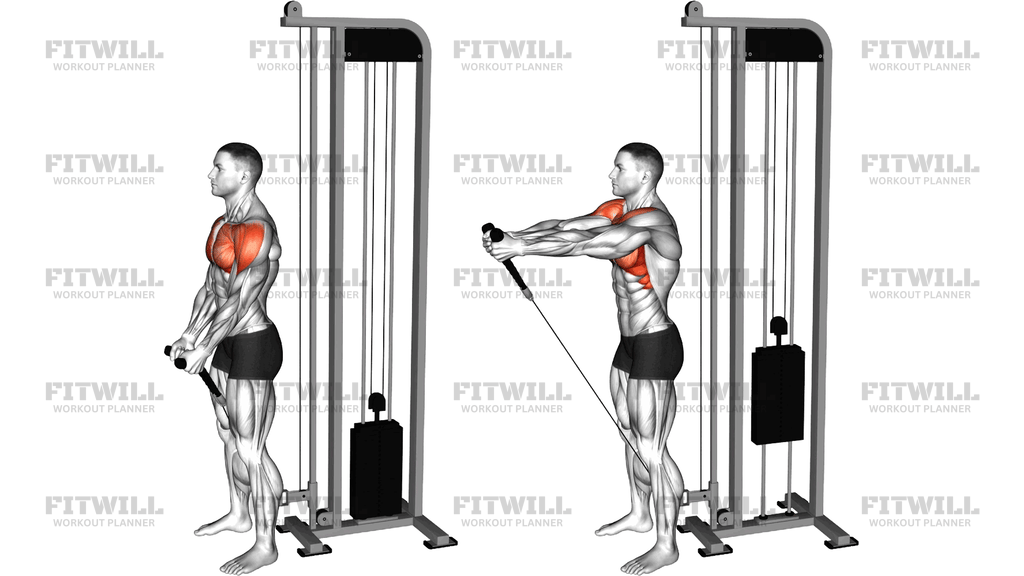
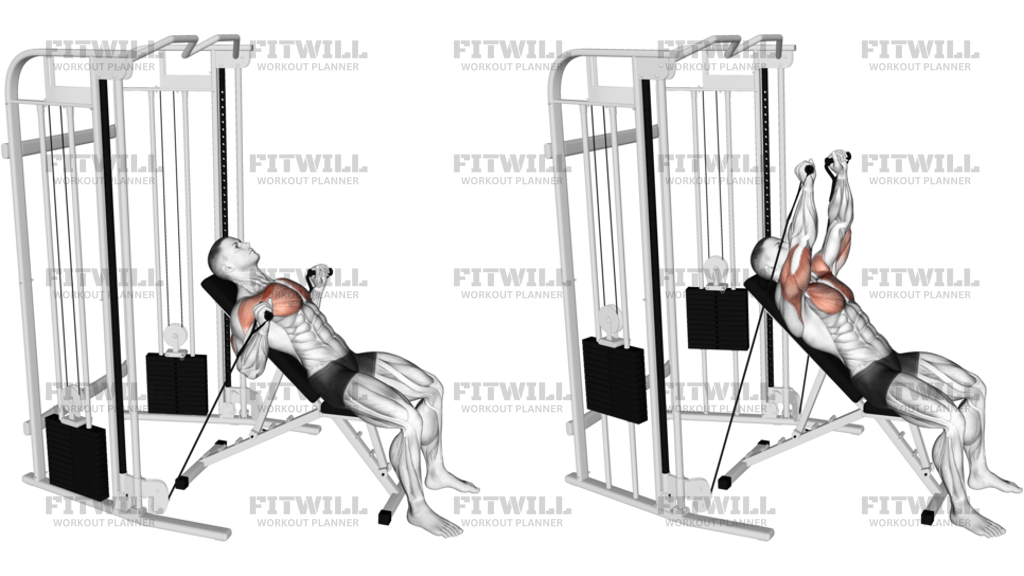
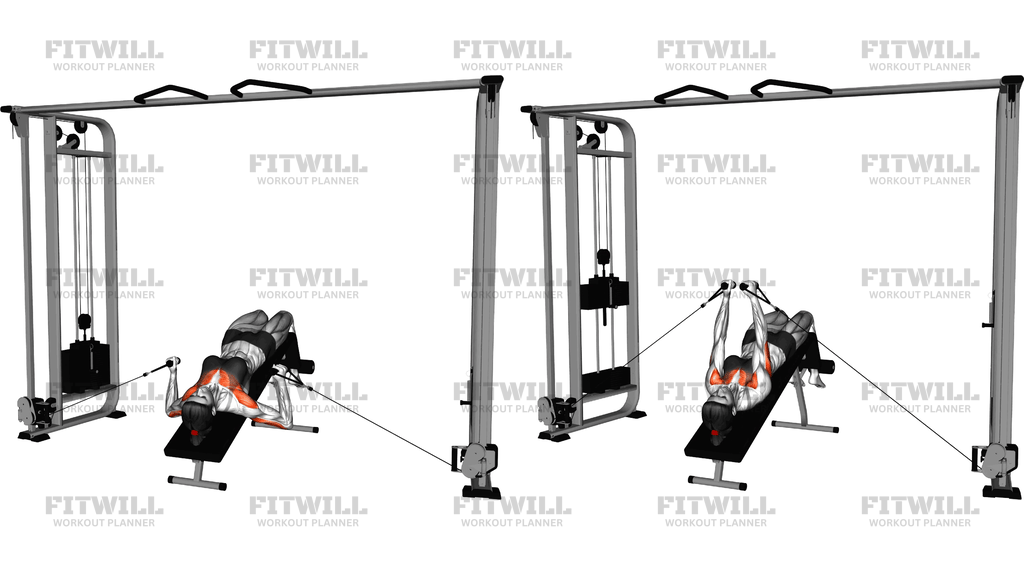
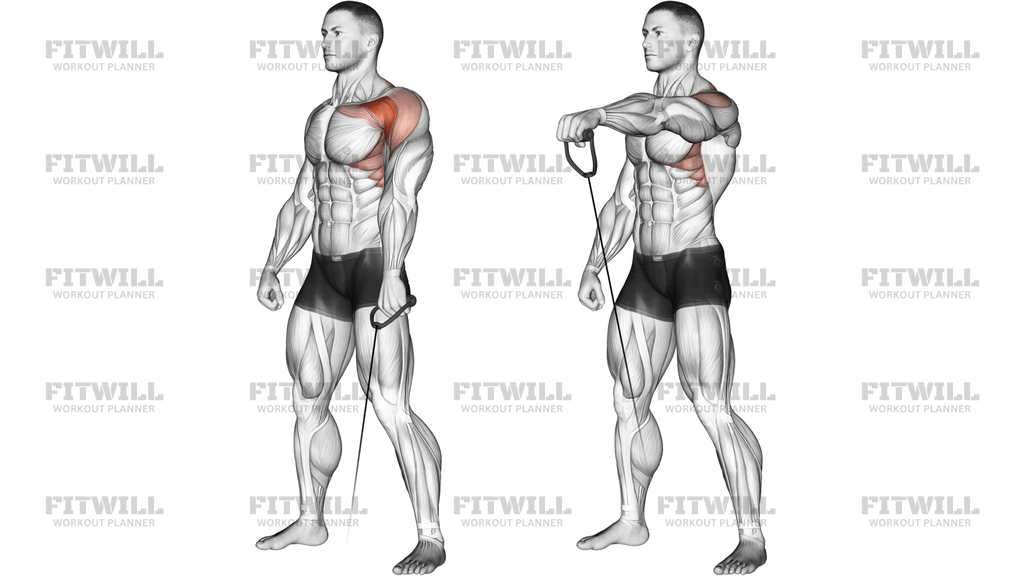
Cable Lying Floor Front Raise
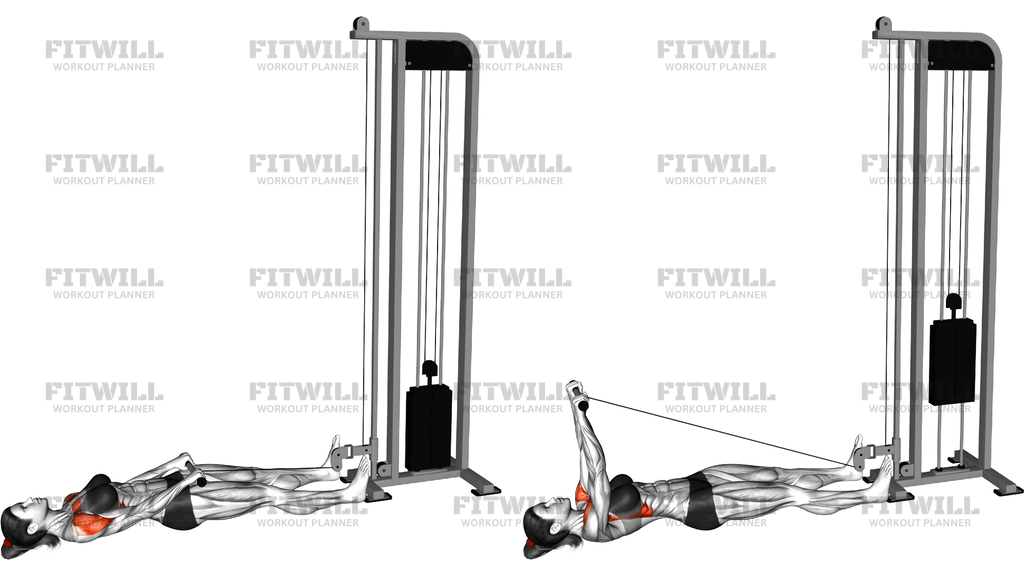
The Cable Lying Floor Front Raise is a supine cable movement where you lie flat on your back on the floor, grip a handle attached to the low pulley of a cable machine, and raise your straight arms from your thighs up to vertical above your chest. Because your head points away from the machine and your feet rest toward the pulley, the cable runs along your body, and the resistance pulls downward toward your hips the entire time. That constant, low-angle tension is what separates this from a dumbbell front raise, where resistance fades as the arm rotates.
The movement primarily trains the front shoulders, with the upper chest contributing meaningfully as the arms approach the top position — which is why the chest lights up in the second half of each rep. The core also works isometrically to keep your ribs down and your lower back flat against the floor while the cable pulls your arms toward your hips.
This setup suits lifters who want strict, isolated shoulder flexion without any body English. Standing front raises make it easy to lean back or swing the weight, but lying on the floor locks your torso in place, so the shoulders have to do the work on their own. The floor also gives you instant feedback: if your lower back arches or your ribs flare, you will feel it immediately and can correct it on the next rep.
Setup matters more here than in most raise variations. Your distance from the machine determines where the cable pulls from — too close and the line drags toward your feet, too far and you lose tension at the bottom. Set yourself so the cable runs smoothly along your legs and your arms can rest at your sides with light, even tension before the first rep begins. Grasp the handle with both hands using an overhand grip, and keep your feet relaxed or lightly braced against the machine base for stability.
To execute it well, keep the raise a straight-arm arc, not a press. The elbows stay extended, the hands travel in a smooth vertical path from your thighs to a point above your chest, and the return is slow and deliberate — the lowering half is where the front shoulders and upper chest do much of their work. Breathe out on the way up, in on the way down, and stop just short of letting the weight stack touch down between reps so tension stays on the muscle.
You will see this movement used as an accessory after pressing work, as a low-load option for lifters with cranky shoulder joints who tolerate lying positions better than overhead pressing, and in programs that pair it with lying cable pullovers to hit the shoulder-to-chest transition from both angles. Start light — the lying position removes momentum, so a weight that feels manageable standing will feel considerably heavier here.
Fitwill
Log Workouts, Track Progress & Build Strength.
Achieve more with Fitwill: explore over 9600 exercises with images and videos, access built-in and custom workouts, perfect for both gym and home sessions, and see real results.
Start your journey. Download today!




Instructions
- Set the pulley of the cable machine to its lowest position and attach a single handle.
- Lie flat on your back on the floor with your head pointing away from the machine and your feet toward the pulley, far enough out that the cable runs cleanly along your legs.
- Grasp the handle with both hands using an overhand grip, arms straight, and let the handle rest on the front of your thighs with slight tension in the cable.
- Press your lower back gently toward the floor, draw your ribs down, and brace your core before the first rep.
- Keeping your elbows locked in a soft-but-straight position, raise the handle in a smooth arc up and over your chest until your arms are vertical and perpendicular to the floor.
- Pause briefly at the top with the handle stacked directly over your upper chest, not drifting behind your head.
- Lower the handle back down along the same arc until it returns to your thighs, resisting the cable's pull the whole way.
- Stop just before the weight stack settles so the cable stays taut, then begin the next rep.
- Exhale as you raise the handle and inhale as you lower it, keeping your breathing steady throughout the set.
- When finished, place the handle back on your thighs, sit up carefully, and let the stack return before letting go of the handle.
Tips & Tricks
- The most common mistake is turning the raise into a press by bending the elbows at the bottom — the elbows should stay extended so the shoulders, not the triceps, move the load.
- If your lower back arches off the floor as the cable pulls down, bend your knees slightly and plant your feet, or reduce the weight; the ribs-down position protects your spine and keeps the work on the shoulders.
- Letting the handle drift behind your head at the top shifts stress away from the front shoulders — finish each rep with the handle stacked over your upper chest.
- Start lighter than you think you need. Lying down removes every opportunity to swing or lean, so the front shoulders face the full load unassisted.
- Adjust your distance from the machine before your first rep: if the cable scrapes your legs or pulls at an angle toward your feet, slide closer or farther until the line runs parallel along your body.
- Control the lowering phase for two to three seconds — the eccentric portion is where the upper chest gets its share of the work, and dropping the handle wastes it.
- Keep tension at the bottom by stopping just short of full stack return; letting the stack clank down turns each rep into a dead start and jerks the shoulder.
- If one arm tends to lead, check your grip — both hands should hold the handle evenly, or use two single handles, one per hand, to keep the effort symmetrical.
Frequently Asked Questions
Which muscles does the Cable Lying Floor Front Raise work?
The front shoulders are the primary movers, raising the straight arms against the cable's downward pull. The upper chest assists strongly in the top half of the arc as the arms approach vertical over the chest.
Why lie on the floor instead of doing a standing cable front raise?
The floor pins your torso so you cannot lean back or swing the weight, forcing the shoulders to do the lifting. It also keeps constant tension on the muscle because the cable pulls toward your hips through the whole range.
Is the Cable Lying Floor Front Raise suitable for beginners?
Yes, as long as the weight is kept light. The movement path is simple and the floor position provides immediate feedback — if your lower back arches, the load is too heavy or your brace has slipped.
How far from the cable machine should I position myself?
Lie far enough out that the cable runs smoothly along your legs and your straight arms rest at your thighs with light tension before the first rep. If the cable drags across your legs or loses tension, slide closer or farther until the line is clean.
Should my elbows stay straight during the Cable Lying Floor Front Raise?
Yes, keep the arms extended with only a very soft bend at the elbows. Bending them turns the movement into a press and shifts work away from the front shoulders.
What is the most common mistake with this exercise?
Letting the lower back arch off the floor as the cable pulls down, usually because the weight is too heavy. Fix it by bracing the core, ribs down, and reducing the load until you can keep your back flat for every rep.
What can I substitute if I don't have access to a cable machine?
A lying front raise with a light dumbbell or a resistance band anchored low behind your feet reproduces a similar path. Neither matches the cable's constant tension exactly, but both train the same front-shoulder pattern.
How heavy should I go on the Cable Lying Floor Front Raise?
Choose a weight you can raise through the full arc without your back arching or your elbows bending — usually noticeably lighter than your standing front raise. Higher reps with clean form work best for this isolation movement.
Is it safe for people with shoulder discomfort?
The lying position and light cable load are often easier on the shoulder joint than pressing, but stop if you feel pinching, especially near the top of the arc. Reduce the range or the weight, and check with a qualified professional if discomfort persists.
Where should the handle finish at the top of each rep?
Directly above your upper chest with your arms vertical and perpendicular to the floor. Finishing over your face or letting the handle drift behind your head changes the angle of pull and reduces front-shoulder work.