Cable Full Front Raise
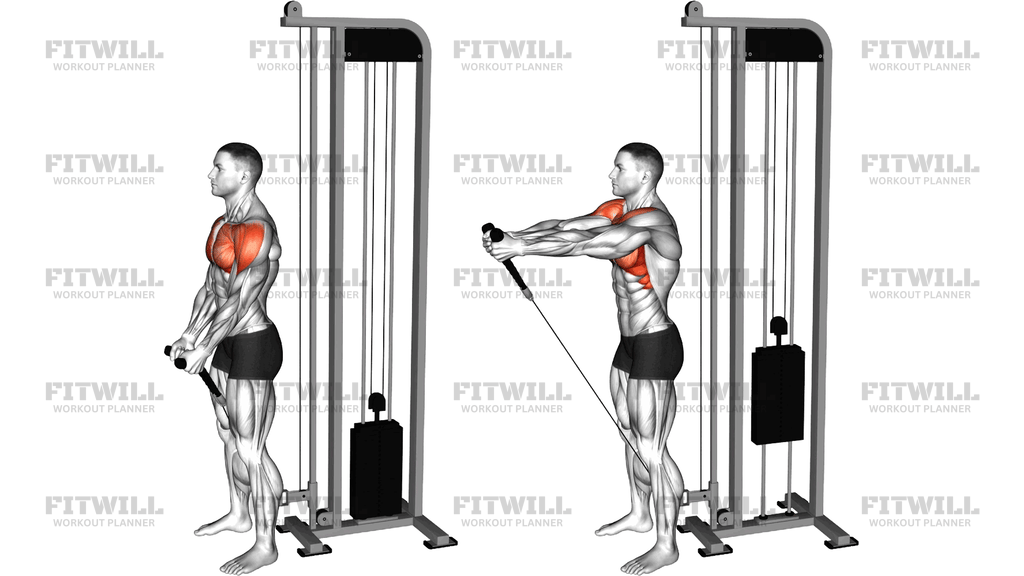
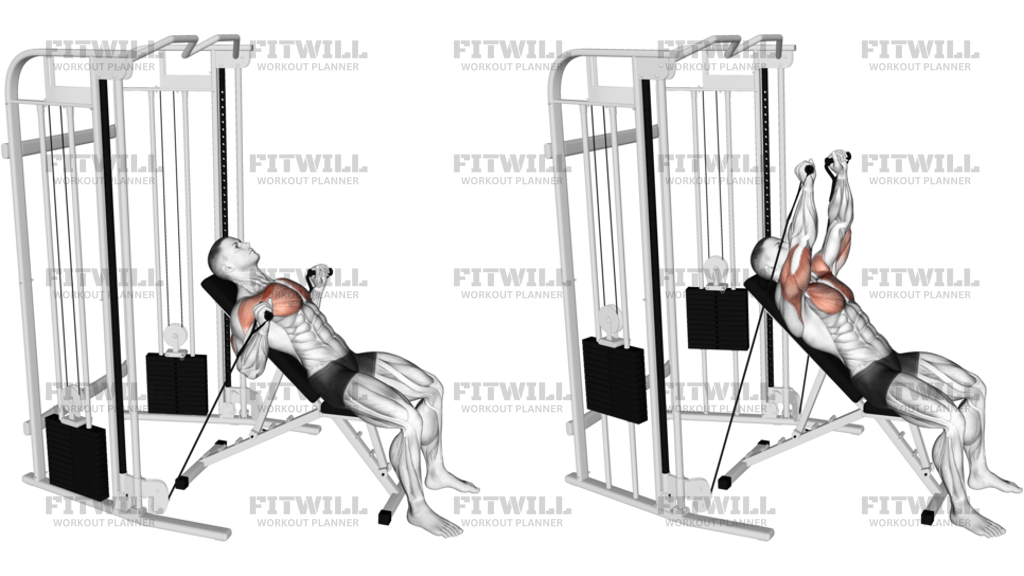
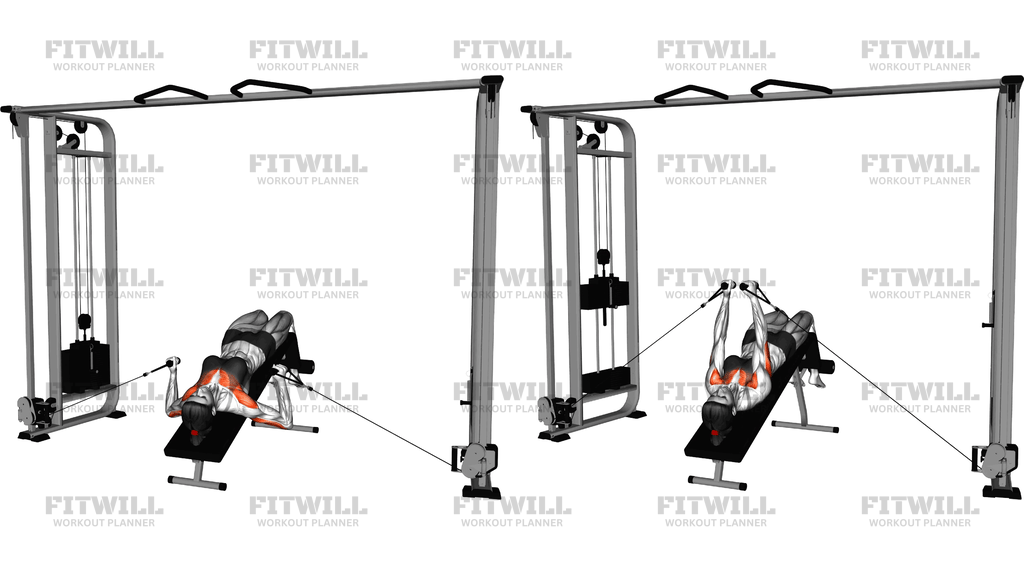
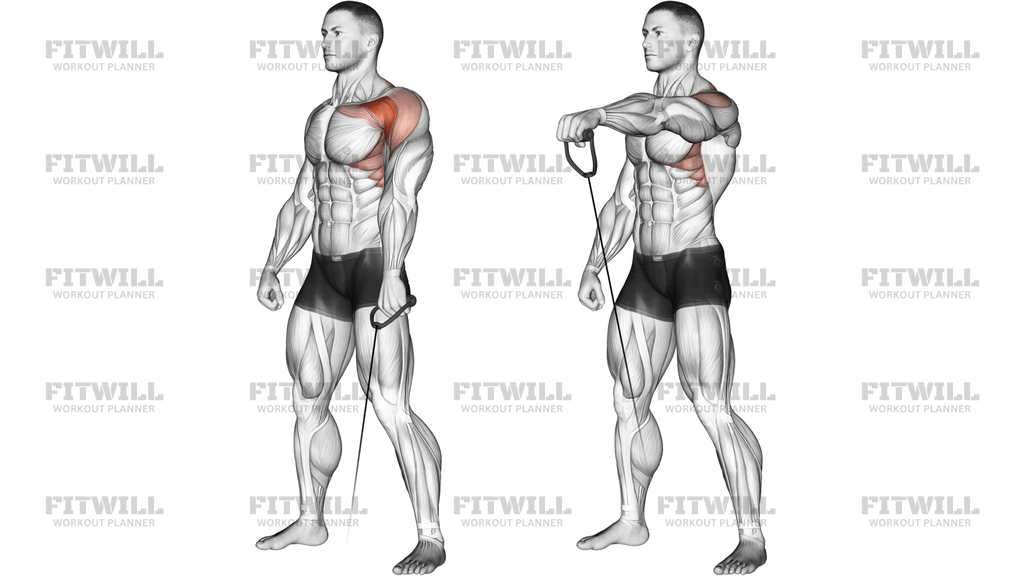
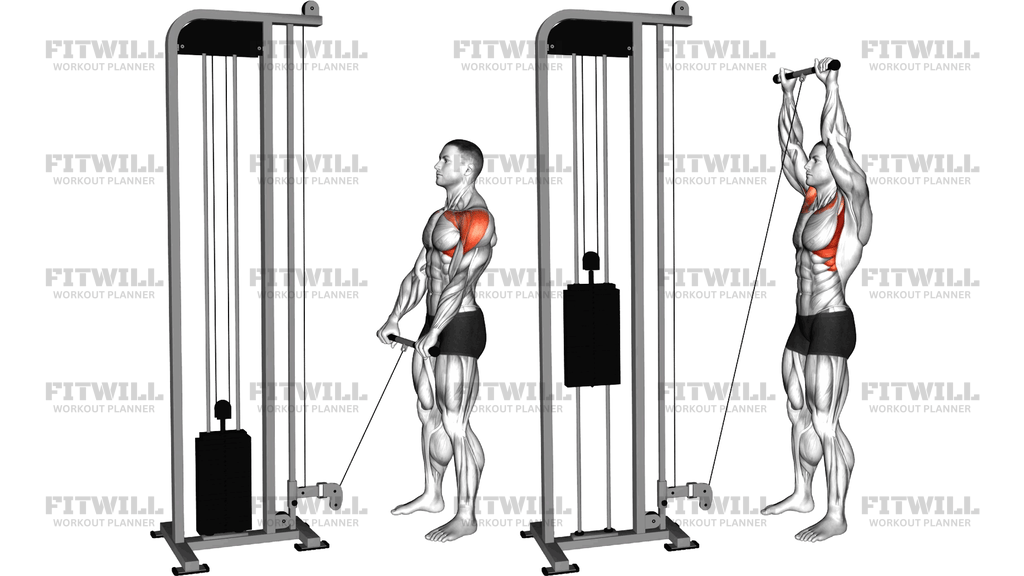
The Cable Full Front Raise is a standing shoulder exercise performed with a straight bar attached to the low pulley of a cable machine. You face away from the machine, hold the bar behind your thighs with an overhand grip, and raise it in a smooth arc in front of your body until your arms are fully overhead. Unlike a standard front raise that stops at shoulder height, the full version takes the bar all the way to the top, which challenges the front shoulders through a much longer range.
Because the cable pulls from behind and below you, the resistance stays on the shoulders at every point of the arc. With dumbbells, tension fades as your arms pass in front of your torso and gravity pulls straight down; the low pulley keeps constant, backward-directed tension, including the often-awkward overhead portion where the front delts and upper chest work together.
The main muscles worked are the front shoulders, with meaningful support from the upper chest near the top of the lift and the upper traps as they assist in elevating the arms. Your core, legs, and the muscles around your shoulder blades work statically the whole time to stop the cable from pulling you backward or arching your lower back.
Setup matters more here than in most raises. Standing roughly a step in front of the pulley, with your back to the machine, gives the cable room to travel and sets the angle of pull. If you stand too close, the cable drags your arms backward and the top of the movement becomes a pulling exercise; too far away, and the start position feels slack. A shoulder-width stance, soft knees, and a braced trunk give you a stable base for a heavy-ish load.
To execute well, keep the bar close to your body on the way up, lead with your hands, and let your arms travel in the sagittal plane rather than drifting outward. Pause briefly overhead, then lower under control until the bar touches your thighs before starting the next rep. Avoid swinging, leaning back, or turning this into a partial shrug-and-throw.
This movement suits lifters who want steady tension on the front delts, people whose dumbbell front raises have stalled, and anyone building a shoulder day around cable work. It pairs naturally with lateral raises and rear delt work for balanced shoulder development, and it is easy to progress by adding small weight increments on the stack.
[ Workout Log & Planner ]
Put your next workout in Fitwill
Keep your plan and training log ready when you are.


Instructions
- Set the pulley of the cable machine to the lowest position and attach a straight bar to the carabiner.
- Select your weight, then grab the bar with an overhand, shoulder-width grip and step forward so you are standing with your back to the machine, about one step in front of the pulley.
- Position the bar in front of your thighs with your arms straight, feet shoulder-width apart, knees slightly bent.
- Brace your core, pull your ribs down, and squeeze your glutes so the cable cannot pull your torso into an arch.
- Raise the bar straight out in front of your body, keeping it close to your torso and your elbows locked in a soft but fixed position.
- Continue the arc until your arms are fully overhead and in line with your ears, without shrugging the bar upward with your traps.
- Hold the top position for a beat, keeping tension on the shoulders rather than letting the cable pull the bar behind your head.
- Lower the bar slowly along the same path until it returns to your thighs, resisting the cable the entire way down.
- Exhale as you raise the bar and inhale as you lower it, resetting your brace before each rep.
- Complete your set, then step back toward the machine before releasing the bar so the weight stack settles without yanking you.
Tips & Tricks
- If your lower back arches at the top, the weight is usually too heavy or your stance is too close to the pulley — drop the load and take a half step forward.
- Keep the bar traveling close to your body; letting it swing away from you turns the raise into a lever arm for your lower back instead of your shoulders.
- Do not let the bar drift behind your head at the top. If it does, stop the arc earlier and shorten the range until your shoulder mobility allows a true overhead finish.
- Resist the temptation to shrug as you press toward the ceiling — upper traps will try to take over from the front delts in the last third of the arc.
- Use a controlled three-second lowering phase; the eccentric is where the cable's constant tension gives you the most value over dumbbell raises.
- Avoid unlocking and re-bending your elbows rep to rep, which turns the movement into a partial front raise plus a mini triceps extension.
- Start lighter than you would for a dumbbell front raise — the full overhead range with cable tension is harder than most people expect.
- If your shoulders pinch at the top, try a slightly wider grip or reduce the range to just above shoulder-to-ear height rather than forcing the full arc.
- Keep your neck neutral by looking straight ahead rather than craning up to follow the bar.
Frequently Asked Questions
What muscles does the Cable Full Front Raise work?
The front shoulders are the primary movers, with the upper chest contributing as the arms pass above shoulder height and the upper traps assisting at the top. Your core and lower back work isometrically to keep you upright against the cable's pull.
Why raise the bar all the way overhead instead of stopping at shoulder height?
The overhead finish extends the range of motion so the front delts work through a longer arc under continuous tension. Stopping at shoulder level leaves the top third of the movement untrained.
Is the Cable Full Front Raise suitable for beginners?
Yes, as long as beginners start with a light weight and focus on keeping the torso still. The cable's backward pull makes any loss of posture obvious, which actually helps new lifters learn to brace properly.
How far should I stand from the cable machine?
Roughly one step in front of the low pulley is a good starting point. This gives the cable a slight downward-backward angle at the start and keeps tension consistent without dragging your arms behind your body.
Why does my lower back arch during this exercise?
The cable pulls you backward and downward, so an unbraced trunk extends at the lower back to compensate. Brace your core, squeeze your glutes, reduce the weight, and check that you are not leaning back as the bar rises past your head.
Can I use a rope or two single handles instead of a straight bar?
You can, but the straight bar keeps both arms locked to the same path and makes the overhead finish easier to control. Handles allow a more neutral grip, which some lifters find friendlier on the shoulder joints.
How is the Cable Full Front Raise different from a dumbbell front raise?
The cable provides resistance that points back toward the pulley at every angle, while a dumbbell only resists you vertically. The cable also loads the overhead portion, where dumbbells provide very little challenge for the delts.
How many reps and sets should I do?
Because it is a smaller, isolation-style movement, 2-4 sets of 10-15 controlled reps works well for most lifters. Keep the tempo strict rather than chasing heavy loads on this one.
Should my elbows be locked or bent during the raise?
Keep them fixed with a very slight bend throughout. Actively bending and straightening the elbows each rep shifts work toward the arms and shortens the effective range for the shoulders.