Dumbbell Side Plank With Rear Fly
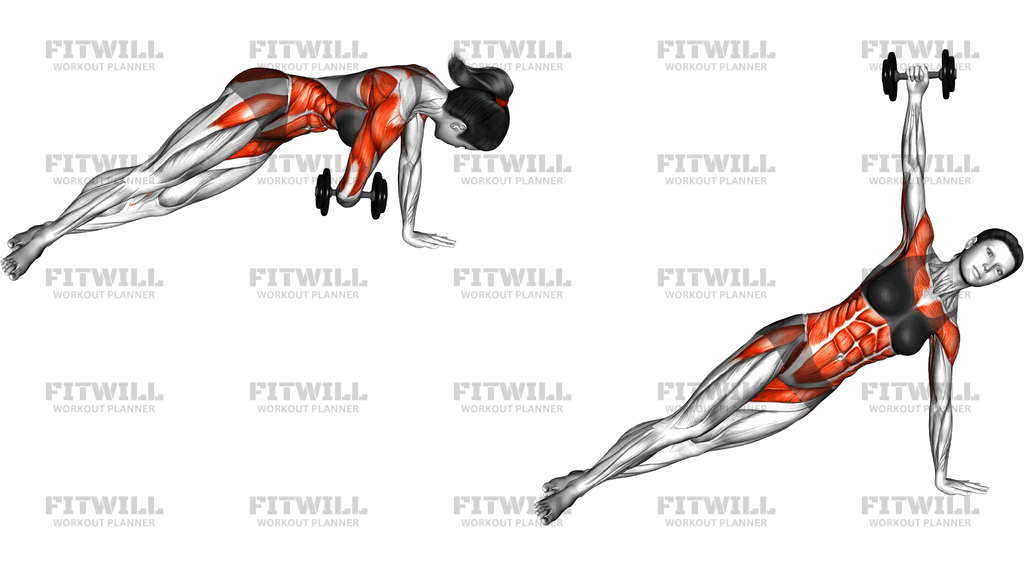
The Dumbbell Side Plank With Rear Fly combines two demands that most exercises keep separate: holding a stable side plank while moving a dumbbell through a controlled fly motion with your top arm. You support your body on one straight arm, stack your feet, and lift the dumbbell from a hanging position beside your ribs up toward the ceiling, all without letting your hips sag or rotate. The result is a movement that trains your waist and your upper back at the same time, under real anti-rotation tension.
This exercise earns its place in a program because the plank position is no longer passive. Every rep of the fly tries to pull your torso out of alignment, so your obliques, deep core, and hip stabilizers have to work continuously just to keep your body in a straight line. Meanwhile the moving arm trains the rear shoulder and upper back through a wide arc, which is useful for anyone whose pressing work or desk posture has left those areas undertrained.
Setup quality decides whether this movement works or falls apart. Because you are supporting yourself on a straight arm rather than a forearm, your wrist, elbow, and shoulder must line up vertically, and your feet must be stacked or staggered so the side of your bottom foot carries the load. Set up on an exercise mat to give your hand and ankle a bit of cushioning, and place the dumbbell within easy reach of your top hand before you commit to the plank.
To perform it well, think of your body as one rigid plank from heels to head while only the top arm moves. The dumbbell travels in a smooth arc from beside your waist up until your arm points toward the ceiling, roughly in line with your shoulder, then lowers with the same control. If your hips drift backward, your supporting shoulder shrugs, or the weight pulls you off balance, the load is too heavy or the arc is too wide.
This drill suits intermediate lifters and anyone training core stability for sport, since rotating and resisting rotation while handling a load mirrors what most field and court sports actually demand. It also works well as a finisher on shoulder or core days, or as part of a circuit where you alternate sides. Beginners can build toward it by mastering a standard side plank on the hand first, then adding a very light dumbbell or no weight at all.
A few practical points keep it safe. Start lighter than you think you need, because a dumbbell you can row comfortably becomes awkward once your body is sideways. Stop the set when you cannot keep your hips high and square, since a sagging or twisted plank stops training the intended muscles and starts loading your lower back and supporting shoulder in ways they are not prepared for.
[ Workout Log & Planner ]
Put your next workout in Fitwill
Keep your plan and training log ready when you are.


Instructions
- Place an exercise mat on the floor and set a light dumbbell next to one end of it, within reach of your top hand once you are lying down.
- Sit sideways on the mat with your legs extended, then lower onto your bottom hip and place your lower hand flat on the mat directly under your shoulder, arm fully straight.
- Stack your top foot on your bottom foot, or stagger the top foot slightly in front for extra support, and reach your top hand across your body to grip the dumbbell.
- Lift your hips off the mat until your body forms one straight line from your heels through your hips to your head, with your supporting wrist, elbow, and shoulder stacked vertically.
- Brace your abs and squeeze your glutes, letting the dumbbell hang straight down beside your lower ribs with your top arm relaxed.
- Exhale and raise the dumbbell in a smooth arc up and out until your arm points toward the ceiling, keeping a slight bend in the elbow and your torso completely still.
- Pause briefly at the top with your arm in line with your shoulder, then inhale as you lower the dumbbell back down beside your ribs under control.
- Complete all reps on one side while keeping your hips high, then lower your hips to the mat, set the dumbbell down, and switch to the other side.
- Breathe steadily throughout, avoiding the urge to hold your breath as the plank position becomes tiring.
Tips & Tricks
- The most common failure is the hips rotating backward as the dumbbell rises, because the moving arm tries to spin your torso. Imagine a water glass balanced on your top hip and keep it level for every rep.
- If your supporting shoulder starts shrugging toward your ear, actively press the mat away and lengthen your neck. A shrugged side plank shifts work away from the obliques and strains the shoulder joint.
- Choose a weight you could lift for a slow lateral raise while standing, not one you could row. The side plank position gives you far less leverage, so a heavy bell will drag your torso out of line.
- Let the dumbbell hang fully at the bottom of each rep rather than cutting the range short. The stretch beside your ribs is part of the rear shoulder and upper back benefit.
- If your bottom wrist aches before your core or shoulders fatigue, drop to a forearm side plank variation with the fly, or spread your fingers and shift some pressure into the heel of the palm.
- Your head is part of the plank line. Looking up at the moving dumbbell is natural, but cranking the neck upward breaks the alignment, so keep your gaze forward and let the top arm move into your peripheral vision.
- Widen your feet slightly or stagger the top foot in front if you wobble side to side. A narrower stance is harder on the hip stabilizers, so earn it before narrowing.
- Do your weaker side first and match the rep count on the stronger side. Balance between sides matters more here than in most exercises, since side planks expose asymmetries quickly.
Frequently Asked Questions
What muscles does the Dumbbell Side Plank With Rear Fly work?
The obliques and deep core work isometrically to hold the side plank, while the rear shoulder and upper back move the dumbbell through the fly. Your glutes and hip stabilizers also work hard to keep the hips stacked and level.
How is this different from a regular side plank with a dumbbell raise?
Because your body is braced on one hand while the top arm moves, every raise challenges anti-rotation as well as shoulder strength. A standing dumbbell raise isolates the shoulder, but this version makes your waist work for the entire set.
Can beginners do the Dumbbell Side Plank With Rear Fly?
Yes, but most beginners should first hold a side plank on the straight arm for 20 to 30 seconds per side without weight. Once that feels solid, add a very light dumbbell of one to three kilograms and keep the arc small.
Why do my hips drop when I lift the dumbbell?
This usually means the weight is too heavy or your glutes have stopped working. Lighten the load, squeeze your glutes to lift the hips slightly higher, and think about pushing the floor away with your supporting hand throughout the rep.
Should my feet be stacked or staggered?
Stacked feet make the plank harder and demand more from the obliques and outer hips, while staggering the top foot in front gives you a wider base and more control. Start staggered if you are new to the movement and progress to stacked.
How many reps and sets should I do?
Two to three sets of 8 to 12 controlled flys per side works well for most people. If your plank collapses before your arm fatigues, treat time under tension as the goal and reduce the weight.
What can I use instead of a dumbbell?
A small weight plate, a kettlebell held by the handle, or nothing at all all work. Performing just the side plank with the top arm sweeping toward the ceiling keeps the anti-rotation challenge and makes a good regression.
Is it safe for my supporting shoulder and wrist?
It is generally fine when your wrist, elbow, and shoulder stack vertically and you stop when form breaks down. If you have a history of wrist or shoulder discomfort, use a forearm support position or get clearance from a qualified professional first.
Where should the dumbbell travel during the fly?
It starts hanging beside your lower ribs and arcs up until your arm points at the ceiling, roughly in line with your shoulder joint. Reaching too far behind your body pulls your torso out of the plank and reduces control.