Dumbbell Low Windmill
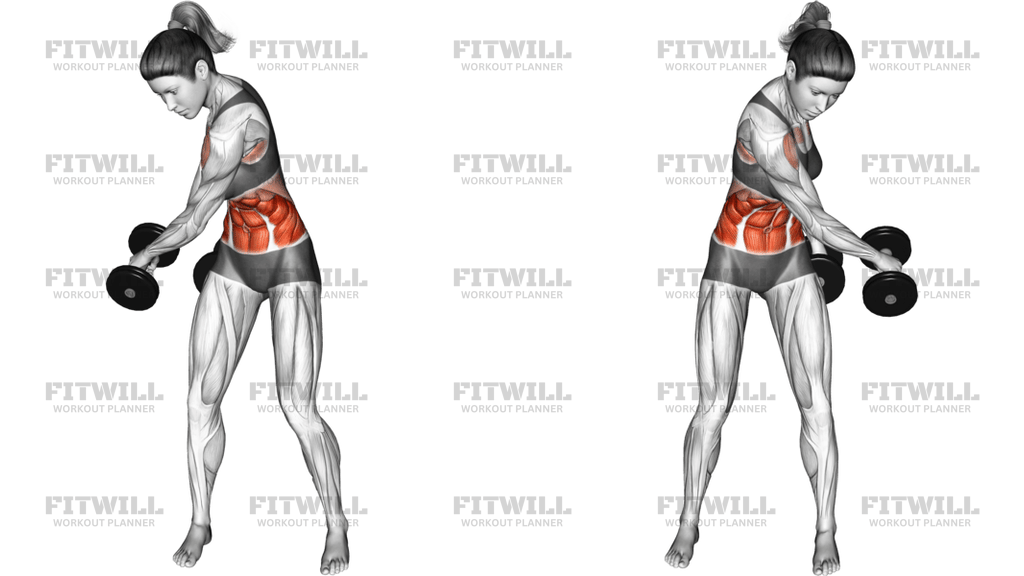
The Dumbbell Low Windmill is a rotational hip hinge built around a wide stance and a single dumbbell. You hold the weight in one hand at your side, press your other arm straight up toward the ceiling, and then fold sideways at the hips until the dumbbell lowers toward your lower leg while the top arm stays reaching vertically. Because the torso rotates around the hip instead of simply bending at the waist, the movement demands hip mobility, hamstring flexibility, and serious control through the trunk all at once.
The main work comes from the obliques on both sides of your waist — one side loads as you fold down, the other resists collapse as you return. The glutes and hamstrings of the loaded leg handle the hinge itself, the shoulder stabilizing the raised arm works hard to keep that arm stacked and vertical, and the adductors and hips hold the wide stance together. It is one of the few standing exercises that trains lateral hip strength and anti-rotation trunk control in the same rep.
This movement suits lifters who already own a decent hip hinge and want to build rotational strength that carries over to throwing, swinging, grappling, or asymmetric carrying like suitcase loads. It is also popular in mobility-focused programs because the windmill position doubles as an active stretch for the hamstrings and outer hip. If you are new to hinging, work on a plain hip hinge and bodyweight windmill first before adding the dumbbell.
The setup is what makes or breaks this lift. Your feet need a stance clearly wider than your shoulders, with both toes rotated toward the side holding the dumbbell. That foot angle lets the pelvis turn so your torso can fold along a diagonal path rather than grinding sideways through your lower back. Skip the foot rotation and the movement becomes a strained side bend that stresses the spine instead of training the hips.
Execution should feel like sitting your hips back and toward the dumbbell side while the raised arm keeps pointing at the ceiling. Keep your eyes on the top hand for as long as you can — that single cue keeps your thoracic spine extended and stops the collapse into a slumped side bend. Go only as low as your hamstrings and hip mobility honestly allow; touching the floor is not the goal. Drive the movement back up by squeezing the glute of the loaded leg, not by yanking with the arm or waist.
Start with a light dumbbell, even just a few pounds, and treat the first few sessions as practice. This is a precision exercise dressed up as a strength exercise, and the lifters who get the most from it are the ones who respect the range they actually have.
[ Workout Log & Planner ]
Put your next workout in Fitwill
Keep your plan and training log ready when you are.


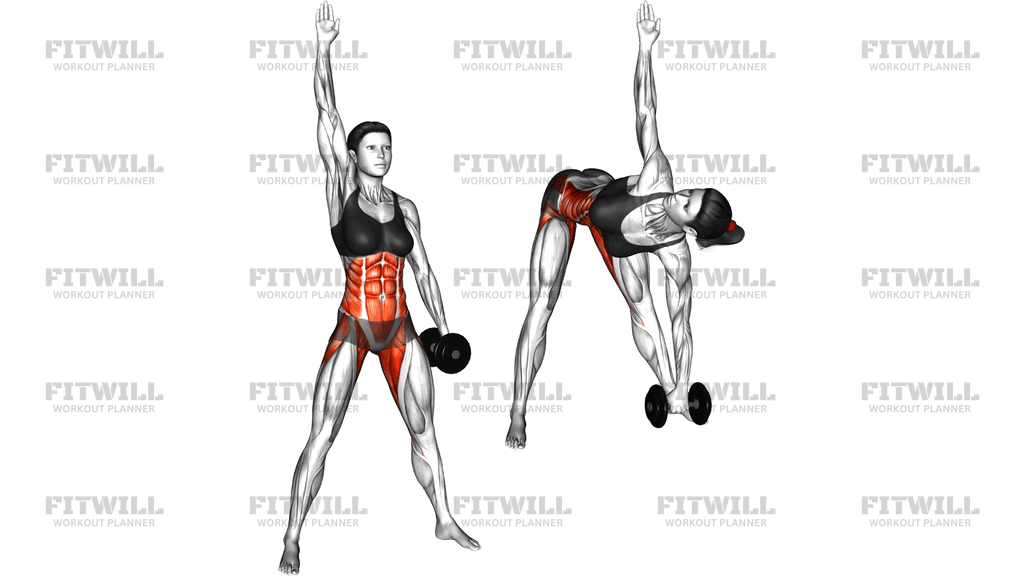
Instructions
- Stand with your feet roughly one and a half to two times shoulder width apart, then rotate both feet so the toes point toward the side that will hold the dumbbell.
- Hold a dumbbell in one hand at your side with a firm grip, letting it hang naturally from the shoulder.
- Press your free arm straight up toward the ceiling and turn your head to keep your eyes on that raised hand.
- Push your hips back and slightly toward the dumbbell side, shifting your weight into the loaded leg.
- Hinge sideways along the diagonal, letting the dumbbell slide down toward your shin or lower leg while the top arm stays vertical.
- Descend until you feel a strong hamstring and outer hip stretch, stopping well before your lower back rounds or twists.
- Pause briefly in the bottom position with the top arm still reaching straight up.
- Drive up by squeezing the glute of the loaded leg and pulling your hips back under your torso.
- Exhale as you fold down, inhale on the way up, and keep your breathing steady rather than holding your breath.
- Complete all reps on one side, switch the dumbbell to the other hand, rotate your feet the other way, and repeat.
Tips & Tricks
- The most common fault is bending sideways through the waist instead of hinging at the hips — if you feel it pinching in your lower back, push your hips further back before descending.
- When the raised arm drifts forward or bends, the trunk usually collapses with it; correct this by pausing at the top and re-stacking the shoulder directly under the hand before each rep.
- A stance that is too narrow is the usual reason lifters cannot rotate enough — widen your feet before blaming your flexibility.
- Look at your top hand throughout the rep; dropping your eyes to the floor is often the first sign your thoracic position is failing.
- Keep the knee of the loaded leg soft but not bent deeply — a deep knee bend turns the windmill into a squat and removes the hamstring stretch.
- If the dumbbell pulls your shoulder down and forward at the bottom, the weight is too heavy; drop to a lighter bell until your shoulder position holds.
- Front foot and back foot both rotate toward the dumbbell side — forgetting to rotate the back foot is a subtle mistake that blocks pelvic rotation.
- Practice the full pattern with no weight or an empty hand for a week; the arm path and hip shift are awkward until your nervous system learns them.
- Do this exercise early in a session while you are fresh, not as a finisher when your grip and hips are already fatigued.
Frequently Asked Questions
What muscles does the Dumbbell Low Windmill work?
The obliques do the primary trunk work, while the glutes and hamstrings of the loaded leg drive the hinge. The shoulder holding the raised arm works isometrically to keep that arm stacked and vertical.
Why does the Dumbbell Low Windmill use such a wide stance with rotated feet?
The wide, rotated stance lets the pelvis turn so your torso folds along a diagonal path around the hip. Without the foot rotation, your pelvis cannot rotate and the movement becomes a strained lower-back side bend.
Is the Dumbbell Low Windmill safe for beginners?
Beginners can do it, but only after learning a solid hip hinge and practicing the bodyweight version first. Start with a very light dumbbell and a reduced range, and progress depth only as hip and hamstring mobility allow.
How low should I reach with the dumbbell?
Lower the dumbbell toward your shin or lower leg only as far as you can keep your back flat and your top arm vertical. Touching the floor is not the goal — depth that costs your spinal position is depth you do not want.
Why do I keep losing the position of my raised arm?
This usually means the trunk is collapsing and the shoulder is drifting forward. Slow the descent, keep your eyes on the top hand, and consider reducing the weight or range until the arm stays stacked.
Can I substitute the Dumbbell Low Windmill with a regular side bend?
A side bend trains the obliques through lateral flexion, but it does not train the hip rotation, hamstring loading, or anti-collapse control of the windmill. If you cannot hinge properly yet, a bodyweight windmill or a kettlebell windmill variant are closer substitutes.
How heavy should the dumbbell be for this exercise?
Start lighter than you think you need — the asymmetric position makes moderate weights feel far heavier than a standard dumbbell move. Add load only when you can hold the top arm perfectly vertical through every rep.
How many reps and sets of the Dumbbell Low Windmill should I do?
Two to three sets of five to eight slow reps per side works well, treated as a strength and control exercise. Keep the pace deliberate so you can feel the hip hinge rather than rushing through it.
Should I do the Dumbbell Low Windmill on both sides?
Yes, always work both sides with the same volume, even if one side feels stiffer or weaker. Matching reps left and right helps avoid reinforcing side-to-side asymmetries in hip mobility and trunk control.