Cable Lying Bench Single Leg Curl
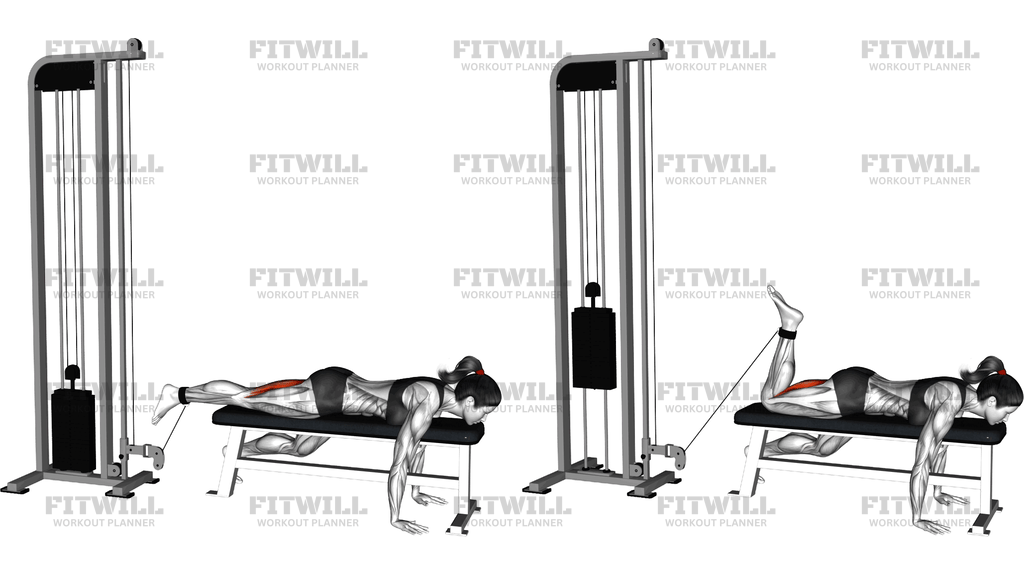
The Cable Lying Bench Single Leg Curl is a prone single-leg hamstring exercise performed with an ankle strap attached to a low cable pulley. You lie face down along a flat bench positioned a short distance from the cable machine, let the cable pull your working leg into a straight line, and then curl your heel up toward your glutes against the resistance. The weight stack provides smooth, constant tension through the entire range, including the stretched position where lying leg curls are hardest to load.
This movement targets the hamstrings as the primary knee flexors, with the gastrocnemius of the calf assisting and the glutes and low back working to keep your pelvis and torso stable on the bench. Training one leg at a time makes it easy to spot and fix side-to-side strength differences, and the supported position removes balance from the equation so you can focus entirely on the curl itself.
Setup matters more here than in most hamstring work. The bench needs to sit far enough from the pulley that the cable pulls your leg straight back when extended, but close enough that the strap and carabiner do not snag on the bench frame. Your kneecap should rest just past the edge of the pad so the knee can bend fully without pressing into the bench, and your hands should grip the bench frame or the floor beneath it to anchor your torso.
To perform it well, keep your hips pressed down and your torso relaxed as you pull your heel toward your buttocks in a smooth arc, pause briefly at the top, then lower with control until your knee is nearly straight. Avoid jerking the weight off the stack or letting the cable yank your leg back down; the return is where a lot of the hamstring stimulus lives. Exhale on the curl, inhale on the way down.
This exercise suits lifters who want dedicated hamstring volume without a dedicated leg curl machine, people rehabbing or prehabbing around knee flexion strength under coachable, low-load conditions, and anyone addressing a weaker leg after a unilateral leg curl comparison. It also works well as a finishing movement after squats or deadlifts when you want direct hamstring work with minimal systemic fatigue.
A few practical points keep it safe and productive: start lighter than you think you need, because a single leg doubles the load the strap and cable experience per rep, and check that the ankle strap is snug around the lower shin or ankle, not loose enough to slide. If your hips lift or your lower back arches hard to cheat the weight up, reduce the load and re-grip the bench before continuing.
[ Workout Log & Planner ]
Put your next workout in Fitwill
Keep your plan and training log ready when you are.


Instructions
- Attach an ankle strap to one ankle and clip it to the low pulley of the cable machine.
- Place a flat bench so its long axis points toward the pulley, far enough away that the cable runs back in a straight line when your leg is extended.
- Lie face down on the bench with your kneecap just past the edge of the pad and the strapped leg extended straight back toward the machine.
- Grip the bench legs or the floor under your shoulders to lock your torso in place, and let the free leg rest with that knee slightly bent for support.
- Brace your core lightly and press your hips down into the bench so your pelvis does not tilt as you pull.
- Curl your heel up toward your glutes, keeping the pull smooth and letting the cable travel close to your body without dragging the bench.
- Pause for a beat at the top with your knee fully bent and the hamstring squeezed.
- Lower your leg back down slowly until your knee is almost straight, resisting the weight stack the whole way without letting it slam down.
- Exhale as you curl up and inhale as you lower back down.
- Complete all reps on one leg, unclip the strap, move it to the other ankle, and repeat for the same number of reps.
Tips & Tricks
- If the cable scrapes the end of the bench or the carabiner rattles against the frame, slide the bench a few centimeters closer to or further from the pulley until the line is clean.
- Watch for hips rising off the bench as the weight gets heavy; that is your lower back stealing work from the hamstring, so cut the load rather than lift the pelvis.
- Point your toes toward your shin (dorsiflexion) at the bottom to slightly increase the hamstring stretch, and avoid pointing the toe, which shifts effort toward the calf.
- Do not let the knee drift forward off the bench edge mid-set; keep the kneecap anchored past the pad so the knee can flex through its full range.
- A common mistake is cutting the top range short and only curling halfway. Bring the heel all the way to the glutes to finish the hamstring contraction.
- Keep the neck relaxed and your face turned to one side on the pad; craning the head up tightens the low back and encourages cheating.
- Because the strap loosens slightly when the leg is straight, keep light tension by never fully relaxing the leg at the bottom of each rep.
- If your weaker leg lags, match reps and weight to the weaker side and let the stronger leg follow, never the other way around.
- Slow the lowering phase to two or three seconds if you feel it only in the back of the knee rather than the belly of the hamstring.
Frequently Asked Questions
Which muscles does the Cable Lying Bench Single Leg Curl work?
The hamstrings are the primary movers, flexing the knee against the cable's resistance. The calves, especially the gastrocnemius, assist with knee flexion, while the glutes and lower back stabilize the pelvis on the bench.
Why train one leg at a time instead of using a regular leg curl machine?
Single-leg work exposes and corrects side-to-side strength differences that a two-leg machine can hide. It also lets you use a cable machine when a dedicated lying leg curl unit is not available.
How far should the bench be from the cable pulley?
Far enough that the cable pulls your extended leg straight back toward the machine without scraping the bench, but close enough that the strap and clip hang clear of the frame. Test the line with one light rep before starting your set.
Should my kneecap be on or off the bench?
Your kneecap should sit just past the edge of the pad so the knee can bend fully without being blocked by the bench. If the knee rests on the pad, your range at the top will be cut short.
Why do my hips lift during the set?
Rising hips usually mean the weight is too heavy and your lower back is extending to help curl the leg. Reduce the load, grip the bench more firmly, and consciously press your pelvis down into the pad.
Can beginners do the Cable Lying Bench Single Leg Curl?
Yes, and the supported position makes it beginner-friendly because there is no balance demand. Start with a light weight to learn the curl path and keep strict hip position before adding load.
What can I use if my gym has no ankle strap?
A sturdy handle attachment secured around the ankle can work in a pinch, but a proper ankle strap is safer and more comfortable for repeated sets. A lying or seated leg curl machine is the simplest substitution.
Is it safe for the knees?
The movement is a controlled knee flexion pattern against adjustable resistance, and the bench supports your body so the joint is not compressed. Keep the weight moderate, move smoothly, and stop if you feel pinching or pain rather than muscle effort.
How many reps and sets should I use?
Two to four sets of 8 to 15 reps per leg works well for most goals, with slightly higher reps as a finisher after squats or deadlifts. Because each side works alone, always match the weaker leg's rep count.
Should my toes be pointed or pulled back during the curl?
Pull your toes toward your shin for a slightly better hamstring stretch at the bottom and to keep the calf from dominating the curl. Pointing the toes tends to shift work toward the gastrocnemius.