Band Incline Biceps Curl
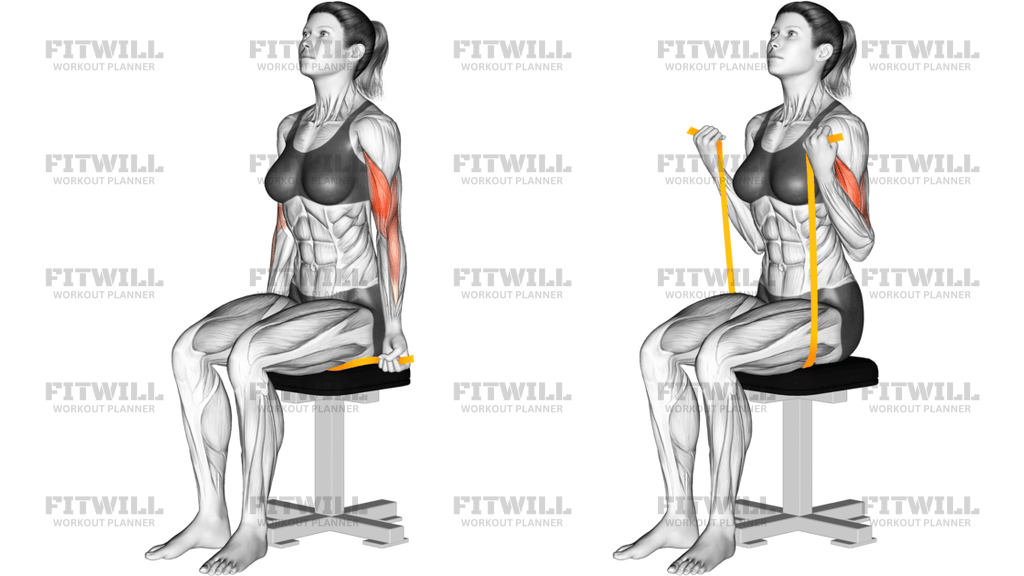
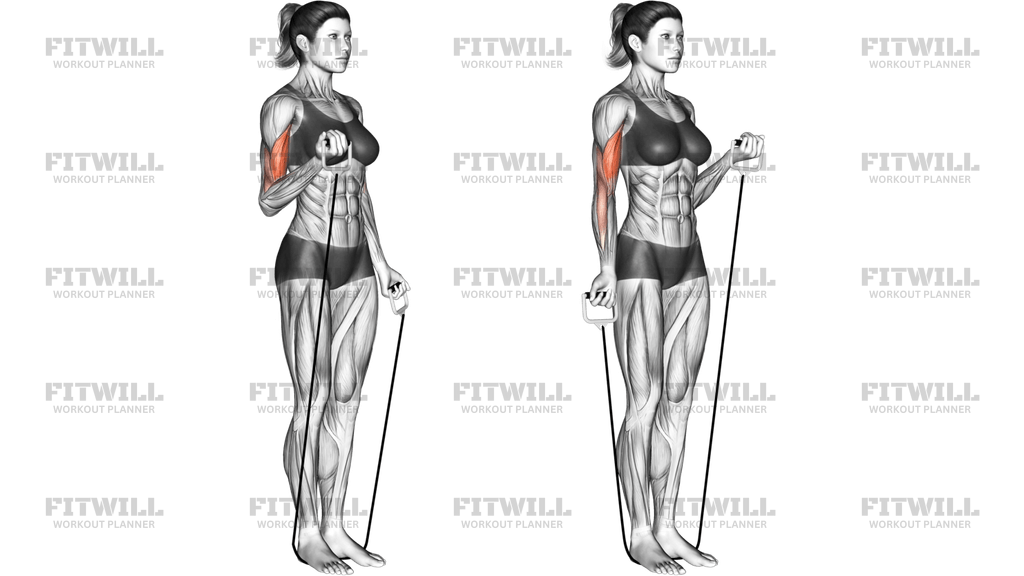
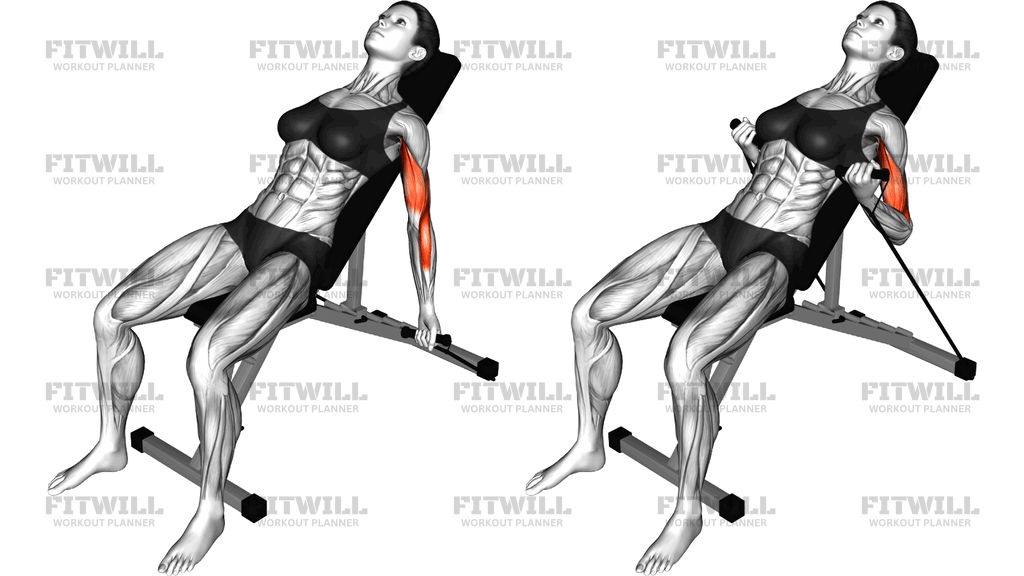
Band Incline Biceps Curl is a seated curl variation performed while leaning back on an incline bench with a resistance band anchored low behind you. You sit on the bench with the back pad supporting your torso, take a handle in each hand, and let your arms hang straight down toward the floor before curling the handles up toward your shoulders. The angled position and the band's line of pull put the biceps under tension through a long range, which is exactly what makes this setup worth learning.
Because the bench holds your torso still and your arms hang behind the line of your body, this exercise trains the biceps in a stretched position that is hard to reproduce with standing curls. The biceps brachii does most of the work, with the brachialis and brachioradialis assisting, and the forearms working to hold the handles securely. Unlike free weights, the band gets harder as it stretches, so the toughest part of each rep is near the top, where the muscle is shortened and the contraction is strongest.
This movement suits lifters who want focused arm work without loading the lower back, since the bench takes your spine out of the equation entirely. It is also a practical choice for home training: one band, one adjustable bench, and you have a complete biceps session. People recovering from grip fatigue on heavy barbell work, or anyone who struggles to feel their biceps on standing curls, often find the incline position makes the target muscle impossible to miss.
Setup quality determines everything here. The band should be anchored securely at a low point behind the bench so the resistance pulls your arms down and slightly behind your torso. If the anchor is too far forward, the tension path shifts and your elbows drift; too loose, and you lose tension at the bottom where the stretch happens. Sit back fully against the pad so your shoulders stay open and your upper arms stay vertical as you curl.
Execution should be smooth in both directions. Curl the handles up until your hands are level with or slightly above your chest, squeeze briefly, then lower slowly until your arms are fully extended and you feel the biceps lengthen. Because the band provides no inertia, there is no momentum to hide behind; the tension stays on the muscle from the first inch to the last, which rewards disciplined tempo and honest reps.
Use this exercise as a primary biceps builder on arm days or as a finishing movement after heavier curls. Start with a lighter band to learn the path, keep reps in the 10 to 15 range while you build control, and progress by shortening the band or moving to a heavier resistance rather than by rushing the lowering phase.
[ Workout Log & Planner ]
Put your next workout in Fitwill
Keep your plan and training log ready when you are.


Instructions
- Anchor the resistance band securely at a low point behind the incline bench, such as around the bench base or a sturdy low attachment, so the band runs from behind and below your shoulders.
- Set the bench to a 45 to 60 degree incline, sit back firmly against the pad, and take a handle in each hand with a supinated grip, palms facing forward.
- Let your arms hang straight down beside your torso with a slight backward angle behind your body, elbows fully extended, and slide forward or back until you feel light tension at the bottom.
- Plant your feet flat on the floor, brace your core lightly, and pull your shoulder blades back and down against the pad so your torso stays pinned to the bench.
- Curl the handles up in a smooth arc, keeping your upper arms fixed in place and your elbows pointing toward the floor throughout.
- Continue until your hands are beside your lower chest or shoulders and your biceps are fully contracted, then pause for a moment in the top position.
- Lower the handles under control for two to three seconds until your arms are straight again and the band is pulling your biceps into a full stretch.
- Exhale as you curl up and inhale as you lower the handles back down, keeping your breathing steady through each rep.
- Complete your target reps, then set the handles down on your thighs before releasing the band to avoid a sudden snap-back.
Tips & Tricks
- If your elbows drift forward as you curl, the biceps are losing the stretch that makes the incline position valuable; think about keeping the backs of your upper arms glued to the bench line and moving only from the elbow.
- Do not let the band's tension pull your shoulders off the pad at the bottom of the rep. If your torso lifts forward, lighten the band or slide your body slightly further back on the bench to reduce slack at the start.
- Losing tension at full extension usually means the anchor point is too far away or the band is too long. Re-anchor closer to the bench base so the band is already taut before you begin the first rep.
- Swinging the handles up with your shoulders defeats the purpose of this setup. If the last few reps need momentum, switch to a lighter band instead of shortening the range.
- A neutral or hammer grip shifts more work to the brachialis and brachioradialis; a fully supinated palm-up grip maximizes biceps brachii involvement, so choose your grip based on which area you want emphasized.
- Check that the band anchor cannot slip before your first set. A band sliding off a bench leg mid-rep is the main safety risk in this exercise.
- Because the resistance peaks at the top, partial-range reps near full extension feel deceptively easy. Finish every rep at full lockout so you are not training only the strongest part of the range.
- If your wrists ache at the top, relax your grip slightly and let the handles rest in your fingers rather than clamping them in a tight fist.
- For a stronger stretch stimulus, pause for one second at full extension on every third or fourth rep instead of adding extra sets.
Frequently Asked Questions
What muscles does the Band Incline Biceps Curl work?
The biceps brachii is the primary muscle, with the brachialis and brachioradialis assisting on every rep. The forearms also work isometrically to hold the handles under tension.
Why use an incline bench instead of standing for biceps curls?
Leaning back on the incline bench lets your arms hang behind your torso, which places the biceps in a longer, stretched position at the bottom of each rep. The bench also removes body English, so the biceps do the work without help from momentum.
Where should the band be anchored for the Band Incline Biceps Curl?
Anchor it low and directly behind the bench, such as around the base of the bench legs or a secure low attachment point. This makes the band pull your arms down and slightly back, keeping tension even at full extension.
Is the Band Incline Biceps Curl suitable for beginners?
Yes, as long as you start with a light band and learn to keep your torso and elbows still. The bench provides back support, which makes it easier to maintain form than many standing curl variations.
How is the resistance different from dumbbell incline curls?
A band is easiest at the bottom and hardest near the top as it stretches, while a dumbbell is hardest mid-range. This means the peak contraction at the top of the Band Incline Biceps Curl is more demanding than with free weights.
What is the most common mistake in this exercise?
Letting the elbows travel forward and turning the movement into a front raise or a standard curl. Keep the upper arms fixed behind the torso and move only at the elbow joint.
Can I do this exercise without an incline bench?
You can sit on a stable bench or box with an upright back support, but the incline angle is what creates the stretched-position benefit. A flat-backed seat is a workable substitute if you keep your chest up and shoulders back.
How many reps and sets should I perform?
Start with 3 sets of 10 to 15 reps with a band you can control through the full range. Increase difficulty by using a heavier band or slowing the lowering phase rather than adding many extra sets.
Are there any safety concerns with the band setup?
The main risk is the band slipping off its anchor point under tension. Test the anchor with a partial pull before your first set, and release the handles onto your thighs at the end of a set rather than letting go with the band stretched.