Cable Standing Row
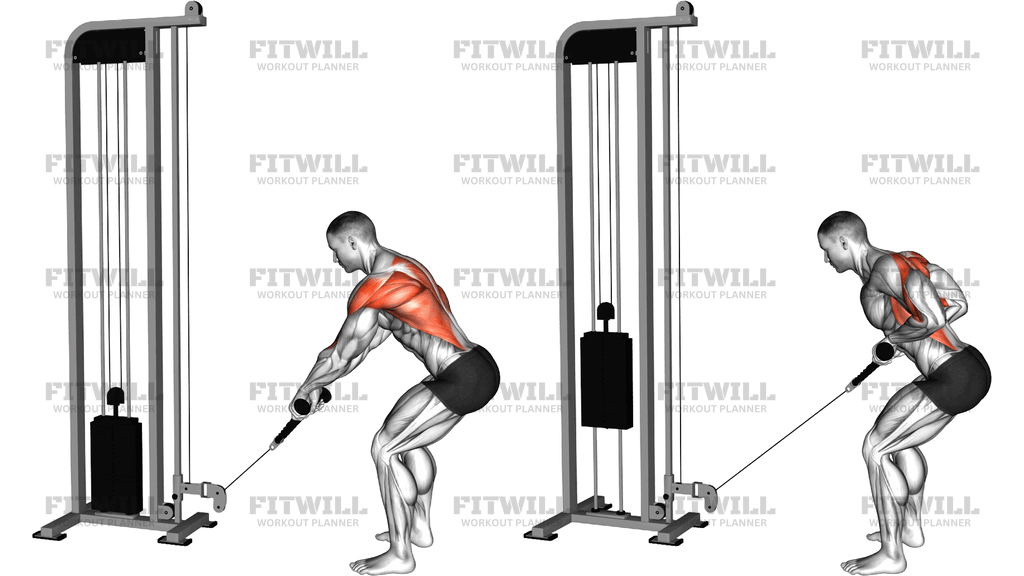
The Cable Standing Row is a horizontal pulling exercise performed face-on to a cable column with the pulley set around waist to chest height. You stand on your own two feet, grip a double handle or V-bar attachment with both hands, and row the handle from full arm extension back toward your torso. Because you are standing rather than seated, your legs and trunk share some of the work, but the pulling action itself comes from your upper back and arms.
The main target is the upper back, particularly the rhomboids and mid-traps, which pull your shoulder blades back and together. Your lats assist on the draw, your rear shoulders help guide the elbow path, and your biceps and forearms handle the flexing and gripping. Staying upright on your feet also means your core and lower back work quietly the entire set to keep your torso from swinging as the cable pulls you forward.
This setup is a good fit for lifters who find a seated row uncomfortable, since standing lets you adjust the hip and knee position freely and removes pressure from the seat pad. It is also useful in busy gyms, because one cable column can serve several standing row variations without needing a dedicated row bench. People who sit a lot during the day often benefit from the posture-reinforcing nature of the movement: repeated scapular retraction against resistance.
Setup matters more here than in a seated row. Your distance from the pulley determines your starting lean, and a too-far stance turns the set into a balance and momentum contest. Position yourself so the stack is slightly lifted at arm extension, with a soft knee bend and a small forward lean from the hips, not the waist. That stance gives the cable a clear line and lets your shoulders do the rowing instead of your spine.
Execution is straightforward but easy to rush. Pull the handle toward your lower chest or upper abdomen with your elbows tracking close to your sides, pause briefly when your hands reach your ribs, and let the handle travel back out under control until your arms are extended and your shoulder blades have protracted fully. That controlled return is where a lot of the upper-back stretch happens, so resist the urge to just let the stack yank your arms forward.
Keep the load honest. A standing row invites body English once the weight gets heavy, and once your hips start rocking, the exercise stops being a row and becomes a full-body heave. Choose a weight you can move through a full, smooth arc for your target reps, and keep your lower back neutral throughout.
[ Workout Log & Planner ]
Put your next workout in Fitwill
Keep your plan and training log ready when you are.


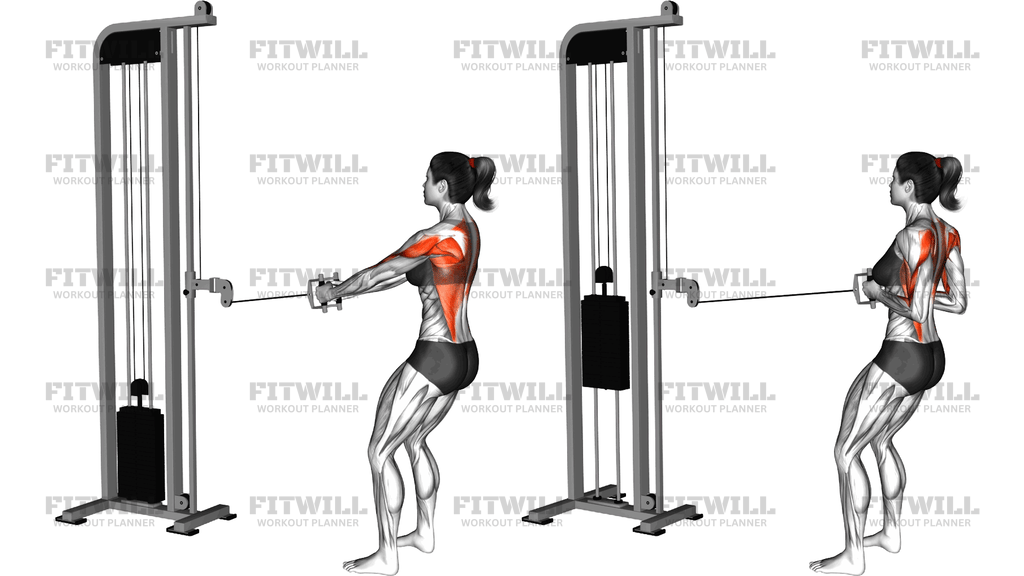
Instructions
- Set the cable pulley to roughly waist height and attach a double handle or V-bar attachment to the carabiner.
- Select your weight, then take an overhand grip on the handle with both hands and step back until your arms are fully extended and the weight stack is slightly lifted off rest.
- Stand with feet about hip- to shoulder-width apart, knees softly bent, and hinge a few degrees forward from the hips so your torso is stable and angled slightly toward the machine.
- Brace your core, pull your shoulders down away from your ears, and let your head stay in line with your spine rather than jutting forward.
- Row the handle in toward your lower chest or upper abdomen by driving your elbows back past your ribs, keeping them close to your body rather than flared wide.
- At the end of the pull, squeeze your shoulder blades together and hold that contracted position for a beat before releasing.
- Extend your arms back out slowly, letting your shoulder blades spread forward at the end of the stretch without letting the stack slam down.
- Exhale as you pull the handle toward you and inhale as you let it travel back out.
- After your final rep, walk the handle forward and lower it with control, or let the stack settle gently rather than dropping it.
Tips & Tricks
- If you feel the work shifting into your lower back, you are likely standing too far from the pulley; step closer so your torso stays nearly upright with only a slight lean.
- A common giveaway of too much weight is a rocking motion at the hips on each pull. If your torso swings backward as the handle comes in, drop the load and re-brace before the set.
- Watch for shrugged shoulders at the top of the pull. If your traps creep up toward your ears, think about pulling with your elbows and keeping the shoulder blades down as they squeeze together.
- Do not cut the stretch short. Letting the handle travel all the way out so your arms are long and your upper back rounds slightly forward is part of the range, as long as the movement stays controlled.
- If your grip gives out before your back does, use lifting straps or slow the tempo down so the pull no longer depends on squeezing the handle hard.
- Keep the wrists straight and neutral. Bending the wrists back as you row shifts tension away from the upper back and can irritate the forearms over a long set.
- Because there is no seat or chest pad, your spine position is self-policed. If you notice your lower back rounding or arching hard as fatigue sets in, end the set rather than fighting for extra reps.
- Angle the pull toward your lower ribs rather than your chin to keep the emphasis on the mid-back instead of drifting toward an upright row pattern.
Frequently Asked Questions
What muscles does the Cable Standing Row work?
It primarily targets the rhomboids and mid-traps of the upper back, with strong assistance from the lats, rear shoulders, and biceps. Your core and lower back also work isometrically to keep you stable while standing.
Is the Cable Standing Row suitable for beginners?
Yes. The cable path is fixed and the movement pattern is simple, making it one of the more approachable pulling exercises. Beginners should start light and focus on moving the elbows back and squeezing the shoulder blades rather than loading up.
How is the Cable Standing Row different from a Seated Cable Row?
The pulling motion is nearly identical, but standing removes the seat and chest support, so your legs and trunk must stabilize you. Many people find the standing version easier on the hips and easier to fit into a busy cable column, though the seated version typically allows slightly heavier loading with less balance demand.
How far should I stand from the cable machine?
Stand at a distance where your arms are fully extended and the stack is just barely lifted, with a slight forward lean from the hips. If you have to fight the cable's pull to stay upright, you are too far away.
Should my knees be locked or bent during the Cable Standing Row?
Keep a soft, slightly bent knee position throughout. Locking the knees while leaning forward and pulling places unnecessary strain on the lower back and makes you less stable.
Why does my biceps fatigue before my back?
This usually means you are yanking with the arms instead of initiating with the shoulder blades. Think about pulling your elbows back and letting the hands simply hold the handle, and consider slowing the pulling phase so the back does the work first.
Can I use a straight bar instead of the V-bar attachment?
Yes, a straight bar or individual handles both work. A V-bar or double handle keeps the hands in a comfortable midline position and encourages the elbows to stay close to the body, while a wider straight-bar grip shifts slightly more emphasis toward the upper-back squeeze.
How do I keep my lower back safe on this exercise?
Keep the forward lean minimal, brace your core before each rep, and avoid letting the weight stack pull your torso into a deeper bend on the return. If your back starts doing the rowing or rounding under load, reduce the weight immediately.
What can I substitute if my gym has no cable machine?
A bent-over dumbbell row, a resistance-band row anchored at waist height, or a chest-supported machine row all train the same horizontal pulling pattern. The band row is the closest match since the resistance stays constant through the pull.