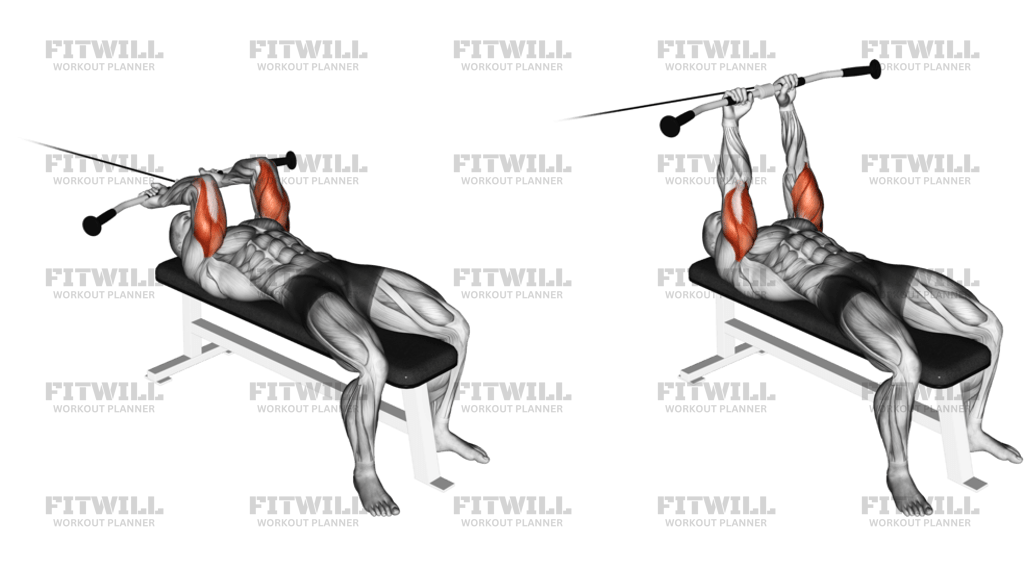
Cable Rope Incline Tricep Extension
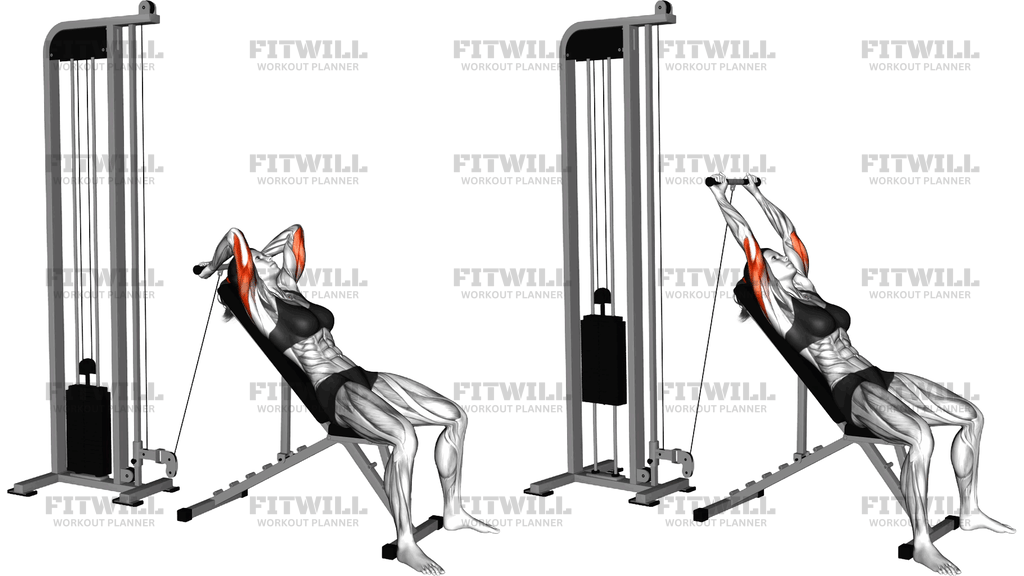
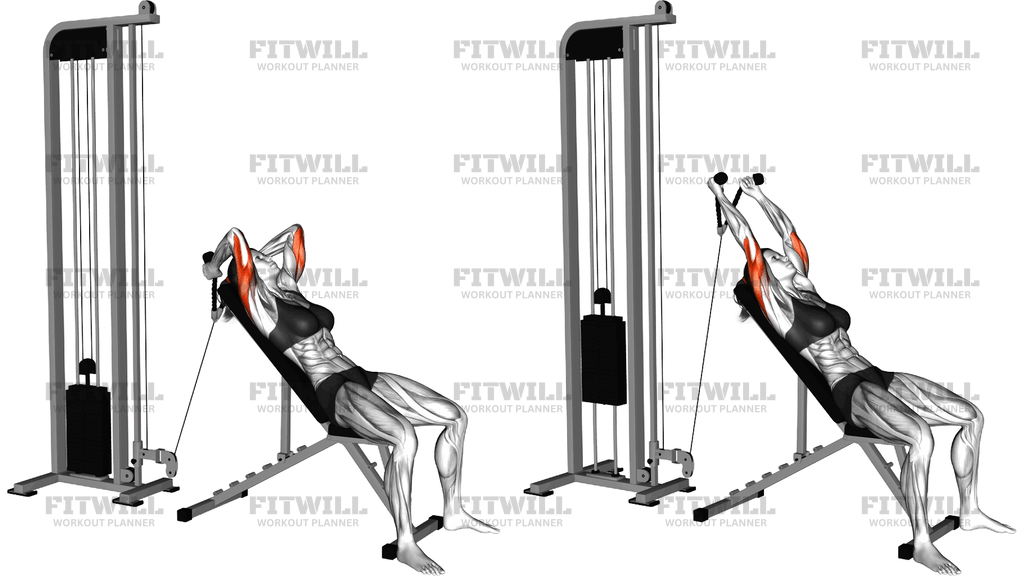
The Cable Rope Incline Tricep Extension is an overhead tricep exercise performed while reclining on an incline bench, using a rope attachment connected to the low pulley of a cable machine. You lie back with the cable running behind and below you, start with your elbows bent and pointed up toward the ceiling, then press the rope handles up and slightly forward until your arms are extended overhead. Because the cable pulls from behind your head rather than from a fixed weight overhead, the resistance stays on the triceps through the entire range of motion.
The angle is what makes this movement worth adding. Reclining on an incline bench places the shoulder in an overhead position, which puts the long head of the triceps in a stretched starting position. Since the long head crosses the shoulder joint, overhead variations generally train it more effectively than pushdowns done at your side. Lifters who feel pushdowns mostly in their elbow or who want fuller-looking upper arms often get more out of this overhead setup.
Setup matters more here than in most tricep work. The bench angle, the distance of the bench from the pulley, and where you plant your feet all determine whether the cable pulls cleanly behind your head or drags you backward. Ideally the cable runs just behind your ears and over the top edge of the bench, with your head, shoulders, and upper back firmly supported. If the bench sits too close to the machine, the rope will interfere with your head; too far away, and the cable angle pulls you out of position.
Execution is simple but demands control. Keep your upper arms relatively fixed as you extend your elbows, separating the handles slightly at the top for a stronger contraction, then lower the rope back with a slow, deliberate bend of the elbows. Let the weight stack return under control rather than letting it yank your arms back. Because the cable pulls behind you, a heavy weight can pull your shoulders off the bench, so this exercise rewards moderate loads and strict technique over ego lifting.
This movement fits well as a secondary tricep exercise after pressing work, typically for sets of 10 to 15 repetitions. It is popular in hypertrophy-focused arm training, useful for lifters who want an overhead option without the balance demands of a standing dumbbell extension, and easy to scale since the cable provides smooth, adjustable resistance. Keep your lower back in contact with the bench throughout, stop short of any elbow or shoulder discomfort, and prioritize a full, controlled stretch at the bottom over moving heavy weight.
[ Workout Log & Planner ]
Put your next workout in Fitwill
Keep your plan and training log ready when you are.


Instructions
- Set an incline bench to roughly 30 to 45 degrees and position it facing away from a cable machine, far enough back that the rope from the low pulley clears the top of the bench and your head.
- Attach a rope to the low pulley, select a light starting weight, and sit back onto the bench with your feet flat on the floor on either side.
- Grip the rope handles with a neutral grip, lie back so your head and upper shoulders rest on the bench, and raise your elbows so they point up toward the ceiling beside your head.
- Brace your core and press your lower back and shoulder blades into the bench before you begin the movement.
- Extend your elbows to press the rope up and slightly forward over your face, keeping your upper arms steady and your elbows from flaring outward.
- At the top, spread the handles a few inches apart and squeeze the triceps with your arms nearly straight but elbows not locked hard.
- Bend your elbows slowly to lower the rope back behind your head until you feel a solid stretch along the back of the upper arms, letting only the elbows move.
- Exhale as you press up and inhale as you lower the rope back down.
- Complete your repetitions, then sit upright and release the rope handle nearest the stack first so the weight returns smoothly without snapping the cable.
- Reset your back position on the bench before each heavy or final set rather than letting your shoulders creep forward.
Tips & Tricks
- If the rope bumps the top of the bench or your head, slide the bench a few inches farther from the pulley rather than twisting your neck to make room.
- The most common fault is turning this into a pullover by extending the shoulders as well as the elbows; the press should come from straightening the elbows, with the upper-arm angle barely changing.
- Letting the weight stack pull your arms down too fast is the usual culprit when you feel this in the elbow joint; take two full seconds on the way down.
- If your lower back arches off the bench as you lower the rope, the weight is too heavy or you are dropping the rope too deep behind your head.
- Spreading the rope handles apart at lockout shortens the triceps further and gives a noticeably better contraction than just pressing straight up.
- Keep your chin tucked and your head resting on the bench; lifting the head to watch the rope rounds the neck and shifts tension away from the arms.
- Warm up with a lighter overhead extension or a set of pushdowns first, since cold elbows tend to complain in this stretched overhead position.
- Do not chase heavy loads here; the cable pulling from behind a reclined body makes cheating easy, so use a load you can pause briefly at full stretch without your shoulders lifting.
Frequently Asked Questions
Which muscles does the Cable Rope Incline Tricep Extension work?
It targets the triceps brachii, with the reclined overhead angle placing extra emphasis on the long head because the shoulder starts in a stretched position. The shoulder stabilizers work lightly to keep the arm position steady.
Why use an incline bench instead of standing for this exercise?
Reclining supports your torso and removes the core and balance demands of a standing overhead extension, making it easier to focus purely on the triceps. It also sets a consistent arm angle set after set.
How far should the incline bench be from the cable machine?
Far enough that the rope travels freely just behind your head without hitting the bench or pulling your shoulders backward. Start with the bench about two to three feet from the tower and adjust from there.
Is the Cable Rope Incline Tricep Extension suitable for beginners?
Yes, as long as beginners start light and learn the elbow-only movement pattern first. The bench gives good support, but the behind-the-head cable path means control matters more than load.
What is the most common mistake in this exercise?
Turning it into a shoulder press or pullover by extending the shoulders along with the elbows, which steals work from the triceps. Keep your upper arms pointing up and let only the elbows hinge.
Can I use a straight bar instead of the rope attachment?
A straight bar works, but the rope lets your hands separate and rotate naturally at lockout, which is easier on the wrists and elbows for most people. The rope also allows a stronger final squeeze.
How does this compare to a lying dumbbell tricep extension?
The cable keeps constant tension through the whole range, including the stretched position behind your head, while a dumbbell loses tension at some angles. The cable version is also easier to adjust in small weight increments.
How many sets and reps should I do?
Two to four sets of 10 to 15 reps works well, usually after heavier pressing or pushdown work. The stretched overhead position favors controlled moderate loads over heavy grinding sets.
Is it safe if I feel discomfort behind my elbow or shoulder?
Reduce the range slightly, slow the lowering phase, and drop the weight; persistent sharp pain is a signal to stop and switch to a pushdown variation instead. Never push through joint pain in a stretched overhead position.
Where should this exercise go in my arm workout?
It works best as a secondary tricep movement after presses or pushdowns, when the long head can be isolated under a controlled load. Doing it first is possible, but heavy fatigue here can make pressing work feel unstable.