Dumbbell Single Arm Z Press
The Dumbbell Single Arm Z Press is an overhead press performed from the floor with your legs extended straight in front of you and your torso held completely upright. Because there is no bench backrest to lean against and no staggered stance to brace with, every inch of stability has to come from your own trunk. One dumbbell works at a time, pressed from shoulder height to a locked-out position overhead while the free hand can rest lightly on your midsection as a tactile reminder to stay braced.
This movement is best known for exposing weak links. In a standing or seated press against a backrest, you can lean, arch, and shift your weight to help the dumbbell up. In the Z Press position, none of that is available, so the front delts and triceps press the weight while the abs, hip flexors, and lower back hold your spine and pelvis still. If your trunk cannot support the press, the dumbbell simply will not go up cleanly, which makes this a favorite diagnostic and accessory lift for people building a stronger standing overhead press.
The setup matters more here than in almost any other press. Sit on the floor with your legs extended together, toes pulled up toward your shins, and stack your ribcage directly over your pelvis. A common mistake is settling into a rounded or backward-leaning posture, which turns the press into something easier and defeats the purpose of the exercise. Think of your body as an L: a vertical line from your hips through your head, with your legs forming the horizontal part.
To execute it well, bring the dumbbell to your shoulder with a neutral or slightly turned grip, take a firm breath into your belly, and press the weight up and slightly back so it finishes over the top of your shoulder joint, not out in front of your face. Keep the working side's ribs from flaring and resist the pull of the weight toward the empty side. Lower the dumbbell under control back to the shoulder, finish your breath at the top or between reps, and complete all reps on one side before switching arms.
This press suits intermediate lifters who already own a comfortable seated or standing dumbbell press, as well as anyone who wants direct anti-rotation and trunk strength work that doubles as shoulder training. Because the position is demanding, most people use lighter dumbbells than they would for a seated press, often in the 6 to 12 rep range per side. If sitting on the floor with straight legs bothers your hamstrings or lower back, elevating your hips on a low step or plate can make the position sustainable while keeping the training effect intact.
[ Workout Log & Planner ]
Put your next workout in Fitwill
Keep your plan and training log ready when you are.


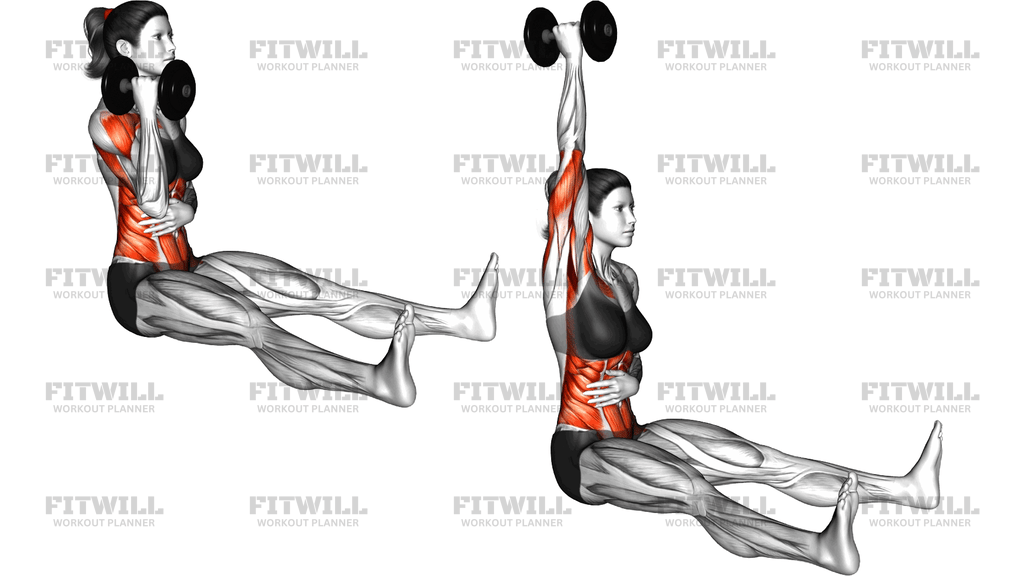
Instructions
- Sit on the floor with your legs extended straight in front of you, knees together, and pull your toes up toward your shins so the backs of your knees press toward the ground.
- Place one dumbbell on top of your thigh, then clean it up to your shoulder so it rests just outside your collarbone with your elbow tucked down and in front of the ribs.
- Sit as tall as possible: stack your ribs over your pelvis, lift the crown of your head toward the ceiling, and brace your abs firmly as if preparing for a light punch to the stomach.
- Rest your free hand lightly on your stomach or opposite shoulder to monitor bracing and to remind yourself not to lean or twist.
- Exhale or hold a firm breath, then press the dumbbell straight up, guiding it slightly back so it ends directly over your shoulder joint with your bicep near your ear.
- At the top, extend the elbow fully without shrugging the weight away from your body, and keep both sit bones planted evenly on the floor.
- Lower the dumbbell slowly back to the shoulder, keeping your torso vertical and your legs locked in position rather than letting the hips slide forward.
- Reset your brace between each rep if your trunk starts to drift, and complete all reps on one arm before switching sides.
- Breathe at the top of each rep or between reps; do not exhale forcefully mid-press, which can collapse your trunk position.
Tips & Tricks
- If your hamstrings pull your pelvis backward and round your lower back, sit on a low plate, step, or folded mat to give your hips a little elevation while keeping the legs straight.
- The most common error is leaning your torso behind vertical as the weight gets heavy; film yourself from the side, because what feels upright often is not.
- Start with a dumbbell noticeably lighter than your seated press weight. The floor position removes all support, and the strength gap is usually bigger than people expect.
- Watch for the dumbbell drifting out in front of your face at the top. The lockout should sit over the shoulder joint, roughly in line with your ear when viewed from the side.
- Keep the non-working hand as a scanner, not a crutch: touching your stomach is fine, but do not push off your thigh or the floor to help complete a rep.
- If the weight pulls you toward the working side, squeeze the glutes and press both sit bones down evenly to straighten yourself before the next rep.
- Rounding the upper back at setup shortens your pressing range and strains the neck; reach the top of your head up before you even touch the dumbbell.
- Stop the set when your torso position degrades, not when your shoulder feels tired. A lean means the trunk has lost the fight and the set is no longer doing its job.
Frequently Asked Questions
What muscles does the Dumbbell Single Arm Z Press work?
The front delts and triceps do the pressing, while the side delts and upper back assist. Just as importantly, the abs, obliques, and hip flexors work hard to keep your upright seated position from breaking down.
Why is the Dumbbell Single Arm Z Press so much harder than a regular seated press?
A regular seated press lets you lean against a backrest and arch your lower back to help the weight up. With your back against nothing and legs straight on the floor, your trunk must hold you vertical, so the usable pressing weight drops significantly.
Can beginners do the Dumbbell Single Arm Z Press?
Beginners can learn it, but it helps to first be comfortable with a seated dumbbell press and a basic brace. Start with a very light dumbbell or even an unloaded movement pattern, and elevate the hips on a step if the floor position feels cramped.
Should my legs be straight out in front of me, and where do my feet go?
Yes, the classic Z Press position has the legs extended together with toes pulled up, forming an L-shape with your torso. If your hamstrings are too tight to sit tall this way, bend the knees slightly or raise your hips rather than rounding your back.
Why does the dumbbell want to drift forward at the top of the press?
Forward drift usually means the shoulder lacks end-range overhead strength or the trunk is leaning back to compensate. Cue yourself to finish with the bicep by your ear and the weight stacked over the shoulder joint, and reduce the load until that position is consistent.
What can I substitute if I cannot sit on the floor comfortably?
A seated single-arm dumbbell press on a bench with no backrest support, or sitting on a low box with hips elevated and legs extended, preserves most of the trunk demand. A half-kneeling single-arm press is another option that trains similar anti-lean control.
How heavy should I go on the Dumbbell Single Arm Z Press?
Pick a weight you can press for 6 to 12 clean reps per side without your torso leaning or your hips shifting. Most lifters need 20 to 30 percent less load here than on a supported seated press.
Is it safe for my lower back?
When done with an upright torso and a braced trunk, the position is actually a controlled way to build trunk strength. Problems arise when people round their lower back at setup or lean backward under load, so prioritize position over weight and stop the set when posture slips.
Should I press both arms at the same time?
This version trains one arm at a time, which adds an anti-rotation challenge because the loaded side pulls you sideways. Single-arm work also lets you spot and fix side-to-side strength differences that a two-arm press can hide.