Lateral Raise With Towel
The Lateral Raise With Towel is an isometric shoulder exercise that uses nothing more than a towel and a wall. You stand sideways to the wall, place a folded towel between the back of your hand or wrist and the wall, then push your arm out to the side as if trying to raise it through the wall. Because the wall is immovable, the side deltoid works hard against fixed resistance without the arm actually traveling anywhere.
This movement is a great option when you have no dumbbells or bands available, when you are traveling, or when you want to add isometric work to a shoulder routine. It is also useful for people rehabbing or managing cranky shoulders, since the intensity is completely self-regulated: you decide how hard to push, and there is no load dragging the joint to the end of its range.
The main muscle at work is the lateral deltoid, the caps the side of the shoulder that gives the shoulder its width. The upper trapezius assists as the arm presses upward and out, and the smaller rotator cuff muscles work to hold the humeral head steady while the deltoid generates force. Because you are pushing through the back of the hand, the arm stays in a slightly internally rotated position, which shifts some of the demand in a way that differs from a standard dumbbell lateral raise.
Setup matters more than it looks. Stand close enough to the wall that your arm can press against it at roughly a 20 to 30 degree angle away from your body, with the towel protecting the back of your hand from friction. Your feet stay together or close, your torso stays tall, and the far arm hangs relaxed at your side. If you stand too far from the wall, you will lean into the push and lose the isolation on the shoulder.
To perform it well, press gradually rather than explosively. Build to a firm push over two or three seconds, hold the effort steady while breathing normally, then release slowly instead of dropping the tension all at once. The effort should come from the shoulder itself, not from shrugging the shoulder up toward the ear or twisting the torso into the wall.
A practical approach is to hold each press for 10 to 20 seconds, rest, and repeat for two to four sets per side. Pair it with other shoulder work as a finisher, use it as a low-equipment travel workout, or use it as a pain-free way to keep the side delts trained when pressing or raising weights is uncomfortable.
[ Workout Log & Planner ]
Put your next workout in Fitwill
Keep your plan and training log ready when you are.


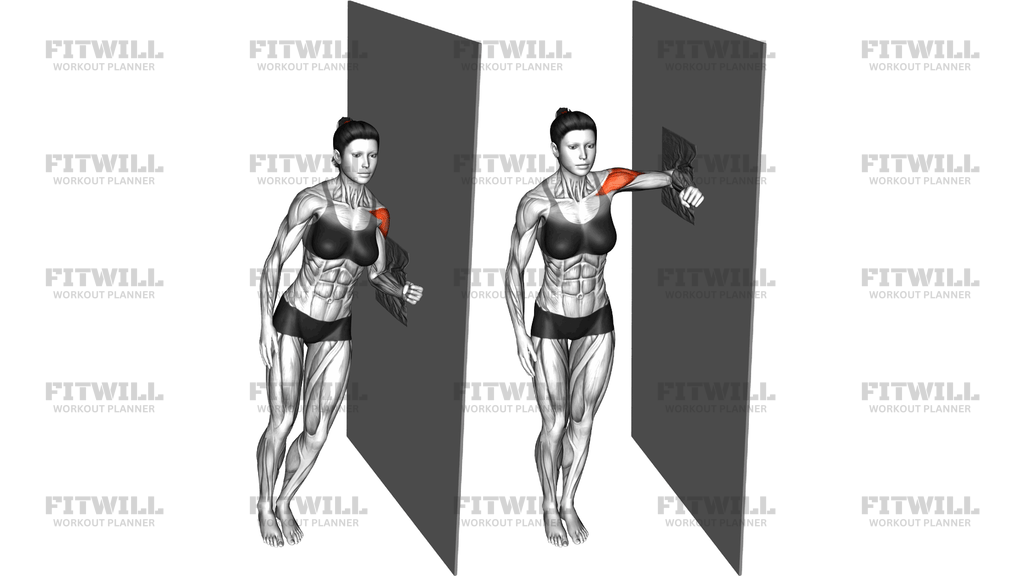
Instructions
- Fold a towel into a pad thick enough to cushion the back of your hand, and stand sideways to a clear section of wall with your working arm closest to it.
- Position your feet close together, keep your torso tall, and let your far arm hang relaxed at your side.
- Place the towel between the back of your wrist or hand and the wall, with your arm angled slightly out to the side and a soft bend in the elbow.
- Brace your core lightly and keep your neck and shoulders relaxed before you start pressing.
- Press the back of your hand into the wall through the towel, as if trying to raise your arm out and up to the side.
- Build the pressure smoothly over two to three seconds until you reach a firm but comfortable effort, around 70 to 80 percent of your maximum push.
- Hold the press for 10 to 20 seconds, keeping the pressure steady and breathing normally the whole time.
- Release the tension gradually over a couple of seconds rather than pulling your hand away suddenly.
- Reset your posture, take a breath, and repeat, then switch sides and work the other arm.
- Complete two to four holds per side, resting 30 to 60 seconds between efforts.
Tips & Tricks
- Stand at a distance where your arm presses at a slight angle away from your body, not straight overhead or jammed behind you; too steep an angle turns the wall push into a shrug.
- If you feel the work climbing into your neck, consciously pull your shoulder blade down before pressing and reduce the effort by 10 to 20 percent.
- The towel is there to protect the skin on the back of your hand from friction against the wall, so keep it flat and reposition it if it bunches mid-hold.
- Push through the back of the hand or wrist, not the palm facing forward, so the resistance line stays in line with the side deltoid.
- Avoid twisting your torso into the wall as the hold gets harder; if your chest starts rotating toward the wall, you are leaking force instead of training the shoulder.
- Breathe throughout the hold. Holding your breath while pressing at high effort can spike your blood pressure and make the hold shake harder than it should.
- Vary your arm angle between sets, pressing at slightly below shoulder height on one set and at shoulder height on the next, to hit the deltoid from slightly different positions.
- Do not go straight to a maximal push. Isometric strength is angle-specific, so ramping into the press gives the tendons time to take up the tension safely.
- If the wall is cold or slick, a larger towel or a shirt draped over the contact point makes the setup more comfortable.
Frequently Asked Questions
What muscles does the Lateral Raise With Towel work?
The lateral deltoid, on the side of the shoulder, does most of the work. The upper trapezius assists, and the rotator cuff muscles stabilize the shoulder joint while you press.
Why is a towel used in the Lateral Raise With Towel?
The towel cushions the back of your hand against the wall so the skin is not scraped by friction during the hold. It also gives you a consistent contact point to press through.
Is the Lateral Raise With Towel actually effective without any weight?
Yes, because the wall provides fixed resistance. Your deltoid contracts against an immovable surface, and you control the intensity by how hard you push, which is the basis of isometric training.
Is this exercise good for beginners?
It is very beginner-friendly because there is no external load and the effort is self-regulated. Beginners should start with lighter pushes of around 50 to 60 percent effort and shorter holds of about 10 seconds.
How high should my arm be during the Lateral Raise With Towel?
Set your arm at or slightly below shoulder height with a small angle out to the side. This matches the mid-range of a lateral raise and keeps the deltoid, not the upper traps, doing the work.
How long should I hold each press?
Ten to twenty seconds per hold works well for most people. If you can easily hold thirty seconds, push harder or add another set rather than extending the hold indefinitely.
Can I use the Lateral Raise With Towel instead of dumbbell lateral raises?
It can substitute when you have no equipment, but remember that isometric strength is specific to the angle you train. For complete development, use it alongside or rotate it with weighted lateral raises.
Why do I feel my neck working during this exercise?
That usually means you are shrugging into the press. Pull your shoulder blade down before pushing and ease off the effort; the sensation should shift back into the side of your shoulder.
Is the Lateral Raise With Towel safe for shoulder pain?
Because you control the force and avoid moving through painful ranges, many people tolerate it well when loaded raises bother them. If a specific push reproduces sharp pain, reduce the pressure, change the arm angle, or clear it with a qualified professional first.