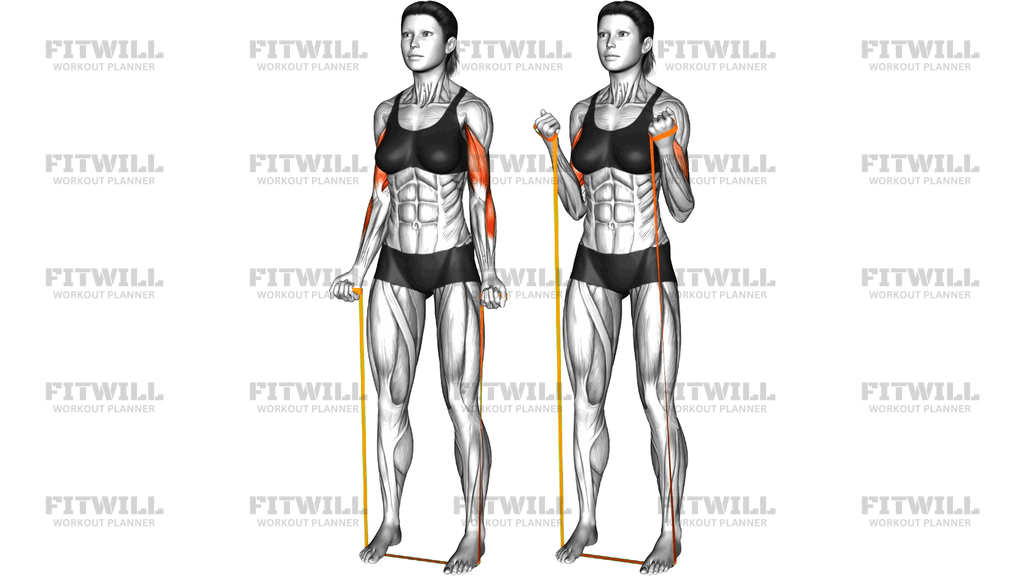
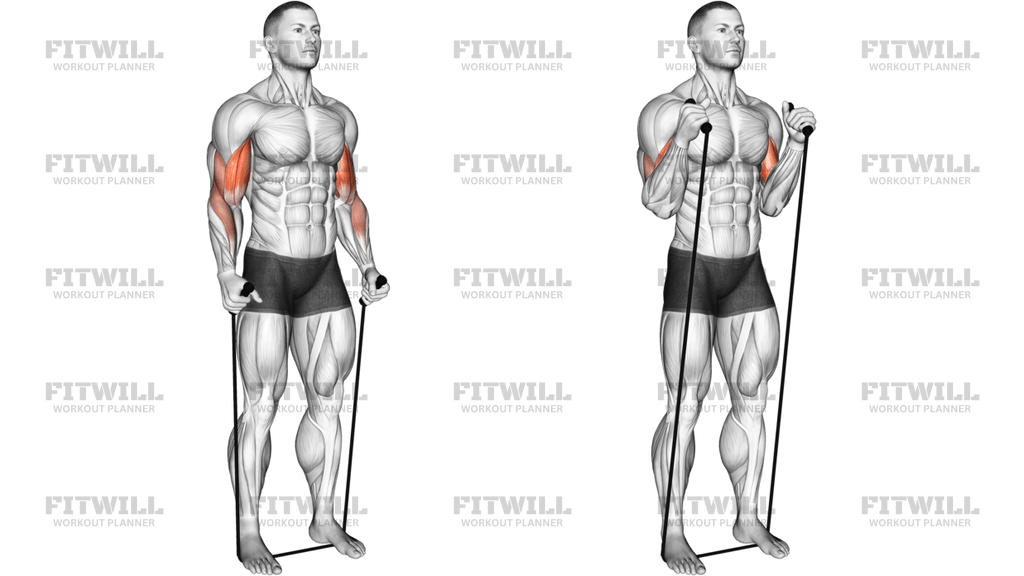
Band One Arm Overhead Biceps Curl
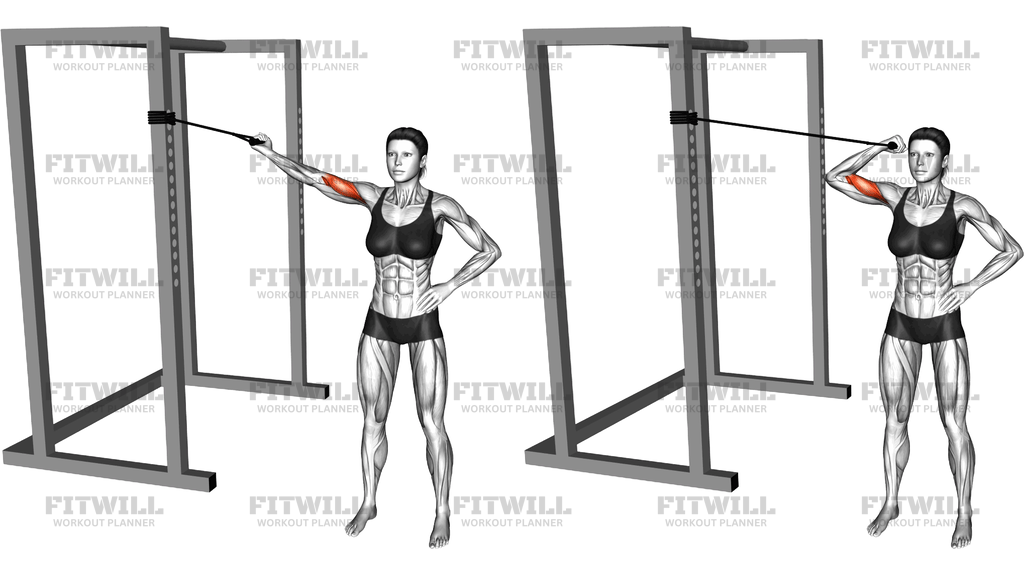
The Band One Arm Overhead Biceps Curl is a unilateral biceps exercise performed with an elastic band anchored at roughly shoulder height behind you. Unlike a standard curl where your arm hangs at your side, this version starts with your arm extended out to the side at shoulder height, so the band pulls your arm backward and outward before you even begin the rep. That starting position changes the angle of tension and keeps constant resistance on the biceps through the entire range of motion.
The main muscle at work is the biceps brachii on the front of the upper arm, with strong support from the brachialis underneath it and the brachioradialis in the forearm. Because the arm is held away from your body rather than hanging down, the front of the shoulder also works to hold the upper arm in position, and your core stays engaged to keep your torso from rotating toward the working side.
This setup is especially useful for people who find that standard curls lose tension at the top, since a stretched band actually pulls hardest where a dumbbell pulls least. It is also a good option for home training with minimal equipment, for fixing left-to-right strength differences one arm at a time, or for adding variety after heavy barbell or dumbbell curl work.
Setup matters more here than in most curls. Anchor the band securely at shoulder height, stand far enough away that there is light tension with your arm extended, and keep the working arm level with your shoulder throughout the set. If your anchor is too low, the movement drifts into a front raise; if you stand too close, the band goes slack and the biceps get a rest at the bottom of every rep.
To execute it well, curl by bending only at the elbow, drawing your hand back toward the side of your head while your upper arm stays still and elevated. Squeeze at the point of full elbow flexion, then lower your hand forward under control until the arm is extended again. Avoid leaning back, shrugging, or swinging the hand past your head, all of which shift work away from the biceps.
Keep the resistance honest: if the band is so strong that your shoulder or torso has to help, switch to a lighter band or move closer to the anchor. Controlled reps with steady tension beat fast, jerky ones every time, and because each arm works independently, always match the number of reps on both sides.
[ Workout Log & Planner ]
Put your next workout in Fitwill
Keep your plan and training log ready when you are.


Instructions
- Anchor a band at approximately shoulder height to a rack or other sturdy attachment point behind your working side.
- Stand side-on to the anchor with feet about hip-width apart, and grip the band's handle in your far hand with your palm facing up.
- Extend your working arm straight out to the side at shoulder height so the band is taut, and place your free hand on your hip for balance.
- Brace your core and square your shoulders so your torso does not twist toward or away from the anchor.
- Keeping your upper arm fixed at shoulder height, bend your elbow to curl your hand back toward the side of your head.
- Pause briefly at the top with your biceps fully contracted and your palm turned toward your head.
- Slowly straighten your elbow, resisting the band as it pulls your hand forward until your arm is extended again.
- Exhale as you curl in, and inhale as you lower your hand back out.
- Complete all reps on one side, then switch hands and repeat on the other side with the same band tension and stance.
Tips & Tricks
- If the band snaps your arm back at the bottom, you are letting it control the tempo — take two to three seconds to extend the elbow instead.
- A common mistake is drifting the elbow down toward your side as you fatigue, which turns this into a normal curl; check that your upper arm stays level with your shoulder on every rep.
- Do not let your hand travel behind your head at the top; stopping when your hand reaches the side of your head keeps the tension on the biceps rather than the shoulder.
- If your front shoulder burns before your biceps do, the band is too heavy — step closer to the anchor or use a lighter band so the curl, not the hold, is the challenge.
- Keep your wrist neutral and in line with your forearm; cocking the wrist back under band tension strains the forearm flexors.
- Watch yourself sideways in a mirror to catch torso rotation, which is easy to miss and quietly steals work from the working arm.
- Because the band is stretched before the first rep, never fully relax your arm at the extended position; keep light tension so the elbow joint is supported.
- Test the anchor point with a gentle pull before your set — a band slipping off a rack pin mid-rep is the main safety risk in this exercise.
Frequently Asked Questions
Which muscles does the Band One Arm Overhead Biceps Curl work?
The biceps brachii is the primary mover, assisted by the brachialis and brachioradialis. The front of the shoulder and your core work to keep the arm and torso steady while the band pulls from behind.
How high should the band be anchored for this curl?
Anchor it at about shoulder height, so your extended arm sits level with your shoulder and the band pulls in a straight line toward the anchor. A much lower anchor changes the movement into a different curl variation.
Why does my arm start out to the side instead of hanging down?
That is the defining feature of this exercise. Holding the arm at shoulder height with the band pulling backward keeps tension on the biceps in a position where a regular curl would give them a break, and it forces the shoulder stabilizers to contribute.
Is the Band One Arm Overhead Biceps Curl suitable for beginners?
Yes, as long as a light band is used and the anchor is secure. Beginners should master keeping the upper arm still at shoulder height before adding more resistance, since that is the hardest part to control.
My torso twists toward the anchor during the set — how do I fix that?
Lighten the band tension by stepping closer to the anchor, keep your free hand pressed on your hip, and think about pointing your chest straight ahead for the whole set. Rotating usually means the band is too strong for the arm to curl alone.
Can I do this exercise without a handle attachment?
Yes, you can grip the end of the band looped around the anchor, but a handle gives a more secure grip and keeps your wrist neutral, which matters when the band is already stretched at the start position.
How is this different from a standing dumbbell curl?
A dumbbell pulls straight down and its resistance drops at the top, while the band here pulls backward and outward and gets harder as you flex the elbow. The overhead-arm position also makes it harder to cheat with body English.
How many reps and sets should I do?
Because band tension rises sharply at the top, moderate sets of 10 to 15 reps per arm work well. Match reps exactly between sides so your stronger arm does not run ahead.
Is it safe to curl with my arm held out at shoulder height?
For most healthy trainees it is fine, and the constant band tension actually supports the arm. If you have a current shoulder problem, the held-out position may aggravate it, so start with very light tension or choose a standard curl instead.
What can I use if I don't have a band and anchor point?
A cable machine set at shoulder height with a single handle from behind reproduces the same arm path and tension profile. A light dumbbell high curl is a rough substitute, though it loses the backward pull on the arm.