Cable Incline Row
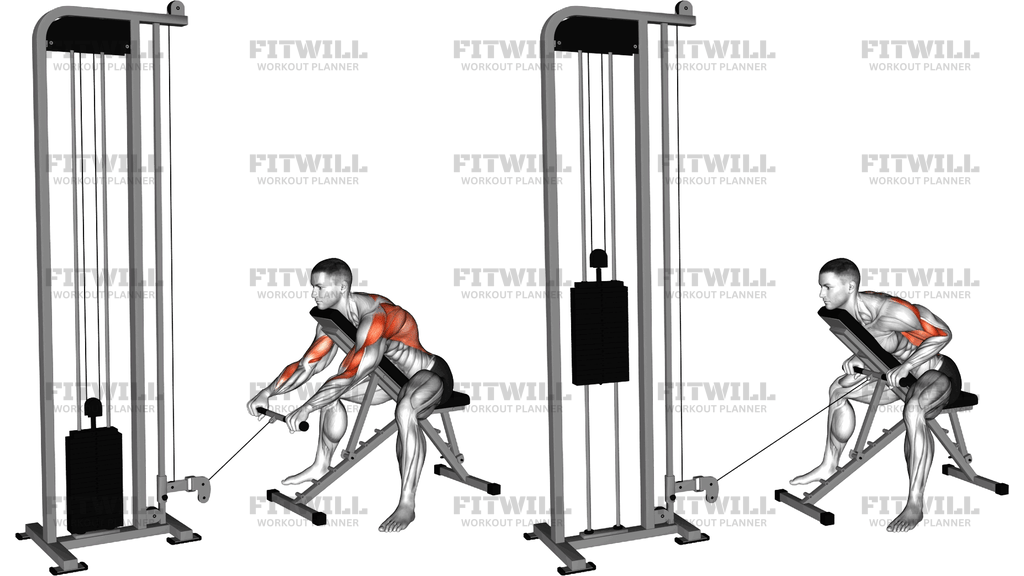
The Cable Incline Row is a chest-supported rowing exercise performed by lying prone on an incline bench positioned in front of a low cable pulley and pulling a handle up toward your lower chest. Because the bench pads your torso against the incline, your lower back and legs are largely taken out of the equation, forcing the muscles of the upper back to do the work without help from momentum or body English.
This setup makes the movement especially useful for lifters who tend to cheat on traditional bent-over rows, as well as anyone dealing with fatigue in the lower back who still wants a heavy rowing stimulus. It is also a strong choice for people who sit a lot, since the horizontal pulling angle directly targets the rhomboids and mid-traps that tend to get weak and lengthened from rounded-shoulder posture.
The primary work comes from the rhomboids and middle trapezius as your shoulder blades retract, with the latissimus dorsi, rear delts, and biceps assisting through the pull. Your forearms and grip work isometrically to hold the handle, and keeping your chest glued to the pad requires steady tension through the trunk.
Setup matters more here than in most rows. The bench angle, the distance from the pulley, and the height of the bench all determine whether the cable pulls through a clean horizontal line or drags your body forward off the pad. Position the bench far enough away that the plates never touch down at full arm extension, but close enough that your arms stay roughly perpendicular to the cable path at the bottom.
To perform the exercise well, think of driving your elbows up and back toward your hips while keeping your chest pressed into the bench. Squeeze the handle all the way in, pause briefly at the top, and lower under control until your arms are fully extended and your shoulder blades are allowed to prostrate forward slightly. That full stretch at the bottom is where much of the benefit lives, so resist the urge to rush it.
You will see this movement used as a primary upper-back builder on pull days, as a strict finishing row after heavier free-weight work, and as a rehab-friendly option when a lifter needs rowing volume without spinal loading. It pairs naturally with pulldowns or chin-ups to cover both vertical and horizontal pulling in one session.
[ Workout Log & Planner ]
Put your next workout in Fitwill
Keep your plan and training log ready when you are.


Instructions
- Set an incline bench to roughly 30 to 45 degrees and place it a few feet in front of the low pulley of a cable machine, facing the pulley.
- Attach a short straight handle to the low pulley and select your weight, then grab the handle with a pronated (overhand) grip about shoulder-width apart.
- Sit onto the bench and lean forward until your chest and the front of your shoulders are resting firmly on the pad, with feet flat on the floor or braced on the bench frame for stability.
- Walk your body back on the seat if needed so that at full arm extension the weight stack is slightly lifted and the cable runs in a straight horizontal line to your hands.
- Brace your core lightly and let your arms hang fully extended toward the pulley, allowing your shoulder blades to reach forward into a mild stretch.
- Exhale and pull the handle up toward your lower chest by driving your elbows back and squeezing your shoulder blades together, keeping your chest in contact with the pad the entire time.
- Pause for a beat at the top with your elbows just past your torso and the handle near your upper abdomen or lower chest.
- Inhale and lower the handle slowly back to full arm extension, letting your shoulder blades spread forward at the bottom before starting the next rep.
- Complete all repetitions, then set the handle down or hold it securely while you let the stack settle before standing up off the bench.
Tips & Tricks
- Do not let your chest peel off the pad as the set gets hard — that is the telltale sign the weight is too heavy and you are turning the exercise into a seated row with momentum.
- Keep your neck neutral by looking down at the pad rather than craning up, which prevents upper-trap tension from hijacking the pull.
- If the cable scrapes your thighs or the seat on the way up, move the bench slightly farther from the pulley or angle your elbows a touch wider.
- Choose a handle width that lets your forearms stay roughly vertical at the top; a grip that is too narrow rounds the shoulders forward at the finish.
- Pause a full second at the top of each rep — the rhomboids and mid-traps respond better to a hard squeeze than to fast, bouncy reps.
- Control the eccentric for two to three seconds; dropping the handle quickly lets the stack yank your shoulders forward and robs you of the stretch portion of the rep.
- If your grip gives out before your back does, use lifting straps or switch to a wider rowing bar rather than shortening the range of motion.
- Adjust the bench angle upward if you feel the work shifting into your shoulders and away from your upper back — a steeper angle makes the pull more strict.
- Warm up with a light set focusing on the stretch at the bottom, since the chest-supported position lets you safely find your full shoulder extension range.
Frequently Asked Questions
What muscles does the Cable Incline Row work?
The primary muscles are the rhomboids and middle trapezius of the upper back, with the lats, rear delts, and biceps assisting. Your forearms and grip hold the handle throughout.
Why use an incline bench instead of a seated row bench?
Lying chest-down on the incline pad supports your torso, which removes momentum and lower-back involvement from the row. This makes the movement stricter and easier to target the upper back.
Is the Cable Incline Row good for beginners?
Yes. The chest support makes it one of the more forgiving rows to learn because the pad gives instant feedback — if your chest lifts, the rep is off. Start light and focus on the squeeze rather than the load.
How far should the bench be from the cable pulley?
Far enough that the weight stack stays slightly lifted at full arm extension, but close enough that your arms stay roughly in line with the cable at the start. If the plates clank down between reps, move back an inch or two.
Should I use an overhand or underhand grip?
The standard setup uses an overhand grip with a straight handle, which emphasizes the rhomboids and mid-traps. An underhand grip shifts slightly more work toward the lats and biceps if you want that variation.
My lower back still gets tired during this row — what am I doing wrong?
Check that your chest and shoulders are fully supported on the pad and that you are not lifting your torso as you pull. If the pad contact keeps breaking, reduce the weight until you can hold position for every rep.
Can the Cable Incline Row replace bent-over barbell rows?
It can replace them for upper-back volume, but it will not train the lower back and hips the same way, since those muscles are supported. Many lifters use both, choosing this version when they want strict back work without spinal load.
What can I substitute if my gym has no low pulley?
A chest-supported dumbbell row on an incline bench is the closest match, or you can use a T-bar row with a chest pad. Both keep the torso supported while training the same horizontal pull.
How heavy should I go on this exercise?
Pick a load you can pull all the way to your lower chest without your chest leaving the pad. Because the position is strict, most people need less weight here than on a seated cable row or barbell row.
Is it safe for the shoulders?
For most people it is a shoulder-friendly row because the pad stabilizes the torso and the cable provides smooth resistance. Keep the stretch at the bottom moderate rather than forcing extreme extension, and stop if you feel pinching at the front of the shoulder.