Medicine Ball Overhead Carry
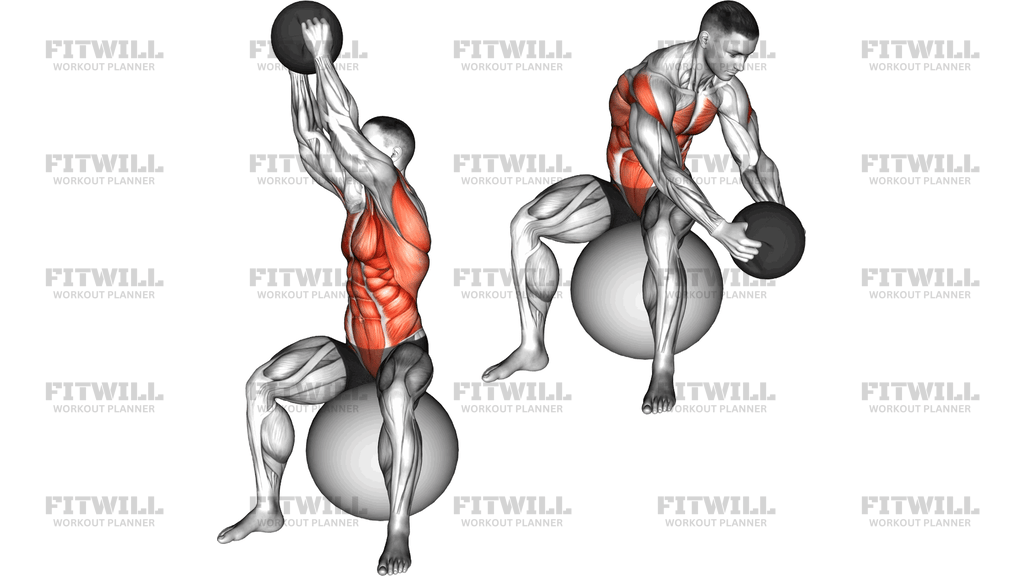
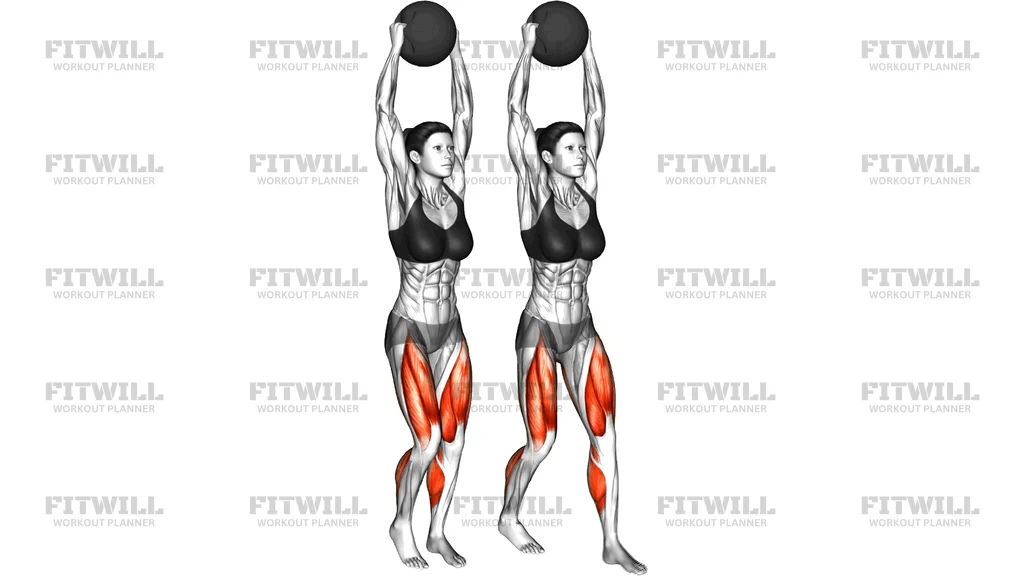
The Medicine Ball Overhead Carry is a loaded carry performed with a medicine ball held directly overhead in both hands while you walk a set distance. Unlike carries that use dumbbells or kettlebells at your sides, the overhead position places the load above your head, which forces your shoulders, upper back, and trunk to work together to keep the ball stable over your base of support with every step.
This movement is especially useful for building overhead shoulder stability and trunk control that transfers to pressing, throwing, and everyday overhead reaching. Because the ball is held with both hands in a single mass, any imbalance or wobble shows up immediately — the ball drifts forward or sideways and you have to correct it through your core and shoulders rather than masking it with one stronger arm.
The primary work comes from the deltoids and upper trapezius holding the arms locked out overhead, while the deep core, obliques, and lower back brace continuously to stop your ribcage from flaring and your spine from arching as you walk. Your grip and forearms work to control the smooth surface of the ball, and your legs — particularly the quads and glutes — drive a steady, controlled gait under load.
Setup matters more than most people expect. The ball should sit in your palms with fingers spread around it, elbows nearly straight, and the weight stacked over your shoulders and hips rather than hanging behind your head. If you start with the ball too far back or with shrugged, cramped shoulders, every step multiplies that error.
To execute it well, press the ball up until your biceps are beside your ears, brace your abs like you are about to take a light punch, and walk with short, deliberate steps, keeping your eyes forward. Move at a pace you can control; this is not a race. Common use cases include conditioning circuits, warm-up or finisher work in strength sessions, and rehab-style programs that need low-skill overhead loading.
For safety, choose a ball weight you can hold overhead with straight elbows and no lower-back arch for the entire distance. If your form breaks down — ribs flare, back arches, or the ball drifts behind your head — set the ball down and rest rather than pushing through a compromised position.
[ Workout Log & Planner ]
Put your next workout in Fitwill
Keep your plan and training log ready when you are.


Instructions
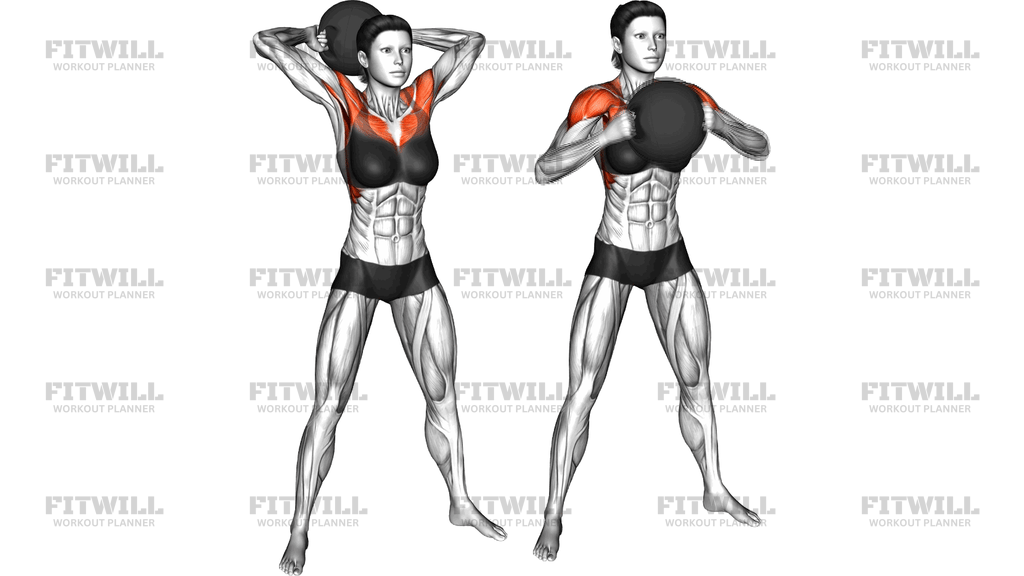
- Stand tall with your feet roughly hip-width apart and a medicine ball resting on a surface or held at chest height in both hands.
- Place your palms on opposite sides of the ball with your fingers spread wide around it, elbows tucked slightly in front of your torso.
- Press the ball straight up until your arms are fully extended overhead, biceps close to your ears and the ball positioned over the crown of your head.
- Pull your shoulders down away from your ears, squeeze the ball gently between your palms, and brace your abdominals so your ribs stay stacked over your pelvis.
- Begin walking forward with short, controlled steps, keeping the ball balanced directly over your shoulders rather than letting it drift forward or back.
- Maintain a neutral spine and a soft but steady knee drive with each step; avoid leaning to one side if the ball starts to wander.
- Breathe steadily throughout — inhale through your nose and exhale through your mouth in a controlled rhythm instead of holding your breath.
- Walk your target distance or time, then stop with your feet together and lower the ball under control to chest height before bringing it down to your side.
- Reset your grip and brace before starting the next set, and set the ball down on the floor between sets rather than dropping it.
Tips & Tricks
- If your lower back arches after the first few steps, the ball is too heavy or your brace is loose — squeeze your glutes and tuck your ribs before walking again.
- Watch for the ball drifting behind your head, which usually means shoulder fatigue; bring your biceps back to ear level instead of letting your elbows bend.
- Keep your neck long and eyes forward rather than craning up at the ball — looking up shortens the back of your neck and destabilizes the overhead position.
- Shorten your stride compared to a normal walk; long steps make it harder to keep the ball stacked over your hips and encourage side-to-side sway.
- Spread your fingers as far around the ball as your hands allow — a fingertips-only grip on a smooth medicine ball is the most common cause of a dropped load.
- If one shoulder tires faster than the other, check that you are not unconsciously pressing more through your dominant arm; both elbows should reach full extension equally.
- Start with distances of 10 to 20 meters or 20 to 30 seconds and progress by walking farther before adding ball weight.
- Avoid shrugging into the carry — think of reaching tall through the ball while keeping space between your shoulders and ears.
- On soft turf or slippery gym floors, slow your cadence; the overhead position gives you less margin for a stumble than a side carry does.
Frequently Asked Questions
Which muscles does the Medicine Ball Overhead Carry work the most?
The shoulders and upper trapezius hold the ball overhead, while the deep core and obliques brace your trunk against the moving load. Your grip, forearms, and leg muscles also work continuously to control the ball and drive the walk.
Is the Medicine Ball Overhead Carry suitable for beginners?
Yes, provided you start with a light ball — 4 to 6 pounds is enough for most newcomers. The two-handed grip makes it more forgiving than single-arm overhead carries, but you should still be able to keep your elbows straight and ribs down for the full distance.
How heavy should the medicine ball be for an overhead carry?
Pick a weight you can hold with locked elbows, no lower-back arch, and steady breathing for the entire distance. If the ball starts drifting behind your head or your ribs flare, drop to a lighter ball before adding distance.
Why does my lower back feel the Medicine Ball Overhead Carry so much?
Holding weight overhead lengthens your leverage and challenges your trunk to stay stacked. Mild effort in your trunk is expected, but if you feel strain rather than work, you are likely arching — squeeze your glutes, tuck your ribs, and shorten the set.
What is the most common mistake in the Medicine Ball Overhead Carry?
Letting the ball drift behind the head with shrugged shoulders, which turns the carry into a strain on the neck and lower back. Correct it by pressing the ball so it sits over the crown of your head with your biceps beside your ears.
How far or how long should I carry the medicine ball?
Start with 10 to 20 meters or 20 to 30 seconds per set and rest until your overhead position feels crisp again. Progress the distance or time first, and only increase the ball weight once your form holds at the longer range.
Can I substitute another exercise if I don't have a medicine ball?
A single dumbbell or small plate held with two hands overhead works similarly, though neither demands the same grip control as a smooth ball. A sandbag or slam ball held overhead is the closest match.
Should my arms be completely straight during the carry?
Yes — nearly locked elbows keep the load stacked over your joints and prevent your triceps from tiring before your core does. A slight softening at the elbow is fine as long as the ball stays over your head, not behind it.
Is it safe to do the Medicine Ball Overhead Carry with a shoulder injury history?
Check with a qualified professional first, since the fully overhead position demands healthy shoulder mobility. If it is cleared, use a light ball, keep the range to a comfortable overhead reach, and stop immediately if you feel pinching.
How is the Medicine Ball Overhead Carry different from a farmer's carry?
A farmer's carry loads your sides and lets your shoulders stay relaxed, while the overhead carry places the load above your head, shifting the demand to shoulder stability and anti-arch core control. The two complement each other rather than replace one another.