Russian Twist With Medicine Ball
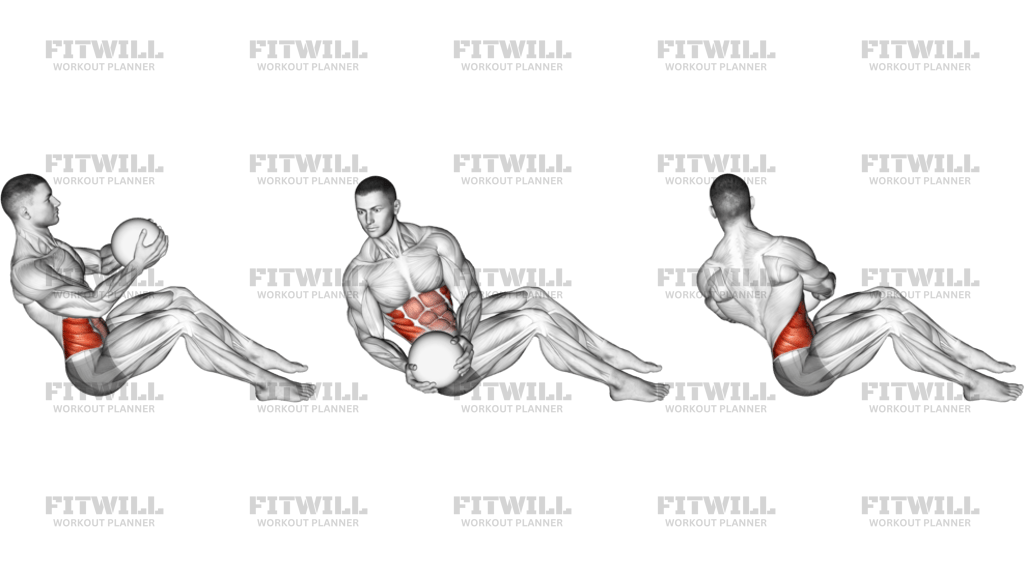
Russian Twist With Medicine Ball is a seated rotational core exercise built to train the obliques through controlled trunk rotation and anti-extension control. The medicine ball gives you a clear external load, so the exercise rewards clean torso movement instead of fast arm swings. It is most useful when you want the midsection to stay organized while the shoulders and hips move together as one unit.
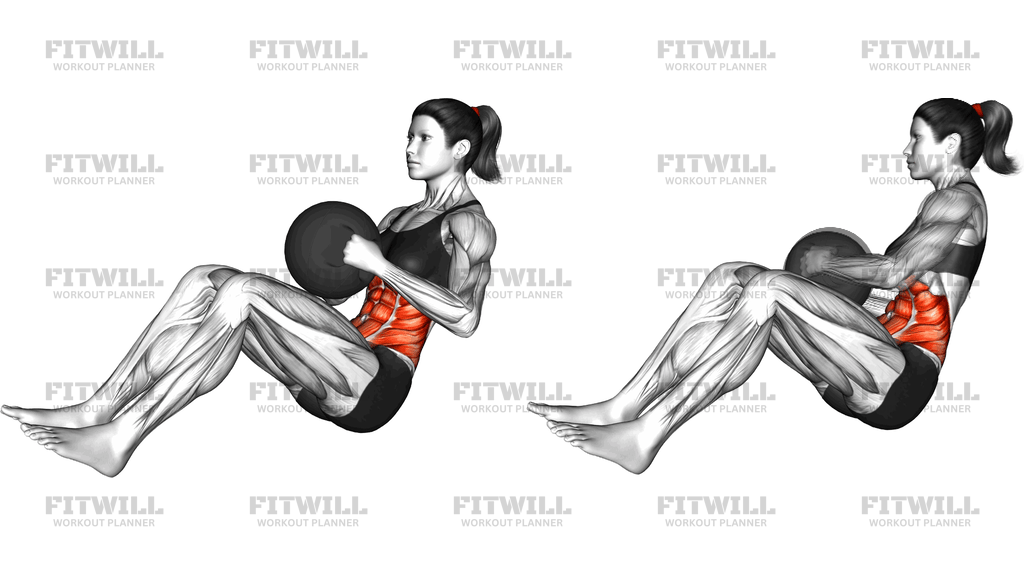
In the featured setup, you sit on the floor with your torso reclined, knees bent, and the medicine ball held in front of the chest or lower ribs. From that position, the trunk rotates from side to side so the ball travels across the body and toward each hip. The lower back should stay long and braced; if you lose that position and collapse backward, the set turns into a hip-flexor or momentum drill instead of a core exercise.
The exercise primarily targets the obliques, with the rectus abdominis, transversus abdominis, and spinal stabilizers helping keep the rib cage stacked over the pelvis. That makes Russian Twist With Medicine Ball a good choice for core sessions, accessory work after compound lifts, or conditioning circuits where you want rotational control. A lighter ball and a smaller rotation are often better than chasing a bigger range that you cannot control.
Good reps look deliberate: rotate the shoulders and rib cage together, keep the ball close to your centerline, and touch or aim the ball toward the floor beside each hip only as far as you can do without rounding aggressively. Exhale as you twist, then return through the center under control instead of bouncing off the floor or throwing the ball to the other side. If you need to reduce difficulty, keep the heels down or sit a little taller. If you need more challenge, extend the lever by leaning back slightly more or slowing the tempo while keeping the torso rigid.
Because the movement is easy to rush, the main coaching priority is staying honest with the torso position and keeping the ball path smooth. When the posture holds, the exercise trains rotational strength, trunk endurance, and coordination in a very visible way. When posture breaks, the set becomes noisy and less useful. For that reason, the best version of Russian Twist With Medicine Ball is the one you can repeat cleanly for the full set without losing the shape of the position.
[ Workout Log & Planner ]
Put your next workout in Fitwill
Keep your plan and training log ready when you are.


Instructions
- Sit on the floor with your knees bent, torso reclined, and the medicine ball held close to your chest or lower ribs.
- Plant your heels lightly on the floor or keep them hovering if you can hold the position without rounding your lower back.
- Brace your abdomen so your rib cage stays stacked over your pelvis before the first twist.
- Rotate your shoulders and torso to one side, moving the ball toward the floor beside your hip.
- Keep the ball close to your body instead of reaching with your arms alone.
- Reverse the rotation through the center and twist to the other side with the same pace.
- Exhale on each turn and keep the neck relaxed while your eyes follow the ball.
- Stop the set if you can no longer control the reclined position or if the lower back starts to round.
Tips & Tricks
- A light-to-moderate medicine ball usually works better than a heavy one because the load is already amplified by the long seated lever.
- If the low back starts to tuck under, sit a little taller or keep the heels down instead of forcing a bigger recline.
- Think about turning the rib cage, not just swinging the hands from side to side.
- Touching the ball to the floor is optional; only reach that low if the torso stays braced and the rotation stays smooth.
- Keep the elbows softly bent so the shoulders do not take over the movement.
- Use a slow side-to-side rhythm to reduce bounce and make each twist distinct.
- If the hip flexors cramp, bring the feet closer in and reduce the amount of lean-back.
- End the set when the ball path becomes jerky or the torso starts drifting backward on every rep.
Frequently Asked Questions
What does Russian Twist With Medicine Ball train most?
It mainly trains the obliques, with help from the deep core and the muscles that stabilize the trunk during rotation.
Should my heels stay on the floor or stay up?
Both are valid. Heels down is the easier version, while hovering the feet increases the challenge if you can keep your torso controlled.
How low should the medicine ball travel?
Bring it toward the floor beside each hip only as low as you can while keeping the back long and the trunk braced.
Why does my lower back feel this exercise?
Usually the torso is leaning back too far or the core is relaxing between twists. Shorten the range and keep the ribs stacked over the pelvis.
Can I use a heavier ball to make it harder?
Yes, but only if the twist stays smooth. A heavier ball is not better if it makes you bounce, shrug, or lose the reclined position.
Do I need to touch the ball to the floor on each side?
No. A controlled near-floor reach is enough as long as the movement stays clean and the torso does not collapse.
Is this a good beginner core exercise?
Yes, if you keep the ball light and the range modest. Beginners should focus on posture and control before trying to lean back farther.
What should I do if I feel the movement in my hips more than my abs?
Bring the feet closer in, reduce the lean-back angle, and slow the twist so the torso does the work instead of the hip flexors.