Medicine Ball Overhead Carry
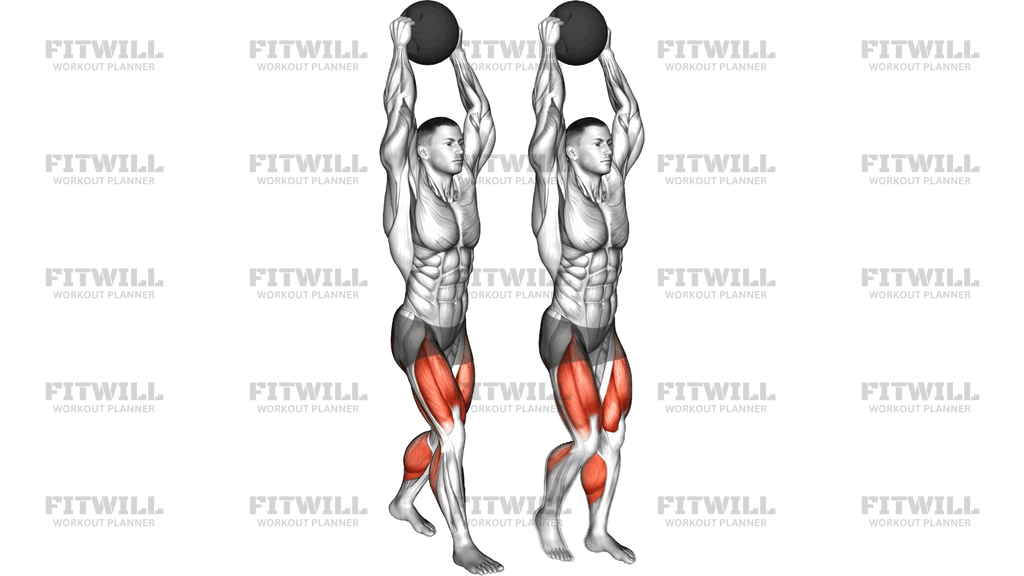
The Medicine Ball Overhead Carry is a loaded carry variation where you press a medicine ball straight overhead and walk with it held there for a set distance or time. Instead of lifting and lowering a weight for reps, you fight to keep it stacked over your shoulders with every step you take. The ball wants to drift forward, your ribcage wants to flare, and your lower back wants to arch — holding all of that in check while moving is the entire point of the exercise.
This movement trains the deep core and abdominals in a way few floor exercises can match. With the weight directly overhead, your trunk has to resist both extension and rotation while your legs create movement underneath it. Your shoulders and upper traps work hard to keep the ball stable, and your grip and forearms stay engaged the whole time. Because you're walking rather than standing still, each step sends small disturbances through your body that force continuous, reflexive bracing.
The overhead carry suits a wide range of lifters. Beginners can use a light ball to learn what a genuinely braced torso feels like, while more advanced trainees can load it heavier or use slower, more deliberate steps to raise the demand. It's a common addition to conditioning circuits, finishers, and athletic programs, since carrying a load overhead builds the kind of trunk and shoulder stability that transfers to running, throwing, and overhead lifting.
Setup matters more than most people expect. The ball should sit directly over — or a touch behind — your shoulders, not hanging out in front of your face. If the load drifts forward, your lower back takes the strain and your shoulders get pulled into a compromising position. Keep your ribs down, squeeze your glutes, and think about pushing the ball toward the ceiling rather than merely holding it up. That active press keeps your shoulder muscles engaged and your spine in a safe alignment.
In practice, choose a ball you can hold overhead with straight arms and controlled breathing, then walk with short, steady steps. Stop the set the moment your form changes: arms bending, ribs flaring, or your torso leaning back are all signs the set is done. It's better to complete more shorter trips with clean positioning than one long grind that ends in a strained lower back.
[ Workout Log & Planner ]
Put your next workout in Fitwill
Keep your plan and training log ready when you are.


Instructions
- Stand with your feet about hip-width apart and place a medicine ball on the floor in front of you.
- Hinge down, grip the ball firmly on both sides with your fingers spread, and pick it up to chest height.
- Press the ball straight overhead until your arms are fully extended, positioning it directly over your shoulders and roughly in line with the crown of your head.
- Squeeze your glutes, tuck your ribs down, and brace your abdominals as if bracing for a light punch, keeping your lower back from arching.
- Begin walking forward with short, controlled steps, keeping your eyes ahead and your head neutral rather than tilting back to look at the ball.
- Keep your elbows locked out and actively push the ball toward the ceiling throughout the walk instead of passively resting it on your hands.
- Breathe in shallow, steady breaths through your nose while maintaining the brace; do not hold your breath for the entire set.
- Walk for a set distance or time, such as 20 to 40 meters or 20 to 30 seconds, keeping your torso upright the whole way.
- When finished, stop with your feet set, lower the ball under control to chest height, then bring it down to the floor with a hip hinge.
- Reset your brace before starting the next trip, and set the ball down rather than dropping it if the surface or ball could bounce unpredictably.
Tips & Tricks
- If your lower back starts to arch as the set goes on, your core has given out before your shoulders — use a lighter ball and keep the ribs stacked over the pelvis.
- The most common fault is letting the ball drift forward over your face; correct it by thinking 'biceps beside the ears' and pushing the ball slightly behind your head.
- Keep your steps shorter than a normal walking stride; long steps make it hard to brace and encourage side-to-side sway of the ball.
- Fully lock out your elbows. Soft, bent arms turn the carry into a shoulder endurance hold and pull your upper traps into your neck.
- If one shoulder tires faster or the ball tilts to one side, check that your hands are placed evenly and your shoulders stay level.
- Do not look up at the ball while walking; a craned neck adds strain. Trust the position and keep your gaze on a point about ten feet ahead.
- Choose a medicine ball with grip-friendly texture or surface. A slick ball forces you to squeeze harder than your core is working, shortening the set for the wrong reason.
- Time your trips so each set ends on form, not on failure — when you notice your torso leaning back or your arms drifting forward, that's the set.
- Because your arms are locked overhead, your breathing room is limited; practice shallow ribcage breathing rather than big belly breaths during the carry.
Frequently Asked Questions
Which muscles does the Medicine Ball Overhead Carry work?
The primary work comes from the deep core and abdominals, which brace to keep your ribcage and pelvis aligned under the load. Your shoulders, upper traps, grip, and the stabilizers around your shoulder blades support and steady the ball overhead.
How heavy should the medicine ball be for this carry?
Pick a ball you can hold overhead with straight elbows, level shoulders, and a flat ribcage for the full distance without your lower back arching. For most people that's far lighter than what they'd press, since the bracing demand adds up quickly while walking.
Is the Medicine Ball Overhead Carry good for beginners?
Yes, provided you start light and keep the distances short. It's actually a useful teaching tool because it gives immediate feedback — the moment your brace fails, the ball position changes and you know it.
Should my arms be fully straight during the overhead carry?
Yes, keep your elbows locked out with the ball positioned over your shoulders. Bent arms shift the load onto your shoulder and triceps endurance and make the ball much harder to stabilize.
Why does my lower back feel this more than my abs?
That usually means your ribcage is flaring and your spine is arching to hold the ball up instead of your abdominals bracing. Squeeze your glutes, pull your ribs down toward your hips, and reduce the ball weight until you can hold that position cleanly.
How far or how long should I walk on each set?
Start with 20 to 30 meters or 20 to 30 seconds per trip, resting briefly between sets. Build distance or weight gradually, and end every set before your form breaks rather than after.
What can I use if I don't have a medicine ball?
A single dumbbell or kettlebell held overhead works, though the ball's size and shared two-handed grip make it easier to keep stable. A sandbag or slam ball with a secure grip are other reasonable substitutes.
How is the Medicine Ball Overhead Carry different from a farmer's carry?
A farmer's carry holds weight at your sides, so your core mainly fights side-to-side lean. The overhead carry raises the load above your head, so your core must resist arching and rotation while your shoulders work through a much less stable position.
Can I do this exercise if overhead pressing bothers my shoulders?
Be cautious. Even with straight arms, the overhead position requires comfortable shoulder mobility, so if pressing overhead causes discomfort, get cleared first or stick to carries at chest or waist height.
Where should I look while walking with the ball overhead?
Keep your eyes on a point about ten feet in front of you with your head neutral. Tilting your head back to watch the ball strains your neck and often pushes your ribs into a flare.