Medicine Ball Overhead Squat
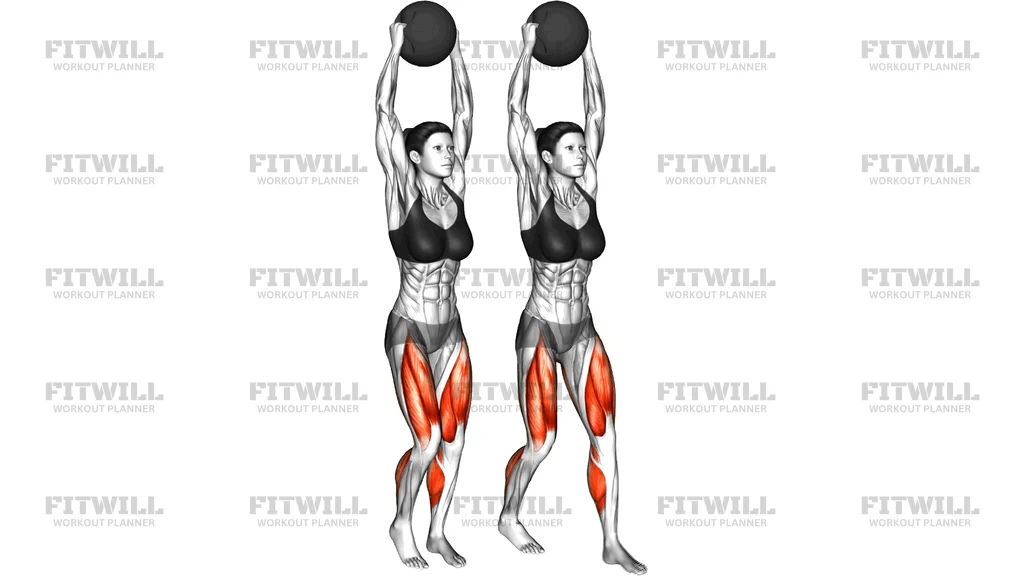
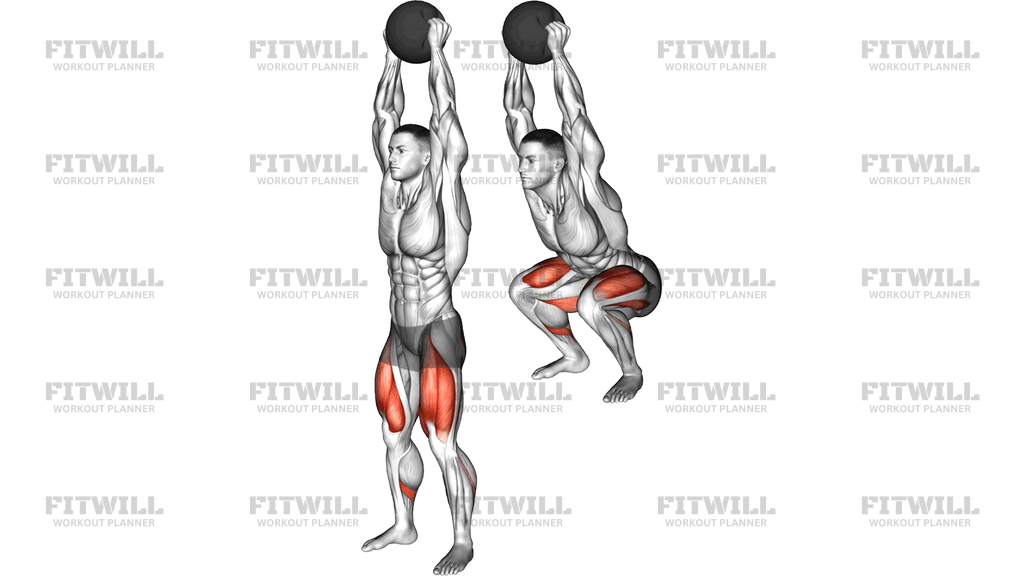
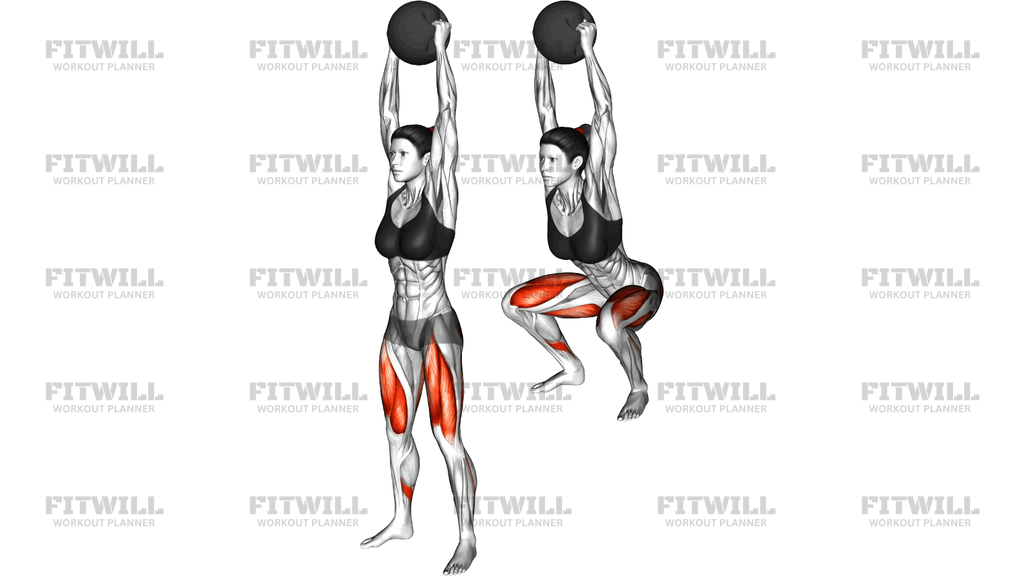
The Medicine Ball Overhead Squat is a full-body squat variation performed with a medicine ball held straight overhead with both hands. Instead of resting a load on your back or at your chest, you support the ball above your head through the entire squat, which forces your shoulders, upper back, and trunk to stay active while your legs drive the movement. The highlighted areas in the demonstration emphasize how heavily the quadriceps and glutes work, but the arms-overhead position is what makes this exercise distinct from a regular squat.
This movement is especially useful for people who want to build squat depth and control without a barbell. Holding a light medicine ball overhead raises your center of gravity and gives you a clear feedback tool: if the ball drifts forward, your torso is leaning too far ahead, and if it drifts back, you are overextending. Coaches often use overhead squats with a light ball or similar object to assess ankle, hip, and shoulder mobility, and it works well as a warm-up primer before heavier lower-body lifting.
Because the ball stays overhead, the exercise trains more than your legs. Your shoulders and upper back hold the ball in place, your deep core stabilizes against the extended-arm position, and your glutes and hamstrings control the descent and drive you back up. The result is a squat that rewards good posture and exposes tight calves, stiff hips, or limited shoulder flexion very quickly.
Setup matters more here than in a bodyweight squat. Choose a medicine ball light enough that you can press it overhead and keep your elbows nearly locked without strain. Stand with feet roughly shoulder-width or slightly wider, toes turned out a few degrees, and reach the ball directly over the crown of your head rather than in front of your face. A bar path that stays stacked over your mid-foot is the goal for every rep.
Execution comes down to sitting down between your hips while keeping that overhead stack intact. Push your hips back and bend your knees together, keeping your chest tall and the ball in line with your spine. Squat as deep as you can while the ball stays overhead and your heels stay connected to the floor, then drive through the floor to stand tall again. Move deliberately; this is not a rep-speed exercise.
In practice, the Medicine Ball Overhead Squat fits well into warm-ups, mobility circuits, and light-conditioning work. Beginners use it to learn squat mechanics with an unloaded overhead reach, while more experienced lifters use it to maintain shoulder and hip mobility between heavy sessions. If your heels rise at the bottom, simply shorten the depth rather than forcing the squat lower, since balance and a neutral spine matter more than reaching full depth on every rep.
[ Workout Log & Planner ]
Put your next workout in Fitwill
Keep your plan and training log ready when you are.


Instructions
- Stand with your feet about shoulder-width apart or slightly wider, toes turned out a few degrees, holding a medicine ball with both hands at chest height.
- Press the ball straight overhead until your arms are fully extended, positioning it over the crown of your head rather than in front of your face. Keep your elbows close to locked and your shoulders pulled down away from your ears.
- Brace your core and squeeze your glutes slightly to set your pelvis in a neutral position before you descend.
- Inhale, then push your hips back and bend your knees at the same time, sitting down between your hips while keeping the ball stacked over your mid-foot.
- Descend until your thighs are at least parallel to the floor or as deep as you can go while your heels stay down and the ball remains overhead. Keep your chest tall and your gaze forward.
- At the bottom, keep tension in your legs and trunk rather than relaxing into the squat position.
- Exhale and drive through your whole foot to stand back up, keeping your knees tracking over your toes and the ball traveling straight up with your body.
- Finish each rep standing fully tall with the ball overhead, hips extended, before starting the next repetition.
- Complete your set, then lower the ball under control back to your chest before setting it down rather than dropping it from overhead.
Tips & Tricks
- The most common mistake is letting the ball drift forward as you squat down, which usually means the chest is falling too. Cue yourself to press the ball slightly back toward the back of your head as you descend.
- If your heels lift off the floor at the bottom, your ankle mobility may be the limiting factor. Squat to a shallower depth with your heels planted, or place a thin book or weight plate under your heels while you build range.
- Do not shrug the ball upward. Keep your shoulders relaxed and down while your arms stay extended, otherwise your upper traps will take over and fatigue long before your legs.
- Widen your grip slightly on the ball if your shoulders feel pinched overhead. A wider hand position often lets you reach higher with a more neutral spine.
- Keep your knees pressing outward in the same direction as your toes during the descent. Knees caving inward is easy to miss when your attention is on the ball overhead.
- Control the descent for two to three seconds. Dropping quickly into the bottom makes the overhead position harder to hold and removes the stability work that makes this squat valuable.
- Start with a light medicine ball, even one or two kilograms. The exercise becomes much harder the moment the overhead load is heavy enough to pull your torso forward.
- Reset your overhead position between reps if the ball has drifted. It is better to pause, re-stack the ball over your head, and continue than to grind through reps with a broken position.
- If you cannot squat deep without your lower back rounding, stop at the depth where your spine stays neutral. Depth can improve over time; forcing it usually shifts stress to the lower back.
Frequently Asked Questions
What muscles does the Medicine Ball Overhead Squat work?
The quadriceps and glutes do the main work of squatting down and standing up. Holding the ball overhead also keeps your shoulders, upper back, and core under constant tension, and your hamstrings help control the descent.
Is the Medicine Ball Overhead Squat good for beginners?
Yes, provided the ball is light. It teaches squat depth, trunk stability, and overhead reach at the same time, which is why it is often used as a learning and assessment drill before barbell squatting.
Why do my heels lift when I squat deep with the ball overhead?
That is usually limited ankle mobility rather than a strength problem. Reduce your depth so your heels stay planted, and work on calf and ankle flexibility separately before chasing a deeper squat.
How heavy should the medicine ball be for this exercise?
Light is correct here. Pick a ball you can hold locked out overhead for your whole set without your torso leaning forward; usually a light ball between one and five kilograms works for most people.
How deep should I squat in the Medicine Ball Overhead Squat?
Aim for thighs at parallel or slightly below, but only as deep as you can go while your heels stay down, the ball stays overhead, and your lower back stays neutral. Depth should come from mobility, not from bending your spine.
Can I substitute another piece of equipment for the medicine ball?
A light dumbbell held with both hands overhead, a small weight plate, or even a single light plate reached toward the ceiling can work. The key requirement is a load light enough to hold straight overhead with locked elbows.
Why does the ball keep drifting forward during the squat?
A forward-drifting ball usually means your chest is dropping or your arms are relaxing into a press in front of the body. Keep your arms fully extended and think about pulling the ball slightly back as your hips travel down.
Is the Medicine Ball Overhead Squat safe for people with shoulder problems?
If overhead reaching causes pain, this is not the right squat variation for you. Goblet squats or squats with the ball held at the chest train the legs with much less shoulder demand, so start there.
How many reps and sets should I do?
Two to three sets of eight to twelve controlled reps works well as a warm-up or mobility drill. Since the exercise depends on holding a stable overhead position, stop the set when that position starts to break down rather than pushing to fatigue.