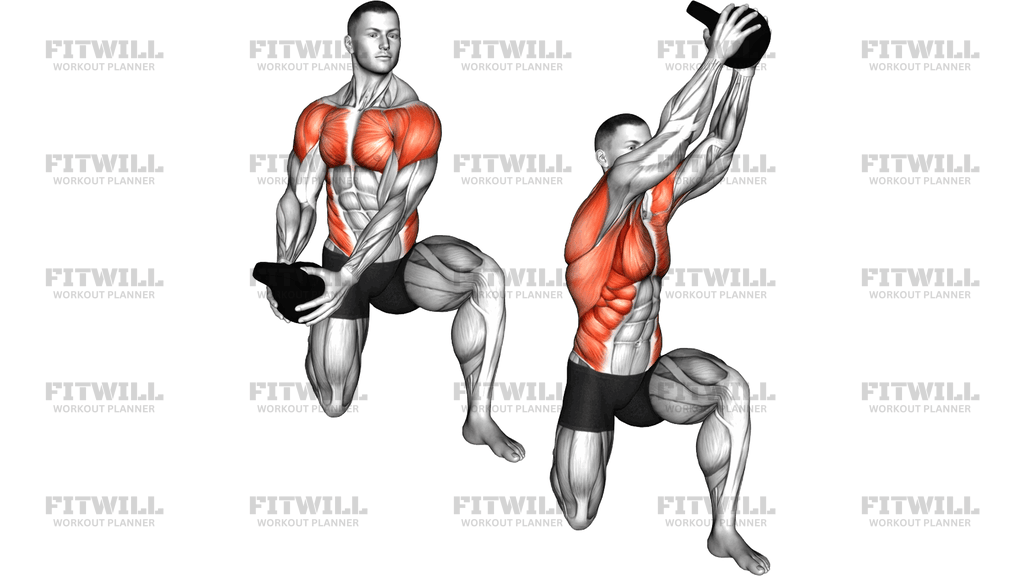
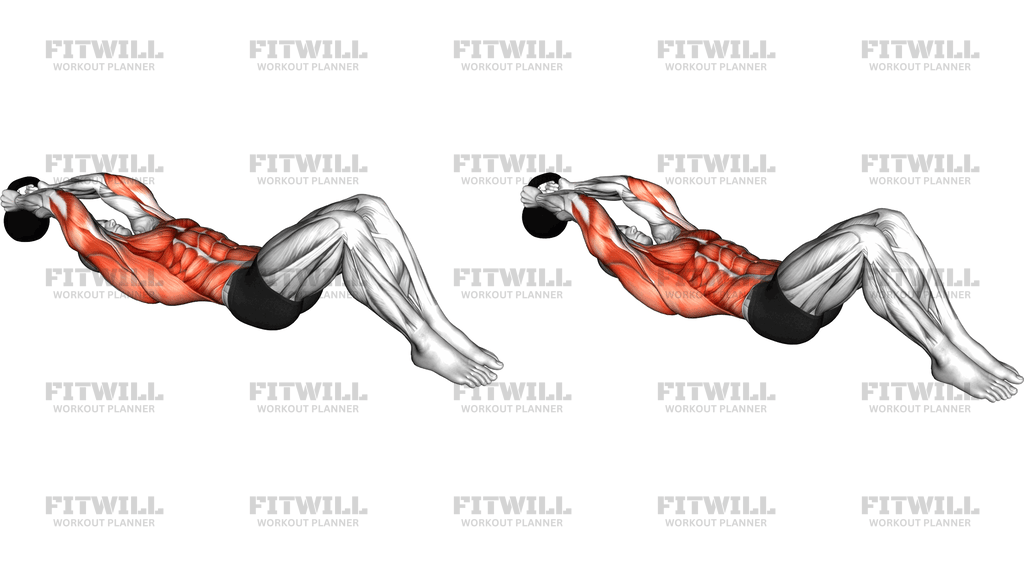
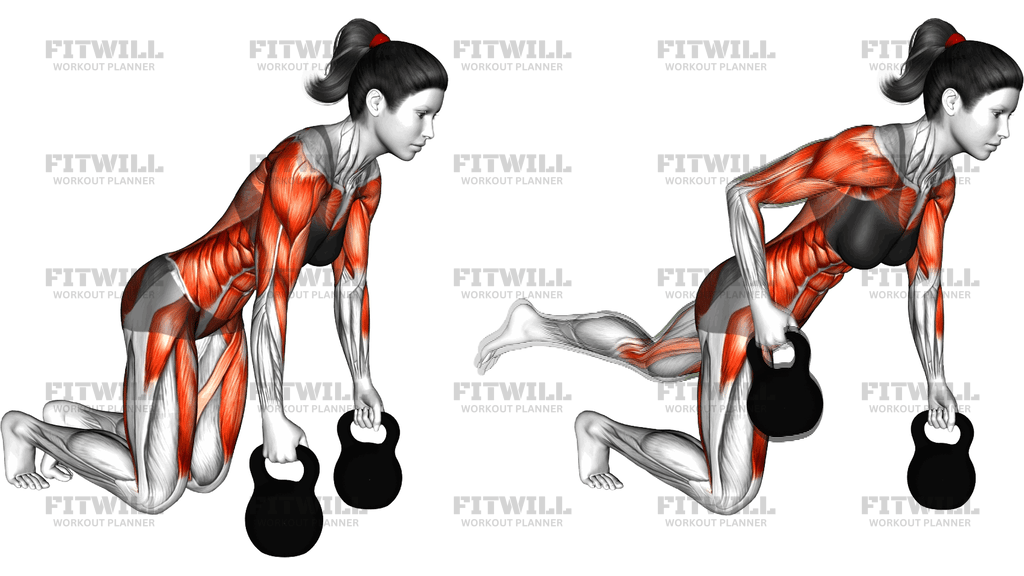
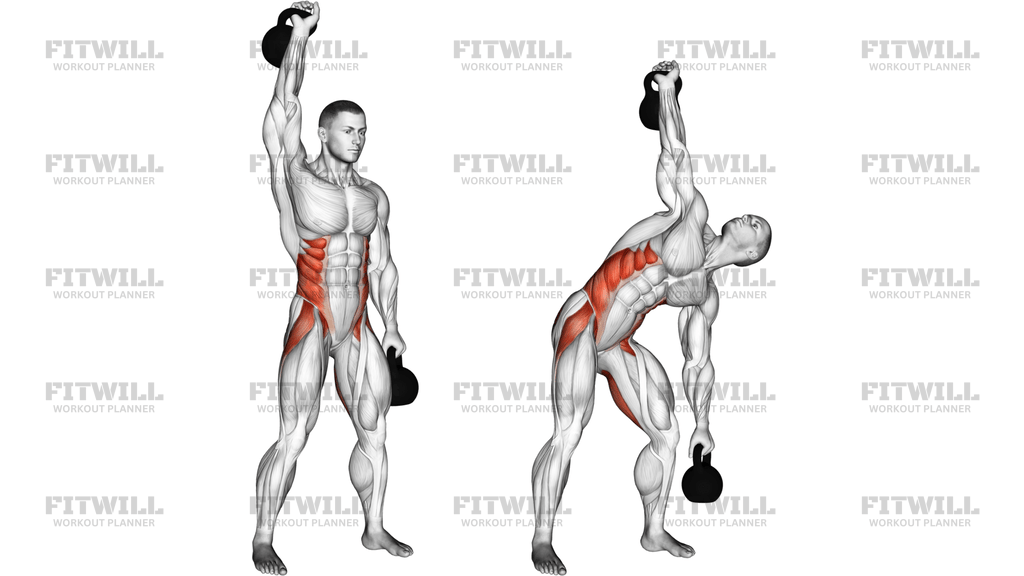
Kettlebell Side Plank Reach Through
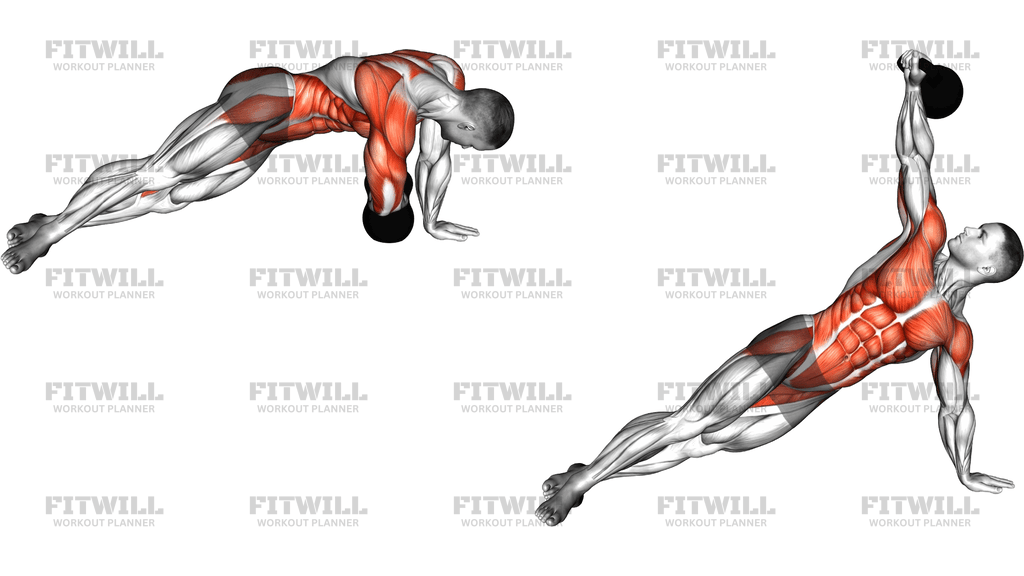
The Kettlebell Side Plank Reach Through combines two demanding elements into one movement: holding a stable side plank while sweeping a kettlebell underneath your torso and then reaching it up toward the ceiling. You start in a side plank supported on your bottom forearm, with the kettlebell resting on the floor in front of your waist. Your top hand grips the handle, pulls the bell under your ribcage as you rotate slightly toward the floor, then reverses the arc so the arm finishes extended straight up, stacked over your shoulder.
This exercise earns its place in a program because it forces the obliques, deep core, and hip stabilizers to hold a rigid line while the shoulder and arm move a load through space. That combination of anti-lateral-flexion and dynamic reaching is rare in simpler core drills. It also trains the bottom shoulder to stay packed and the hips to resist sagging, which carries over well to carrying, throwing, and rotational sports movements.
It suits intermediate trainees who can already hold a solid forearm side plank for 30 seconds or more without the hips dropping. Golfers, tennis players, and combat athletes appreciate the rotational reach component, while general lifters can use it as a finishing core movement after heavier compound work. Because the load is relatively light and the position self-limiting, it fits well into circuits and warm-up sequences too.
Setup quality determines everything here. Place the kettlebell close enough to your waist that you can grab the handle without shifting your hips, and align your supporting elbow directly under your bottom shoulder. Feet can be stacked or staggered for a wider base. If your elbow and shoulder are not stacked, or the bell sits too far away, your torso will twist to compensate and the obliques lose their job.
To execute well, brace your trunk before you move the arm, then trace a smooth arc under your body and back up, letting the rotation come from the thoracic spine rather than the pelvis. Keep the movement deliberate; the reach-through should feel like your ribs are wrapping around a barrel. Avoid rushing, and stop the set the moment your hips start to sink or your supporting shoulder collapses.
Start with a light kettlebell, somewhere in the 8 to 12 kg range for most men, and complete all reps on one side before switching. Two to three sets of 6 to 10 controlled reaches per side is a practical working dose. If your bottom forearm or shoulder complains before your core does, reduce the range or drop to a bodyweight reach-through until the position feels solid.
[ Workout Log & Planner ]
Put your next workout in Fitwill
Keep your plan and training log ready when you are.


Instructions
- Place a kettlebell on the floor next to your waist and lie on your side with your bottom elbow directly under your bottom shoulder and your forearm pointing forward.
- Stack your feet or stagger the top foot in front of the bottom foot, then lift your hips so your body forms one straight line from head to heels.
- Grip the kettlebell handle with your top hand and let it rest on the floor in front of your torso until you are ready to move.
- Brace your core and squeeze your glutes so your hips cannot sag or drift backward during the reach.
- Sweep the kettlebell under your torso, allowing your upper back and shoulders to rotate toward the floor while your hips stay stacked and level.
- Reverse the arc smoothly and press the kettlebell up and back until your top arm is extended straight toward the ceiling, in line with your supporting shoulder.
- Pause briefly at the top with the arm vertical, keeping your ribs down and your hips lifted.
- Lower the kettlebell back along the same arc under your torso with control rather than letting it drop.
- Exhale as you reach the bell up toward the ceiling and inhale as you bring it back through, keeping your breathing steady throughout the set.
- Finish all repetitions on one side, set the kettlebell down safely, then reset your plank position and repeat on the other side.
Tips & Tricks
- The most common failure is the hips sinking toward the floor as the arm rotates; consciously drive the bottom hip toward the ceiling before every reach.
- If the kettlebell is placed too far from your waist, you will twist your pelvis to grab it. Reposition the bell closer before you start rather than reaching for it mid-plank.
- Let the rotation come from your upper back. If your lower back twists instead, your obliques are being bypassed and the lumbar spine takes unwanted stress.
- Keep the kettlebell handle resting across the base of your fingers with a firm but relaxed grip; a death grip on the handle will fatigue your forearms before your core.
- If your bottom shoulder feels unstable, press the floor away slightly with your forearm to keep the shoulder blade active instead of letting it sink into the joint.
- Watch that your top arm finishes stacked over the supporting shoulder. Reaching behind your head or out to the side changes the resistance line and strains the shoulder.
- Slow the lowering half down deliberately. Most people control the reach up but let the bell fall back under the torso, losing half the training effect.
- Staggering your feet instead of stacking them gives a wider base and makes the hold far more manageable when you are learning the reach pattern.
- Stop the set as soon as your form breaks, not when you hit a rep number. A sagging hip in the final reps teaches your body the exact position you are trying to avoid.
Frequently Asked Questions
Which muscles does the Kettlebell Side Plank Reach Through work?
The obliques on the underside of your trunk do most of the stabilizing, supported by the deep core and the quadratus lumborum. The moving arm works the shoulders and upper back through the reach, and the hips work hard to keep the body level.
Can beginners do the Kettlebell Side Plank Reach Through?
Yes, if they can already hold a forearm side plank for about 30 seconds. Beginners should use a very light kettlebell or simply reach with an empty hand, and stagger the feet for a wider base.
How heavy should the kettlebell be for the Kettlebell Side Plank Reach Through?
Most men do well starting between 8 and 12 kg. The limiting factor should be trunk stability, not grip or shoulder strength, so choose a bell you can control smoothly for all prescribed reps.
Why do my hips drop during the reach portion?
The rotating arm pulls your torso toward the floor, and if your obliques and glutes are not braced, the hips follow. Squeeze the glutes and think about pushing the bottom hip up before initiating each reach.
What is the difference between this and a regular kettlebell side plank?
A static side plank only trains anti-lateral-flexion, while the reach through adds a rotating arc that loads the obliques dynamically and challenges thoracic rotation. The moving version is more demanding and more specific to rotational sports actions.
Can I do the Kettlebell Side Plank Reach Through every day?
Because the load is light and the position is self-limiting, frequent practice is possible, but two to four focused sessions per week is enough for most people. Alternate sides evenly and skip a day if your shoulders or wrists feel worn down.
What can I substitute if I do not have a kettlebell?
A small dumbbell or a single medicine ball works, or you can perform the reach with an empty hand to learn the pattern. The key is keeping the load light enough that your torso position never changes.
Should my feet be stacked or staggered in this exercise?
Stacked feet increase the balance demand on the obliques and outer hips, while a staggered stance gives a wider, more stable base. Start staggered and progress to stacked once you can control the full reach without hip drift.
Is it safe for my lower back and shoulder?
When performed with a braced trunk, stacked elbow under the shoulder, and a controlled arc, the movement is generally well tolerated. If you have an acute shoulder injury or significant lower back pain, get clearance from a qualified professional before adding load.