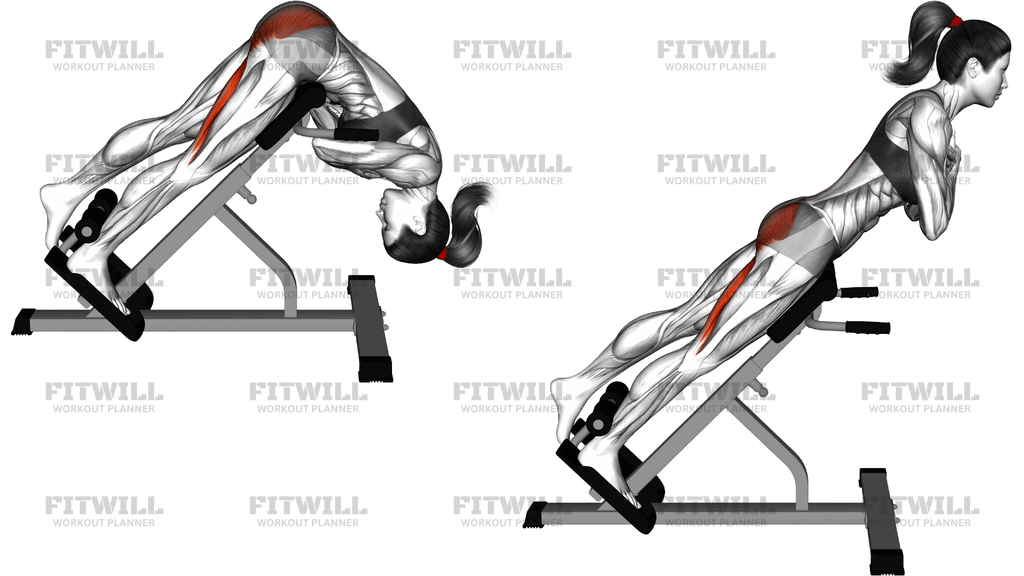
Roman Chair 45 Degree One Leg Hyperextension Arms In Front Of Chest
Roman Chair 45 Degree One Leg Hyperextension (arms In Front Of Chest) is a bodyweight posterior-chain exercise built around a supported hip hinge on a 45-degree roman chair. The single-leg setup makes the movement more demanding than a standard back extension because the pelvis has less support and the working side has to control the lift without twisting or bouncing. With the arms crossed in front of the chest, the upper body stays compact and the focus shifts to clean hip extension.
The main training effect is on the hamstrings, with the glutes, spinal erectors, and trunk stabilizers helping keep the torso and pelvis aligned. Because one leg is held out of the base, the exercise also challenges balance and side-to-side control. That makes it useful for athletes and lifters who want stronger hamstring engagement, better hip extension mechanics, and a more controlled hinge pattern without external loading.
Setup matters more than load on this movement. Position the hips on the pad so the crease of the hip can hinge freely, then secure the working leg and extend the free leg so the body stays long from heel to head. Cross the arms over the chest instead of reaching forward, which would make the torso drift and reduce the work on the posterior chain. Before each rep, brace lightly, set the ribs down, and keep the neck in line with the spine.
Each repetition should feel like a smooth arc, not a snap. Lower under control until the torso reaches a comfortable hinge point, then drive the chest up by extending the hips and squeezing the hamstrings and glutes together. The pelvis should stay square to the bench and the motion should stop before the lower back starts to take over. At the top, hold a brief, strong finish, then return to the bottom with the same control you used on the way up.
This is a good accessory exercise for hamstring-dominant lower-body sessions, posterior-chain warmups, or core work that needs a stable but challenging hinge. It also works well when you want to train unilateral control without heavy external resistance. Start with a small range if the single-leg position feels unstable, and progress by improving the pause, tempo, and control before adding difficulty. Sharp low-back pain, pelvis rotation, or momentum are signs to shorten the set and reset the setup.
[ Workout Log & Planner ]
Put your next workout in Fitwill
Keep your plan and training log ready when you are.


Instructions
- Adjust the roman chair so your hips sit just ahead of the pad and your upper legs can hinge freely.
- Secure the working leg against the lower support and extend the free leg straight behind you for balance.
- Cross your arms in front of your chest and set your ribs down without rounding your upper back.
- Start with the torso in line with the bench and the pelvis square to the floor.
- Lower your chest under control by hinging at the hips until you feel the hamstrings lengthen.
- Drive the torso back up by extending the hips and keeping the free leg long behind you.
- Squeeze at the top for a brief pause without overextending the lower back.
- Return to the bottom slowly, keep tension on the hamstrings, and repeat for the target reps.
Tips & Tricks
- Keep the pelvis pointed straight ahead; if one hip opens, the one-leg version turns into a twisting back extension.
- Think about lifting the chest with the hamstrings, not arching the lower back to finish the rep.
- A smaller range with perfect alignment is better than dropping too deep and losing the square hip position.
- Crossing the arms removes a lot of cheating from the shoulders, so avoid reaching forward or swinging the elbows.
- Move slowly through the lowering phase so the hamstrings stay loaded instead of the rep falling into the bottom.
- If the free leg drifts upward or sideways, shorten the set and reset the bench position before continuing.
- Keep the neck neutral and look slightly ahead of the bench rather than cranking the head up at the top.
- Stop the set when the lower back takes over or the torso starts bouncing out of the bottom.
Frequently Asked Questions
What muscle does Roman Chair 45 degree one leg hyperextension (arms in front of chest) target most?
The hamstrings do the main work, with the glutes and spinal erectors helping finish the hip extension.
Can beginners perform this exercise?
Yes, but beginners should start with a short range and a slow tempo so the single-leg setup stays controlled.
Why are the arms held in front of the chest?
Crossing the arms keeps the torso compact and reduces the chance of using momentum to swing through the rep.
Should I feel this more in my hamstrings or lower back?
You should feel the hamstrings first, with the lower back assisting. If the low back is dominating, shorten the range and reset your hip position.
How far down should I lower on the roman chair?
Lower only until you can keep the pelvis square and the spine long. Depth should come from the hip hinge, not from rounding the back.
What is the biggest mistake on the one-leg version?
Letting the hips rotate or bouncing out of the bottom is the most common error.
When is this exercise most useful?
It works well as hamstring accessory work, a posterior-chain warmup, or unilateral control training in a lower-body session.
How do I make it harder without adding weight?
Use a slower lowering phase, hold the top position longer, or increase the range only if the pelvis stays stable.