Band Decline Close Grip Press
The Band Decline Close Grip Press is a band-resisted pressing exercise performed on a decline bench, where the resistance band is anchored low to the floor and held with a narrow, close grip. Because your head is lower than your hips and your hands travel over the lower portion of your chest, the setup shifts emphasis toward the lower chest and heavily recruits the triceps, which do most of the work of straightening the arms against the band's pull. The close grip also keeps your elbows tracking close to your torso, which many lifters find gentler on the shoulder joints than a wide press.
The setup is what makes this version distinct. The band runs from a low anchor point, typically looped under or around a heavy weight plate on the floor, up to a V-bar handle held over your chest. This creates resistance that gets harder as you press toward lockout, which suits the triceps well since they are strongest near full extension. It is a practical option for home training or for anyone who wants a pressing stimulus without loading a barbell or dumbbells while lying head-down.
This movement is useful for lifters who want to target the triceps and lower chest together, for people rehabbing back into pressing after time off, and for home gym users whose only bench is a decline model. It also works well as a finishing movement after heavier barbell or dumbbell pressing, when you want to fatigue the triceps with a smooth, joint-friendly resistance curve.
To execute it well, anchor the band securely, take the V-bar with both hands close together, and keep your wrists stacked over your elbows throughout. Press up and slightly back over your lower chest until your arms are straight, squeeze briefly, then lower with control until your hands are just above chest level. Because the band pulls you downward and toward the anchor, keeping tension in your upper back and core is important to avoid drifting or arching off the bench.
A few practical points will keep the exercise safe and effective. Make sure the decline bench is stable and your ankles are hooked under the roller pads so you do not slide. Check that the band anchor cannot slip before your first rep, since a band releasing under tension is the main risk in this setup. Start with a light band to learn the path, keep the movement slow at the bottom, and only progress resistance once you can press and lower without your elbows flaring or your hips lifting off the pad.
[ Workout Log & Planner ]
Put your next workout in Fitwill
Keep your plan and training log ready when you are.


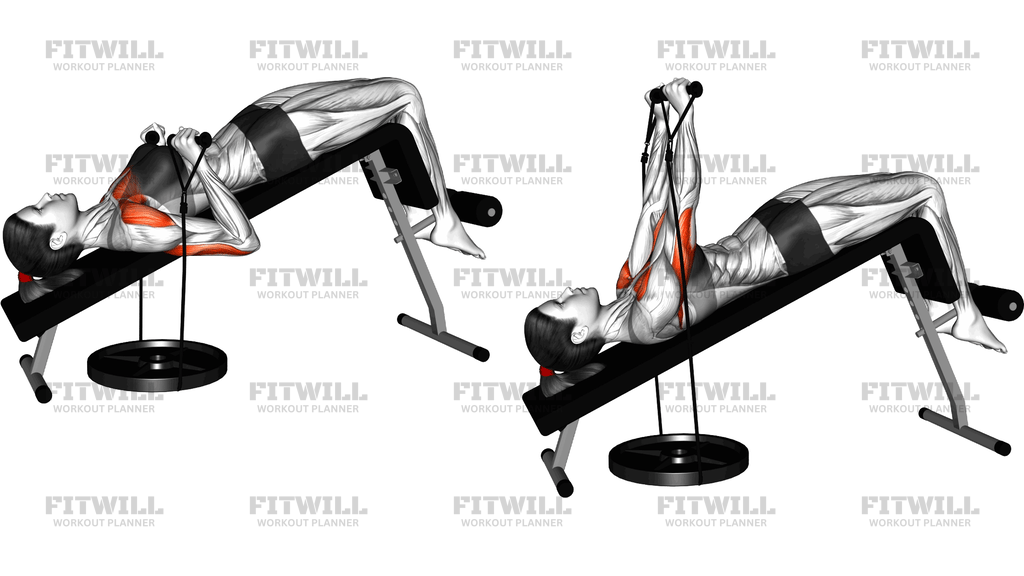
Instructions
- Anchor one end of the resistance band low to the ground, such as looped under a heavy weight plate on the floor, and attach the other end to a V-bar handle.
- Set a decline bench so the band runs from the floor anchor up along your pressing line, then sit back on the bench and hook your ankles securely under the roller pads.
- Grip the V-bar with both hands close together, roughly inner shoulder-width, and bring it down so it rests over your lower chest with your elbows bent and tucked near your ribs.
- Brace your core and press your upper back into the bench so you are stable before the band reaches full tension.
- Exhale and press the handle straight up over your lower chest until your arms are fully extended, letting the band stretch as you reach lockout.
- Hold the top for a beat and squeeze your triceps and chest without letting the handle drift back over your face or forward past your shoulders.
- Inhale as you slowly lower the handle back down until your hands are just above your lower chest and the band is still under light tension.
- Keep your elbows pointing down and tracking close to your torso on both the pressing and lowering portions rather than flaring outward.
- Complete your reps, then carefully guide the handle down before sitting up so the band never snaps back toward you.
- Reset your grip and ankle position between sets, and check that the anchor and band remain secure before each set.
Tips & Tricks
- If the band slips off the weight plate mid-set, loop it around the plate twice or double the band over itself so friction holds it in place.
- Because the head is lower than the hips on a decline bench, some lifters feel pressure in the head or neck; keep your neck relaxed on the pad and avoid straining your chin forward to watch the handle.
- The most common mistake here is flaring the elbows out wide to involve more chest, which defeats the close-grip purpose; consciously keep them brushing your ribs.
- Do not let the handle travel back over your head at lockout; the pressing line should finish roughly over your lower chest, where the image's path shows the arms stacked vertically.
- If the band tension is overwhelming at the top but easy at the bottom, use a lighter band and add a slow three-second lowering phase instead of stacking multiple bands.
- A neutral or slightly turned-out wrist on the V-bar keeps the wrists from folding backward under the band's pull at lockout.
- If your hips rise off the pad as you press, the resistance is likely too heavy; reduce band tension so your glutes and lower back stay in contact with the bench.
- Warm up your elbows and shoulders with a few light, fast sets first, since the close grip places steady tension on the triceps tendons at the bottom of each rep.
- Dumbbells can replace the band if you have no anchor point, but you lose the rising resistance at lockout that makes the band version triceps-focused.
Frequently Asked Questions
What muscles does the Band Decline Close Grip Press work?
The triceps are the primary movers because the close grip and lockout-heavy band tension demand full elbow extension. The lower chest assists the press, with the front shoulders providing support.
Why use a decline bench instead of a flat bench for this press?
The decline angle positions the pressing line over the lower chest, which biases the sternal fibers of the pecs while the close grip keeps the triceps heavily involved. It also lets the band anchor low to the floor in line with the press.
Is the Band Decline Close Grip Press suitable for beginners?
Yes, provided you start with a light band and learn the setup carefully. Beginners should practice the pressing path with minimal tension before progressing, since the decline position takes a session or two to feel comfortable.
How close should my grip be on the V-bar handle?
Your hands should sit about inner shoulder-width apart, close enough that your elbows stay beside your ribs but not so narrow that your wrists bend inward. On a V-bar, one hand on each side of the peak usually achieves this.
How do I anchor the band safely for this exercise?
Loop the band securely under or around a heavy, flat weight plate on the floor directly below the bench, and test it with a gentle pull before lying back. A slipping anchor under tension is the main hazard, so verify it before every set.
Can I substitute a barbell close grip decline press for this exercise?
Yes, a barbell close grip press on a decline bench is a valid substitute if you have the equipment and a spotter or safety setup. The band version offers a smoother resistance curve and less joint compression, while the barbell allows heavier progressive loading.
Why does the resistance feel hardest at the top of the press?
The band is stretched furthest when your arms reach full extension above your lower chest, which increases tension at lockout. This matches your triceps' strength curve, since they are most powerful near full extension.
Should my elbows stay tucked the entire time?
Yes, in a close grip press the elbows should travel close to your torso rather than flaring wide. Keeping them tucked directs the load to the triceps and keeps the shoulder joint in a more comfortable position.
Is it safe to lie head-down while pressing a band overhead?
It is safe when the anchor is secure and you control the descent, but always guide the handle down before sitting up so the band cannot snap back. If you feel lightheaded in the decline position, shorten your sets or raise the bench angle slightly.
How many sets and reps should I do for the Band Decline Close Grip Press?
Three to four sets of 10 to 15 reps works well for most lifters, since band resistance suits moderate rep ranges. Adjust band thickness rather than adding lots of sets when you need more challenge.