Resistance Band Kneeling Chest Press
The Resistance Band Kneeling Chest Press is a horizontal pressing movement performed from an upright kneeling position, with the band looped behind your upper back and gripped in each hand at chest height. From there, you press both hands forward until your arms reach full extension at mid-chest level, then control the band back to the starting position. Because the band runs across your shoulders rather than anchoring to a wall or post, the tension path stays locked to your torso, which keeps the resistance traveling exactly where you press.
Kneeling changes this exercise in a way most people underestimate. With no bench behind you and no leg drive available, your trunk has to hold itself upright while your arms push against the band's pull. That makes it a genuine chest and triceps builder that also demands real work from your abs, hip flexors, and the muscles steadying your spine. Lifters who struggle to keep their ribs from flaring or their lower back from arching during bench work often find the kneeling setup exposes and corrects that habit quickly.
This is a strong choice for home training where a cable station or loaded barbell is not available, for lifters traveling with a band in a bag, or as a finishing movement after heavier pressing to add volume to the chest without loading the joints. It is also a good bridge exercise for beginners: the band gives smooth, joint-friendly resistance, and stepping on or shortening the band lets you scale the difficulty precisely.
Setup details matter here. The band should sit across the top of your back at roughly shoulder-blade level, held firmly under each hand so it cannot slip. Your knees stay planted about hip-width apart, your torso tall, and your hands start just outside your chest with elbows angled slightly down rather than flared straight out to the sides. Pressing with the elbows too high turns the movement into a shoulder-dominant push and can pinch the front of the shoulder.
To execute well, think of pushing your chest toward your hands as much as your hands away from your chest. Extend until your arms are straight and your hands are roughly in line with the middle of your chest, squeeze briefly, then resist the band on the way back instead of letting it snap you in. A controlled return is where much of the chest and core benefit lives, so take the same two to three seconds coming back that you spend pressing out. If you find yourself leaning backward to finish reps, the band is too heavy or you are simply fatigued; either reduce the tension or end the set.
[ Workout Log & Planner ]
Put your next workout in Fitwill
Keep your plan and training log ready when you are.


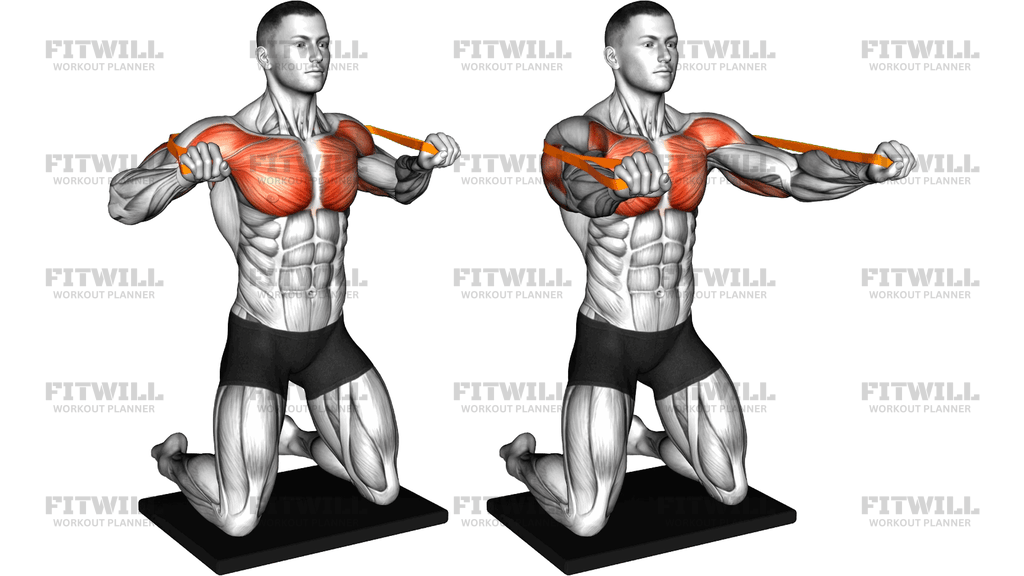
Instructions
- Kneel on an exercise mat with both knees down, shins parallel behind you, and knees set about hip-width apart.
- Loop the resistance band behind your upper back so it sits across the top of your shoulder blades, then grip an end in each hand close to your shoulders so the band is held snugly under your palms.
- Bring your hands to the sides of your chest at roughly nipple height, elbows bent and angled about 45 degrees down from your torso.
- Sit tall through your torso, brace your abs as if bracing for a light push, and tuck your pelvis slightly so your lower back is not overly arched.
- Press both hands forward together until your arms are fully extended straight out from the middle of your chest, keeping the band pressed against your upper back the entire time.
- Pause for a beat at full extension with your hands level with the center of your chest, and feel your chest squeeze as the band stretches across your shoulders.
- Slowly bend your elbows and control your hands back to the sides of your chest, resisting the band's pull rather than letting it yank your arms in.
- Exhale as you press forward and inhale as you return, keeping your breathing steady and never holding your breath through a rep.
- Keep your hips stacked over your knees and your torso vertical throughout; do not rock backward or lean into the press.
- Complete your set, release the band carefully from one hand at a time, and stand up slowly before moving on.
Tips & Tricks
- If the band slides up toward your neck, you are gripping too high or with too little tension; choke down on the band so it sits across the shoulder blades and is pinned firmly under your hands.
- The most common failure in this movement is leaning back as the press gets hard. Film yourself from the side once and check whether your torso stays vertical; if it does not, use a lighter band.
- Keep your elbows tracking slightly below shoulder height. Pressing with elbows flared level to the shoulders shifts the work to the front delts and stresses the shoulder joint.
- Squeeze a pair of imaginary coins between your knees or place a small pad under your kneecaps if the kneeling position becomes uncomfortable before your chest fatigues.
- Do not let your hands cross at the top. Press both arms straight ahead on parallel paths so each side of the chest does equal work.
- Tension should already be present before the first rep. If your elbows are relaxed and slack at the start, add a fold in the band or grip lower so the set begins under load.
- Widen your stance slightly or lengthen your shin position if you feel the band pulling you off balance; a stable base lets you push harder with your upper body.
- Range matters more than speed. A full extension with a two-second return builds more chest tension than fast, partial reps ever will.
- When progressing, move to a heavier band before adding reps. Once form breaks down past about fifteen reps, extra repetitions mostly train endurance rather than pressing strength.
Frequently Asked Questions
Which muscles does the Resistance Band Kneeling Chest Press work?
The chest is the primary mover, with the triceps extending the elbows and the front shoulders assisting the press. Because you are kneeling without a bench, your abs, hip flexors, and lower back also work hard to keep your torso upright against the band.
Why kneel instead of standing for this chest press?
Kneeling removes leg drive and forces your trunk to stabilize on its own, which increases core demand and makes cheating with body English much harder. It also shortens your height so the band wraps behind your shoulders more naturally without an external anchor.
Where should the band sit during the Resistance Band Kneeling Chest Press?
It should rest across your upper back at shoulder-blade level, held firmly under each hand. If it rides up toward your neck, choke your grip lower on the band and press your palms against it before starting.
Is this exercise suitable for beginners?
Yes, it is one of the more beginner-friendly chest presses because the band's resistance is smooth and easy to scale. Start with a light band, master keeping your torso upright, and progress the tension only when your form holds for twelve or more reps.
How do I make the Resistance Band Kneeling Chest Press harder?
Use a thicker band, shorten it by gripping closer to the anchor point across your back, or slow the returning phase to three or four seconds. Adding reps only helps up to a point; once you pass roughly fifteen, move to heavier tension instead.
What is the most common mistake with this movement?
Leaning the torso backward as fatigue sets in, which turns a chest press into a partial standing push and unloads the core. Keep your hips stacked over your knees and cut the set short if you cannot stay vertical.
Can I use this exercise instead of a bench press?
It trains the same horizontal pressing pattern, but the resistance profile and loading are different, so it is best viewed as a substitute when equipment is limited or as an accessory rather than a direct replacement for heavy barbell work.
Is it safe for my shoulders and knees?
For most people, yes, provided the band is light enough to control and your elbows stay angled slightly down rather than flared at shoulder height. Kneel on a mat to protect your kneecaps, and stop if you feel pinching in the front of either shoulder.
How should I breathe during the Resistance Band Kneeling Chest Press?
Exhale as you press your hands forward and inhale as you control the band back to your chest. Continuous breathing keeps your trunk braced without the pressure spikes that come from holding your breath rep after rep.