Bent Legs Half Wipers
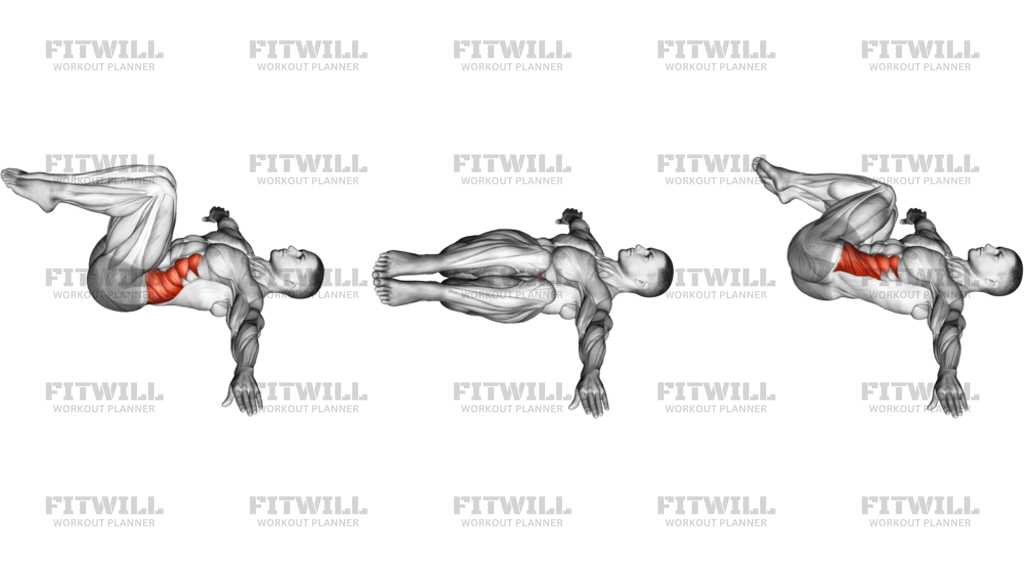
Bent Legs Half Wipers is a floor-based core exercise where the legs move together from side to side while the knees stay bent, turning the lower body into a short-lever windshield-wiper pattern. The bent-knee position reduces the lever arm so the obliques can work hard without requiring the same level of strength or mobility as a straight-leg version. That makes the movement useful for building rotational control, trunk stability, and clean side-to-side tension through the waist and hips.
The main job of the exercise is to keep the rib cage, shoulders, and opposite side of the torso anchored while the legs travel in a controlled arc. In anatomy terms, the primary work comes from the external obliques, with rectus abdominis, transversus abdominis, and the deeper hip and trunk stabilizers helping control the pelvis. The picture matters: you are not swinging the legs loosely, you are resisting rotation and lowering the knees only as far as you can keep the low back organized.
Setup is important because the floor gives you a clear reference for whether the rep is clean. Lie on your back, open the arms out for support, and start with the knees bent and the thighs lifted so the shins can move together as one unit. If the shoulders come off the floor or the lower back arches hard, the range is too large. A good rep looks smooth and deliberate, with the pelvis rotating as a single block and the movement stopping before control is lost.
Use Bent Legs Half Wipers as direct core work, a warmup for harder ab training, or an accessory drill after lifts that demand trunk control. The exercise is especially useful when you want oblique work without loading the spine or using external weight. Keep the movement slow, breathe through the lowering phase, and finish each rep by bringing the knees back through center rather than snapping them upward. The best set leaves the waist working hard but the neck, shoulders, and low back quiet and stable.
Because the exercise is bodyweight and floor-based, it is easy to regress by shrinking the range or shortening the lever, and it is also easy to make harder by slowing the tempo and pausing near the end of each side. What matters most is not how low the knees go, but whether the torso stays controlled the whole time. If the movement turns into a swing, a twist, or a lumbar arch, the set is too aggressive for the current level of control.
[ Workout Log & Planner ]
Put your next workout in Fitwill
Keep your plan and training log ready when you are.


Instructions
- Lie on your back on a mat and open your arms out to the sides at shoulder height, palms down for support.
- Bring both knees up together so the hips and knees are bent and the shins are lifted off the floor.
- Press your shoulders and upper back into the mat, then brace your abs so your lower back does not arch.
- Keep the knees and feet together as one unit and start with the legs centered over your hips.
- Exhale and lower both bent legs slowly toward one side in a controlled arc.
- Stop the descent before the opposite shoulder lifts or your lower back peels off the floor.
- Use your obliques to draw the legs back through the center without jerking or bouncing.
- Repeat the same arc to the other side for the planned number of repetitions, then lower the legs carefully to finish.
Tips & Tricks
- Think of the knees as one locked unit; if they drift apart, the movement turns into a looser twist instead of a controlled core drill.
- Keep both shoulders heavy on the floor, especially the one opposite the side you are lowering toward.
- Shorten the range if your low back starts to arch before the knees reach the side.
- A slower descent usually makes the obliques work harder than chasing a bigger range.
- Bend the knees more if you need an easier version; a tighter tuck shortens the lever and reduces strain.
- Do not let the feet crash to the floor unless that is part of a deliberately easier progression.
- Keep the neck relaxed and look straight up or slightly away from the moving legs.
- Exhale as the legs move down and use the return through center to reset your brace.
Frequently Asked Questions
What muscle does Bent Legs Half Wipers target most?
The obliques do most of the work, with the abs and deeper trunk stabilizers helping keep the torso from spinning out of position.
Can beginners perform this exercise?
Yes. Beginners usually do better with a smaller range of motion and a slower tempo so the lower back stays flat and the shoulders stay grounded.
Do my knees have to touch the floor on each side?
No. Lower the bent legs only as far as you can keep the opposite shoulder down and the lower back controlled.
Why are the knees bent instead of straight?
Bent knees shorten the lever and make the movement more manageable for the abs and obliques while still training rotational control.
What should I feel during the rep?
You should feel the sides of the waist working as the legs lower and return through center, not a sharp pull in the low back or hips.
Is it normal for my shoulders to want to lift off the floor?
Some effort is normal, but the shoulders should stay pressed down. If they keep lifting, reduce the range or bend the knees more.
Where does this fit in a workout?
It works well as accessory core work after big lifts, or as a controlled warmup before harder abdominal or rotational training.
What is the easiest way to make Bent Legs Half Wipers easier?
Keep the knees tighter to the chest and reduce how far the legs travel toward each side.
What is the most common mistake?
The most common mistake is letting the movement become a fast swing instead of a controlled lower-body rotation with a stable torso.