Bodyweight Lying Lower Back Curl
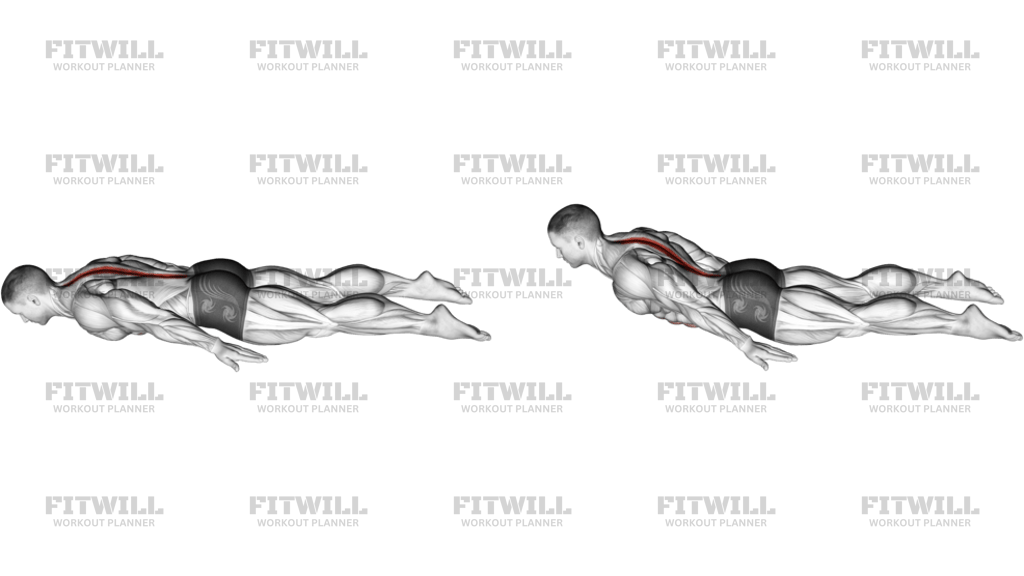
Bodyweight Lying Lower Back Curl is a prone bodyweight posterior-chain drill performed on the floor or a mat. You lie face down and make a small controlled extension through the spine, lifting the chest just enough to create tension through the lower back without turning the rep into an exaggerated backbend. The exercise is useful when you want simple, low-load work for spinal erectors, glutes, and the muscles that keep your torso organized during extension.
The setup matters more than the range of motion. In the image, the body stays long and close to the floor, which is the right idea for this movement: pelvis heavy, neck long, shoulders relaxed, and hands staying quiet by the sides. If the ribs flare and the chest yanks up too high, the set stops being a controlled lower-back drill and becomes an uncomfortable lumbar crunch. Keep the lift small enough that the low back, not the neck or momentum, sets the rhythm.
Bodyweight Lying Lower Back Curl is best thought of as a control exercise, not a max-strength lift. You should feel a smooth contraction as you lift, a short pause at the top, and a slow return to the mat. The rep should look clean from the first inch of motion to the last, with the torso and pelvis staying aligned instead of twisting or rocking side to side. That makes it useful as warm-up work, accessory volume, or a technique drill before heavier hinging, deadlifting, or back-extension variations.
It also works well for people who need a gentler way to train the posterior chain without loading the spine. Use it to build endurance, body awareness, and tolerance for extension, especially if your usual training is dominated by sitting, flexion, or heavy pulling. Stop the set if you feel pinching, sharp pain, or excessive compression in the low back, and shorten the range before you chase more height. Done well, Bodyweight Lying Lower Back Curl should feel deliberate, quiet, and repeatable rather than dramatic.
[ Workout Log & Planner ]
Put your next workout in Fitwill
Keep your plan and training log ready when you are.


Instructions
- Lie face down on a mat with your legs straight, tops of the feet resting on the floor, and your arms relaxed by your sides.
- Keep your forehead close to the mat, lengthen the back of your neck, and look straight down so your chin stays neutral.
- Set your shoulders away from your ears, lightly brace your midsection, and press the pelvis gently into the floor before you lift.
- Squeeze your glutes and lift your chest a few inches off the floor, using a small controlled extension instead of a big arch.
- Keep your rib cage from flaring and let the movement come from the torso, not from kicking the legs or swinging the arms.
- Pause for a brief moment at the top with the neck long and the shoulders still relaxed.
- Lower your chest back to the mat under control until your body is long and flat again.
- Reset your breathing between reps and repeat for the planned number of repetitions or timed holds.
Tips & Tricks
- Think about lengthening the spine first, then lifting the chest, so the rep stays smooth instead of jerky.
- If your low back pinches, reduce the height of the lift and keep the pelvis heavier on the mat.
- Keep the chin slightly tucked so you do not turn the exercise into a neck extension drill.
- Do not let the shoulders shrug toward the ears at the top; keep them down and quiet.
- A short pause at the top makes the set more effective than chasing extra height.
- If your legs start peeling off the floor, you are probably lifting too high for this variation.
- Exhale as you lift to help keep the ribs from flaring and the torso from overextending.
- Use slow lowers, because the eccentric phase is where many people lose control and start sagging.
Frequently Asked Questions
What muscles does Bodyweight Lying Lower Back Curl work?
It mainly trains the spinal erectors and glutes, with the upper back helping keep the chest lifted and the torso steady.
Is Bodyweight Lying Lower Back Curl the same as a Superman?
It is similar, but this version should stay smaller and more controlled, with less dramatic arm and leg lift than a full Superman.
Do I need equipment for Bodyweight Lying Lower Back Curl?
No. A floor or mat is enough for the bodyweight version, and the exercise is usually done with no external load.
How high should I lift in Bodyweight Lying Lower Back Curl?
Only lift the chest a few inches, enough to feel the lower back and glutes work without forcing a big lumbar arch.
Should my legs stay on the floor during Bodyweight Lying Lower Back Curl?
Yes, in the floor version the legs should stay long and quiet. If they start lifting, reduce the range immediately.
Can beginners do Bodyweight Lying Lower Back Curl?
Yes. Beginners should start with short holds, a very small lift, and a slow lowering phase to learn the pattern.
What should I do if Bodyweight Lying Lower Back Curl hurts my lower back?
Shorten the range, squeeze the glutes harder, and keep the ribs down. If the pinch stays sharp, stop the set and choose a gentler variation.
Where should I feel Bodyweight Lying Lower Back Curl most?
You should feel it across the lower back and glutes, with some upper-back support. You should not feel it jammed into the neck or front of the hips.