Squat Side Kick
Squat Side Kick is a bodyweight lower-body and core exercise that combines a controlled squat with a standing side kick. It is designed to train hip control, glute engagement, single-leg balance, and trunk stability in one smooth pattern. The squat loads the thighs and hips, while the kick asks the outer hip and standing leg to keep the pelvis steady instead of letting the body twist or lean.
The main training effect comes from the transition between the low squat and the upright kick position. In the squat, the glutes, quads, and adductors help you lower under control. In the kick, the standing glute and core work to keep the torso tall while the free leg lifts out to the side. That makes this a useful drill for athletic warmups, lower-body accessories, and conditioning circuits where you want movement quality more than external load.
Setup matters because the exercise only works well when the squat depth and kick height stay honest. Start with feet about hip to shoulder width apart, chest lifted, and hands in front of the body for balance. Sit back into the squat without collapsing the knees inward, then drive up through the standing foot before kicking the free leg out to the side. The kick should come from the hip, not from swinging the torso or snapping the lower back.
Perform each rep with a controlled tempo and a brief reset at the top so you can switch sides cleanly or repeat the same side with intent. Breathe into the squat, then exhale as you stand and kick. Keep the movement smooth, the planted foot grounded, and the pelvis level. If the kick becomes sloppy, shorten the range before you add speed or repetitions.
Fitwill
Log Workouts, Track Progress & Build Strength.
Achieve more with Fitwill: explore over 9600 exercises with images and videos, access built-in and custom workouts, perfect for both gym and home sessions, and see real results.
Start your journey. Download today!




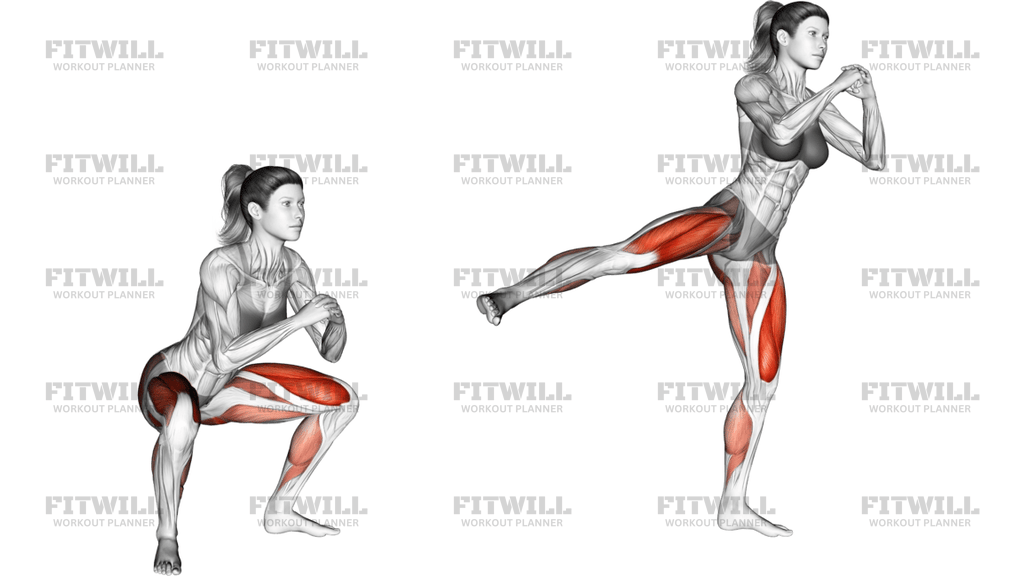
Instructions
- Stand with your feet about hip to shoulder width apart and bring your hands up in front of your chest for balance.
- Set your weight evenly through both feet, keep your chest tall, and point both knees in the same direction as your toes.
- Lower into a squat by sitting the hips back and down until your thighs reach a depth you can control without rounding the lower back.
- Press through the whole foot to stand up, keeping the torso stacked over the hips instead of pitching forward.
- As you reach the top, shift into a side kick with one leg, lifting it out to the side from the hip rather than swinging it across the body.
- Keep the standing leg soft but stable and avoid leaning away from the kicking leg as it rises.
- Pause briefly at the top of the kick, then bring the leg back under control to the starting stance.
- Repeat on the same side or alternate sides as prescribed, keeping each squat and kick smooth and deliberate.
Tips & Tricks
- If the kick forces you to lean, reduce the height before you add speed or reps.
- Keep the planted foot rooted and think about pushing the floor away on the way out of the squat.
- Let the squat stay comfortable and repeatable; this movement works better with clean depth than with an exaggerated low position.
- Keep the kicking knee and toes pointing out to the side so the hip does the work instead of the low back.
- Avoid letting the standing knee cave inward when you drive up from the squat.
- Use the hands only for balance; if they are swinging hard, the leg action is probably too aggressive.
- Exhale as you stand and kick so the trunk stays braced without holding your breath through the whole rep.
- If one side feels unstable, slow the return and reset fully before the next repetition.
Frequently Asked Questions
What does Squat Side Kick train?
It trains the glutes, thighs, outer hip, and core while also challenging balance and body control.
Do I stay low during the side kick?
No. The image shows a full squat followed by a rise to standing before the leg kicks out to the side.
Should my torso lean toward the kick?
A small natural shift is normal, but the torso should stay mostly upright and not tip hard to the side.
How high should the side kick go?
Only as high as you can lift it without twisting the pelvis or arching the lower back.
What is the main mistake to avoid?
The biggest mistake is turning the rep into a fast swing instead of a controlled squat and deliberate side lift.
Is this exercise good for beginners?
Yes. Beginners can start with a shallow squat and a low side kick, then increase range as balance improves.
Can I alternate sides each rep?
Yes. Alternating sides works well as long as you reset your stance and keep the squat depth consistent.
What if I feel it in my lower back?
Shorten the kick, keep the ribs down, and stop lifting the leg once the pelvis starts to rotate or the back starts to arch.